Choosing a junior Team is not only about where a Player can make a roster. It is also about where a Player can develop in a stable, honest environment.
Below are 10 warning signs parents should watch for before committing.
- Nobody will answer direct questions
- If a Team will not clearly answer questions about roster openings, role, billets, or development, that matters.
Everything sounds like a sales pitch
- Good programs explain things clearly. Weak programs often rely on hype.
- There is no clear role for the Player
- If the staff cannot explain where the Player fits, parents should be cautious.
- Communication feels rushed or pressured
- Families should never feel pushed into making a fast decision without enough information.
5. Billet answers are vague
For players moving away from home, an unclear billet structure is a major concern.
6. The program seems to change direction constantly
Too much instability in coaching, roster planning, or communication can create a difficult environment.
7. Staff talk only about exposure, not development
Exposure matters, but development, ice time, and coaching matter more.
8. Current players or parents sound frustrated
It is worth listening carefully to how current families describe communication, role clarity, and trust.
9. The Team cannot explain how players move forward
A strong program should explain how players develop and advance.
10. The Player is being recruited emotionally, not honestly
The best programs are clear and realistic. They do not oversell.
Parent takeaway
A good Junior Team should feel:
- Clear
- Stable
- Honest
- Development-focused
- If a situation feels confusing early, it usually does not become simpler later.
College-bound student-athletes
Enrolling for the first time at a Division I or II school, one must receive a final amateurism certification before being eligible to compete. This includes transfers from junior colleges, NAIA schools, international schools, or Division III schools.
College-bound international student-athletes (first-year attendees and transfers) initially enrolling in a Division III school during the 2023-24 academic year should register with an Amateurism-Only Certification account with the NCAA Eligibility Center.
This account includes a $70 registration fee for all student-athletes.
Please note: International prospective student-athletes who have registered with an Academic and Amateurism Certification account (previously titled “Certification account”) do not need to create a new account and should maintain their original account.
To receive an amateurism certification, prospective student-athletes should:
- Determine the right NCAA Eligibility Center account for your circumstances
- Register with the NCAA Eligibility Center.
- Completely and accurately fill out the “Sports Participation” section during registration.
- Request final amateurism certification promptly; and
- Monitor tasks assigned to their account.
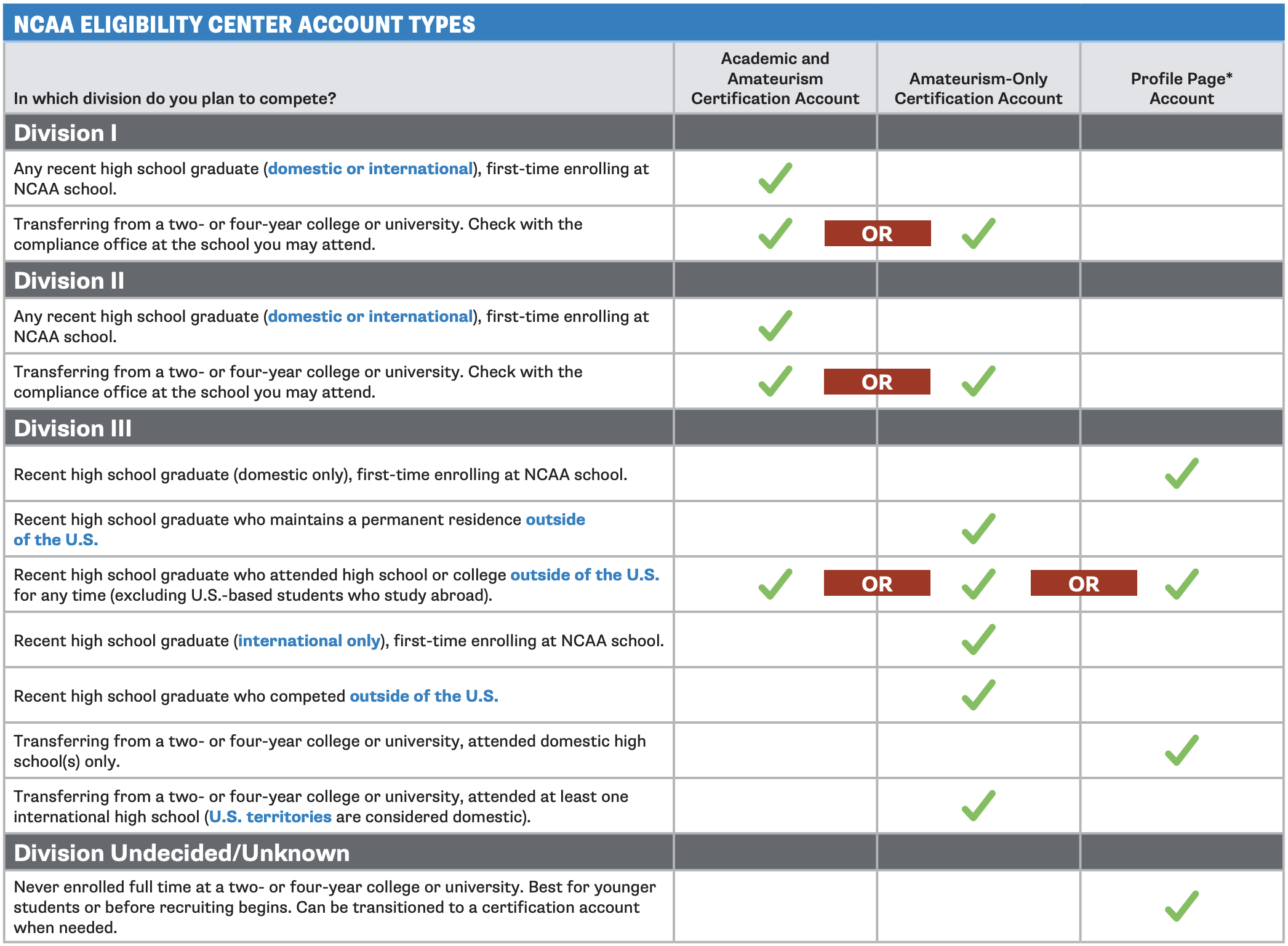
Below are some situations that may impact a prospective student-athlete’s amateur status. Click on each topic to learn more about the NCAA Eligibility Center’s requirements in each of these examples.