Why the Los Angeles Kings Still Believe Their Future Runs Through the 2020 Second Overall Pick
The Hockey Resource™ presents: NHL Draft Career Files™ – Los Angeles Kings
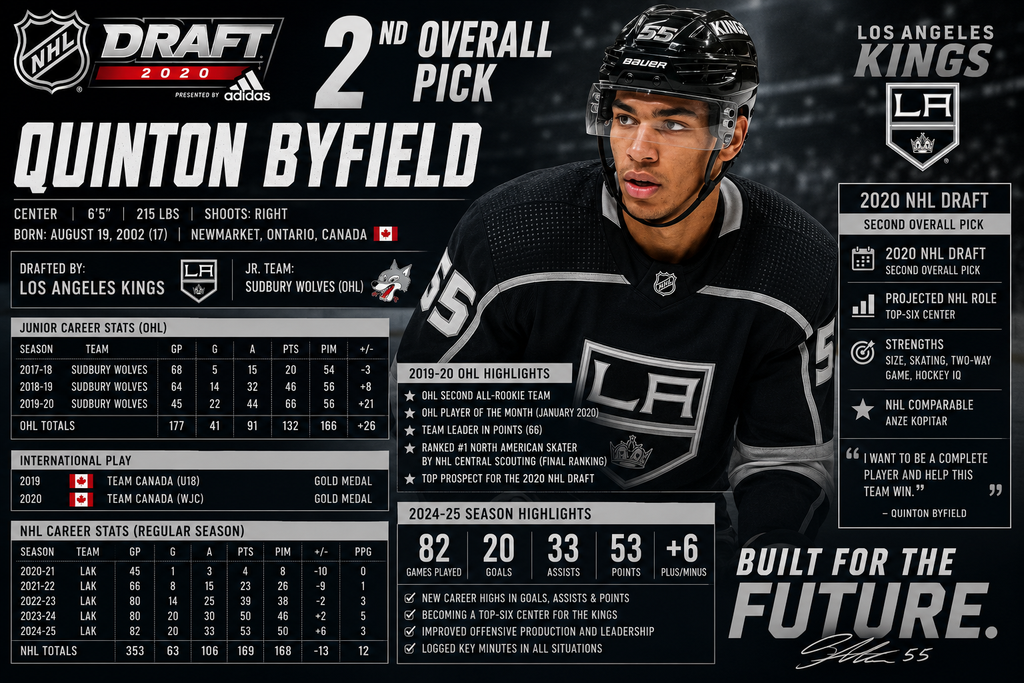
Los Angeles Kings stepped to the podium with the second overall selection in the 2020 NHL Draft; there was little debate about their choice. After Alexis Lafrenière went first overall, the Kings selected Quinton Byfield, a towering 6-foot-5 center from the Sudbury Wolves who many scouts believed possessed the highest physical ceiling in the entire draft class.
At just 17 years old, Byfield already combined elite skating, exceptional puck skills and rare size. Comparisons to franchise centres such as Anze Kopitar were inevitable. The Los Angeles Kings believed they had found the player who would eventually lead the organization into its next championship window.
Six years later, Byfield’s NHL journey has been one of steady development rather than instant superstardom. While some fans expected immediate dominance, the Kings remained patient, understanding that power centres often require more time to reach their full potential. That patience is beginning to pay dividends.
A Dominant Junior Career
Byfield’s rise through junior hockey was remarkably fast.
Playing for the Sudbury Wolves of the OHL, he showcased an uncommon combination of speed, reach and offensive creativity. Despite being one of the youngest players in the league, he consistently controlled games against older competition.
His final OHL season produced:
- 45 Games
- 22 Goals
- 44 Assists
- 66 Points
Internationally, Byfield also represented Canada with distinction, earning a gold medal at the World Junior Championship while continuing to build his reputation as one of hockey’s elite young centres.
His physical tools convinced NHL scouts that his ceiling was among the highest in the draft.
Entering a Rebuilding Organization
Unlike many top draft picks who join established contenders, Byfield entered a Kings organization still transitioning from the Stanley Cup era built around Anze Kopitar, Drew Doughty and Jonathan Quick.
Rather than rushing him into a starring role, Los Angeles emphasized development.
He split time between the NHL and the American Hockey League during his early seasons, learning defensive responsibility, improving his strength and adapting to the speed of professional hockey.
While some questioned the slower approach, the organization viewed it as an investment rather than a delay.
Learning Behind Anze Kopitar
Few young centres receive the opportunity to learn from one of the NHL’s premier two-way players.
Byfield benefited tremendously from watching Anze Kopitar prepare, practice and compete every day.
Instead of carrying unrealistic expectations immediately, he gradually expanded his responsibilities.
His skating became more explosive.
His puck protection improved.
His defensive awareness matured.
Most importantly, he developed into a player coaches trusted in every situation—not simply on the power play.
The Breakthrough
Every highly drafted player reaches a point where potential begins turning into production.
For Byfield, that breakthrough arrived over the last several seasons.
His offensive confidence grew significantly while continuing to use his size to dominate along the boards and protect possession through the neutral zone.
Rather than forcing plays, he began controlling them.
Los Angeles increasingly trusted him in top-six minutes, against stronger opponents and in critical situations.
The Kings now view him as a core piece of their future, particularly following the retirement era of longtime franchise leaders. His 2025-26 season again surpassed 20 goals, though the organization believes there is still another level available offensively.
Career BRAIN™ Evaluation
Offensive Ability ★★★★☆
Byfield possesses excellent hands for a player his size and continues improving as both a scorer and playmaker.
Hockey IQ ★★★★★
He processes the game extremely well, especially through the neutral zone where his puck-carrying ability creates controlled entries and offensive opportunities.
Physical Presence ★★★★★
Very few NHL centres combine his skating with elite size.
When fully engaged physically, he becomes one of the league’s most difficult forwards to defend.
Defensive Game ★★★★☆
His commitment away from the puck has improved dramatically.
The Kings continue trusting him against quality competition because of his defensive reliability.
Leadership ★★★★☆
While still developing, Byfield has matured into one of Los Angeles’ emerging leaders both on and off the ice.
Has He Met Expectations?
This remains one of the more interesting debates from the 2020 NHL Draft.
Some observers expected Byfield to become an immediate superstar.
Instead, his progression has resembled many elite power forwards and big centres throughout NHL history.
Players with his combination of size and skill often require additional time before everything comes together.
The Kings have never lost confidence.
Neither should hockey fans.
Recent evaluations from the Kings continue to describe him as a proven top-six forward while emphasizing that his next challenge is becoming a true first-line centre capable of driving a championship contender.
Career BRAIN™ Verdict
Draft Value: ★★★★☆
Current NHL Status: Established Top-Six Centre
Future Projection: First-Line NHL Centre
Ceiling: Franchise cornerstone capable of producing 70–80 points while matching up against the league’s best players.
Quinton Byfield’s story demonstrates an important lesson in player development.
Not every second overall selection becomes a superstar overnight.
Some require patience.
The Los Angeles Kings invested in long-term development rather than short-term headlines, and today they appear positioned to reap the rewards.
If Byfield continues on his current trajectory, the conversation may soon shift from whether he justified his draft position to whether he has become one of the NHL’s premier power centres.
As always, thank you for being part of The Hockey Resource Community.
AMAZON Hockey
NEW Tournament Search APP
https://play.google.com/store/apps/details?id=com.hockeyresource.hockeytournamentapp&hl=en_CA&pli=1
NEW!!! The Hockey Moments Cards
GUMROAD – eBooks
https://thehockeyresource.gumroad.com
SEE My Interview with the Mental Health Academy
SEE My Interview on Podcast with Constant Sports
https://www.youtube.com/watch?v=_8VJUTfAGp
The Hockey Resource
https://thehockeyresource.com/category/blog/hockey-career-starts-here