
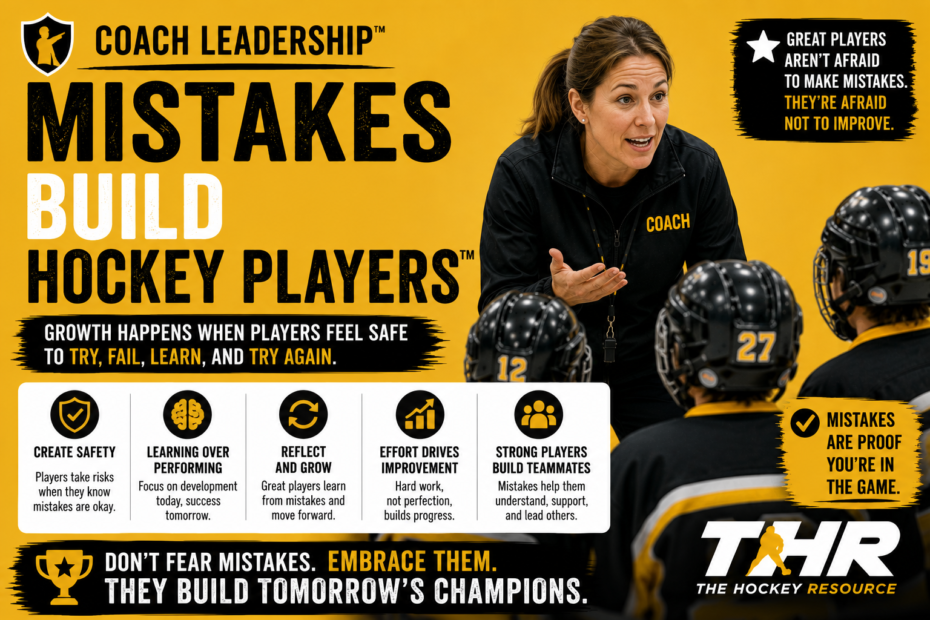
Separate the Decision From the Outcome
A Bad Outcome Does Not Automatically Mean a Bad Decision.™
By U15, players are making decisions in a faster and more demanding environment.
They must process pressure, positioning, time, score, shift length, team structure and opponent tendencies—often within seconds. They are also becoming more aware of ice time, roles, evaluations and how coaches perceive their performance.
That makes fair feedback especially important.
At U13, coaches introduce a structured review of information, options and execution. At U15, players should begin leading more of that review themselves.
The coach still provides expertise and accountability, but the conversation changes from:
“Here is what you did wrong.”
To:
“Walk me through the information you had, the options you considered and why you selected that play.”
The U15 objective is not merely to correct the previous decision.
It is to develop a player capable of evaluating the next decision independently.
U15 Feedback Must Reflect a More Complex Game
Hockey Canada identifies U15 as a stage that continues fundamental development while introducing more tactical responsibility. Its U15 development guidelines recommend practice time be divided among technical skills, individual tactics, team tactics, team play and strategy.
Players are now expected to consider:
- Time and score
- Shift length
- Puck location
- Teammate support
- Opponent pressure
- Possession risk
- Team structure
- Game momentum
- Matchups
- Available space
- What may happen after the first play
A decision cannot be evaluated properly without considering this context.
Evaluate the Process Before the Result
Every play contains several distinct stages:
- Information: What did the player know?
- Options: What choices were realistically available?
- Decision: Which option did the player select?
- Execution: How well was the action performed?
- Outcome: What happened afterward?
- Learning: What should be recognized or repeated next time?
A coach who jumps directly from outcome to criticism skips most of the development process.
A turnover does not reveal whether the player:
- Missed important information
- Recognized the correct option
- Selected an unreasonable risk
- Executed a reasonable decision poorly
- Received incomplete communication
- Was following the team’s plan
- Was forced into a limited choice by teammates’ positioning
Those possibilities require different coaching responses.
The U15 Player-Led Review
At U15, the player should begin answering five questions:
- What information did I have?
- What was I trying to accomplish?
- What reasonable options did I consider?
- Why did I choose that option?
- What would I recognize or execute differently next time?
The coach should listen before providing an evaluation.
This does not mean the player determines whether every decision was acceptable. It means the player participates meaningfully in understanding it.
USA Hockey encourages coaches to pull reflection from players rather than constantly push answers toward them.
Four Types of U15 Outcomes
| Decision | Execution | Outcome | Development response |
|---|---|---|---|
| Reasonable | Successful | Favourable | Reinforce the entire process |
| Reasonable | Unsuccessful | Unfavourable | Protect the decision and develop execution |
| Questionable | Successful | Favourable | Examine the risk despite the result |
| Questionable | Unsuccessful | Unfavourable | Review information, options and team principles |
The player must understand that a successful result does not excuse every decision.
An accidental bounce may reward a poor choice. A skilled opponent may disrupt an intelligent one.
Add Risk and Game Context to the Review
At U15, “Was there another option?” is no longer enough.
The coach and player should also examine whether the selected risk was appropriate.
Questions can include:
- What was the score?
- How much time remained?
- How long had the line been on the ice?
- Where was puck support?
- What would happen if possession was lost?
- Was the team changing?
- Was the opponent applying pressure or protecting space?
- Did the decision follow an established team principle?
- Was the possible reward worth the risk?
A pass through the middle may be reasonable when trailing late in a game and unnecessary while protecting a lead.
The technical action is identical. The game context changes its value.
Example: The Offensive Blue-Line Turnover
A U15 defenceman attempts to make a lateral move at the offensive blue line. The puck is lost, and the opponent creates a breakaway.
The coach could react:
“You cannot make that play at the blue line.”
That instruction may prevent the mistake from recurring, but it may also discourage the player from recognizing future opportunities to attack open space.
A player-led conversation is more useful:
Coach: “Walk me through your decision.”
Player: “Their winger was moving toward the boards, and I thought the middle was open.”
Coach: “What changed?”
Player: “The winger stopped and reached back with the stick.”
Coach: “What was our risk if the move failed?”
Player: “There was nobody behind me.”
Coach: “Would the same move be reasonable if our partner was covering?”
Player: “Yes, but not when I was the last player.”
Coach: “Good. The issue was not attempting the skill. It was recognizing the support and risk before using it.”
The lesson becomes more sophisticated than “never try that again.”
Example: The Correct Read and an Inaccurate Pass
A center recognizes a weak-side winger moving behind the defense. The pass is delivered inaccurately and creates a turnover.
The coach can say:
“You recognized the weak-side option at the right time. The decision was reasonable. Let’s work on delivering that pass while moving and under pressure.”
The player should continue looking for that option.
The execution requires development. The recognition does not need to be removed.
This supports the confidence-building principles outlined in Confidence Is Built, Not Given.
Example: A Successful Play That Should Not Be Repeated
A player attempts a blind pass through the defensive slot. The puck strikes an opponent’s skate and reaches a teammate, who creates a scoring opportunity.
The play worked.
The decision remains questionable.
Coaches can ask:
“If that puck had reached the opponent instead, how would we evaluate the play?”
The player should not learn that success makes every decision correct.
Strong feedback reinforces repeatable processes—not fortunate results.
Look for Patterns, Not Isolated Clips
One play can provide a teaching opportunity, but it should not automatically define a player’s decision-making.
A coach should look for patterns, DOES THE PLAYER
- repeatedly fail to scan?
- consistently force passes through pressure?
- recognize the right option but struggle to execute?
- make different decisions depending on game pressure?
- avoid reasonable risks after being criticized?
- affect the player’s judgment?
- understand the team principle being applied?
Evaluating patterns produces a more accurate development plan than reacting emotionally to one turnover.
The principle remains consistent with Why One Hockey Game Never Defines a Player.
Use Video for Player-Led Reflection
At U15, video review can become more sophisticated.
Instead of beginning with the coach’s conclusion, pause the clip before the decision and ask the player to identify:
- Available information
- Opponent pressure
- Teammate support
- Reasonable options
- Risk associated with each option
- Likely next play
Then let the video continue.
The player should explain: THIS IS
“what I saw.”
“what I expected.”
“why I chose the play.”
“what changed.”
“what I would recognize earlier next time.”
Video becomes most valuable when it develops self-evaluation—not when it is used to prove the coach was right.
Hockey Canada’s U15 Player Pathway provides a progressive framework covering skills, concepts, tactics and meaningful practice development.
Players Can Select Their Own Clips
Occasionally, ask U15 players to identify: ONE
- decision they would repeat
- decision they would reconsider
- execution problem
- situation they did not understand
This reveals what players notice about their own performance.
The player’s selected “mistake” may not be the coach’s greatest concern. That difference can produce a valuable conversation about priorities and self-awareness.
A player who can identify the correct learning point is becoming less dependent on constant coaching instructions.
Keep Complicated Feedback Away From the Bench
U15 players may understand detailed tactical feedback, but that does not mean they should receive it during every game.
Too much in-game feedback can cause players to:
- Overthink
- Stop reacting naturally
- Avoid the puck
- Make safe decisions automatically
- Seek approval after each play
- Carry one mistake into the next shift
During games, use brief cues:
“Check your support before attacking.”
Or:
“The read was there. Finish the execution.”
Save detailed review for practice or a short individual meeting.
A player should also be able to explain:
“I understand feedback better after the game. Too much information between shifts affects my confidence.”
The coach can still address urgent safety, effort or tactical issues immediately. Complex evaluation does not need to happen under emotional and time pressure.
Build Individual Feedback Agreements
U15 coaches should learn how each player receives information most effectively.
An individual agreement may include:
- One short cue during games
- Detailed feedback during practice
- Individual rather than public video review
- Player-selected clips
- Written weekly priorities
- Assistant-coach follow-up
- Time for the player to reflect before answering
Different feedback methods do not mean different standards.
They mean delivering the same standard in a form the player can use.
Organizations should develop resilient people rather than emotionally exhausted people.
Record the Player’s Explanation and Development Plan
The coach or assistant coach should document recurring decisions.
A U15 record can include:
- Game situation
- Player’s explanation
- Information recognized
- Information missed
- Risk evaluation
- Execution issue
- Practice response
- Follow-up observation
Example:
Situation: Offensive-zone blue-line turnover
Player recognized: Open middle lane
Player missed: No defensive support
Decision issue: Risk inappropriate while last player back
Practice response: Blue-line attack with support recognition
Follow-up: Player checked partner position before attacking during next game
This prevents repeated criticism without meaningful teaching.
Turn Decisions Into Practice Problems
If the player understands the issue but continues making the same error, the coaching staff must ask whether practice has recreated the situation.
A lecture cannot replace repetition.
Practice activities should include:
- Multiple reasonable options
- Changing pressure
- Time limitations
- Unpredictable defenders
- Risk and support recognition
- Consequences for lost possession
- Opportunities for another attempt
Small-area games are valuable because they create frequent decisions in limited time and space. Hockey Canada provides small-area-game resources, while USA Hockey identifies constant decision-making as a core element of effective practice.
The practice should train the information-processing skill—not merely repeat the physical movement.
Greater Accountability Is Appropriate at U15
U15 players can be expected to accept greater responsibility for:
- Understanding team principles
- Preparing for games and practices
- Applying reviewed information
- Communicating honestly
- Competing consistently
- Responding constructively to feedback
- Tracking personal development priorities
If a player repeatedly ignores a team principle after understanding and practising it, the coach can say:
“We have reviewed this situation, and you have demonstrated that you understand it. What prevented you from applying it today?”
That is direct accountability.
However, reduced ice time should not become an emotional punishment for every mistake. Role and ice-time decisions should be connected to clearly communicated standards and repeated behavior—not one unfortunate outcome.
Avoid Public Video Prosecution
Team video should teach team concepts.
It should not become an opportunity to embarrass one player.
Before showing an individual mistake, ask:
- Is this relevant to the entire team?
- Can the situation be taught without humiliating the player?
- Am I evaluating the decision fairly?
- Would I show the same clip if it involved a top player?
- Does the clip reveal a pattern or only one result?
- Have I shown examples of positive decisions too?
Players should not enter video sessions wondering who will be publicly blamed.
Organizations built around fear encourage players to hide mistakes and avoid responsibility, as explored in Stop Building Systems Around Fear.
Parents Must Allow Players to Own the Review
By U15, parents should gradually step back from tactical analysis.
Instead of telling the player what should have happened, ask:
- “How did you evaluate that decision?”
- “Was the result different from what you expected?”
- “Did you recognize another option afterward?”
- “Is that something you want to review with your coach?”
- “What will you look for next time?”
Then allow the player to decide whether to continue the conversation.
The goal is to develop a player who can reflect without needing a coach or parent to provide every conclusion.
Coaches Must Review Their Own Decisions
A U15 coach may:
- Select an unsuccessful matchup
- Call an ineffective system
- Shorten the bench too early
- Choose an unfortunate line change
- Provide unclear instructions
- Fail to prepare the team for pressure
- Misread an opponent
The coach should apply the same questions:
- What information did I have?
- What was I trying to accomplish?
- Where alternatives available?
- Was the decision consistent with our plan?
- Would I criticize it if the outcome had been favorable?
- What should I recognize earlier next time?
A coach who demands reflection from players while refusing to examine personal decisions weakens leadership credibility.
Signs U15 Feedback Is Working
Effective U15 feedback produces players who increasingly:
- Lead their own review
- Explain the information they used
- Compare multiple options
- Evaluate risk using game context
- Separate execution from decision quality
- Identify fortunate outcomes honestly
- Recognize repeated patterns
- Select useful video clips
- Apply review points in practice
- Accept accountability without losing confidence
- Require fewer instructions to solve familiar situations
The purpose is not to create players who agree with every coaching conclusion.
The purpose is to create players capable of examining evidence, understanding team principles and improving their next decision.
The Hockey Resource™ U15 Coaching Standard
At U15, separating the decision from the outcome remains essential—but the player must assume more responsibility for the review.
Ask the player to explain:
What did you know?
What options did you consider?
Why did you choose that play?
Was the risk appropriate?
Did execution change the outcome?
What will you recognize next time?
Then use video, practice and recorded follow-up to determine whether the lesson transfers into competition.
Protect reasonable decisions when execution fails.
Correct questionable decisions even when the outcome succeeds.
Address repeated patterns with accurate accountability.
A Bad Outcome Does Not Automatically Mean a Bad Decision.™
At U15, the next step is teaching players to understand and explain why.
U7 — Correct Less, Encourage More
U9 — Help Players Recognize What Happened
U11 — Ask What the Player Saw Before Correcting
U13 — Separate the Decision From the Outcome
- Confidence Is Built, Not Given
- The Scoreboard Doesn’t Define You
- Respect for the Game, Not Fear of Failure
- Develop Resilient People
- Stop Building Systems Around Fear
External Links
- Hockey Canada U15 Age Division
- Hockey Canada U15 Player Pathway
- USA Hockey: How to Pull the Best Out of Your Players
- USA Hockey: Five Elements of a Great Practice
As always, thank you for being part of The Hockey Resource Community.
AMAZON Hockey
NEW Tournament Search APP
https://play.google.com/store/apps/details?id=com.hockeyresource.hockeytournamentapp&hl=en_CA&pli=1
NEW!!! The Hockey Moments Cards
GUMROAD – eBooks
https://thehockeyresource.gumroad.com
SEE My Interview with the Mental Health Academy
SEE My Interview on Podcast with Constant Sports