
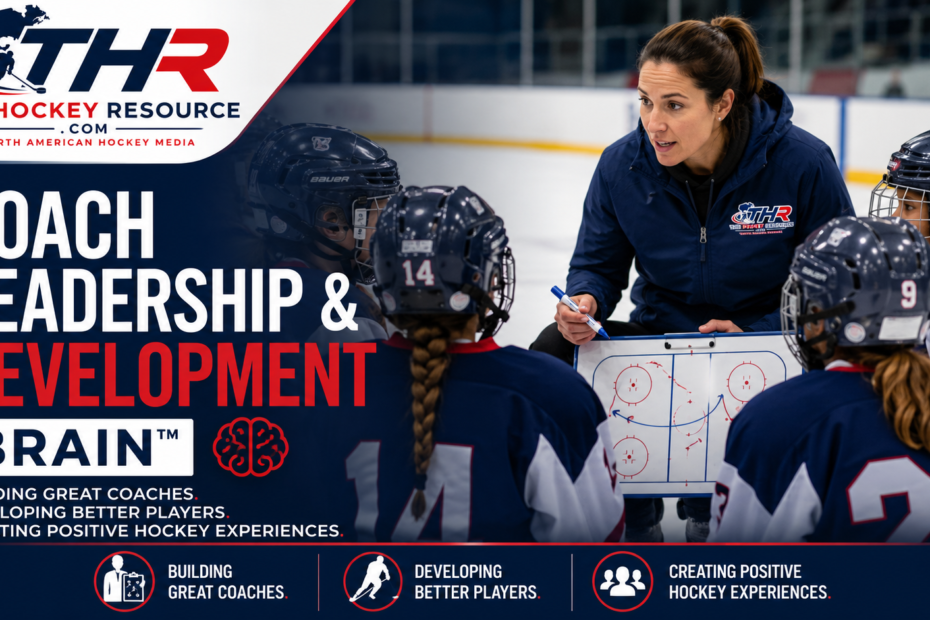
Coach Leadership & Development BRAIN™
A cornerstone article by The Hockey Resource
Why Coaching Matters More Than Ever
There has never been a greater need for outstanding hockey coaches.
Youth hockey continues to grow across North America, creating opportunities for thousands of young athletes to experience teamwork, competition, friendship, and personal growth. Behind every positive hockey experience is usually someone who chose to coach—not because they were looking for recognition, but because they wanted to make a difference.
Some coaches arrive with decades of playing experience. Others volunteer because no one else stepped forward. Some have coached for twenty years, while others are tying on a whistle for the very first time.
Despite those different backgrounds, every coach shares something in common:
Every practice, every game, and every conversation has the potential to shape a young person’s future.
That’s an extraordinary responsibility.
Winning games matters. Development matters. Championships matter.
But years from now, most players won’t remember your breakout system or the final score of a tournament.
They’ll remember whether they felt respected.
Whether someone believed in them.
Whether they looked forward to coming to the rink.
Whether hockey became one of the greatest experiences of their childhood.
That is why great coaching matters.
At The Hockey Resource, we believe coaching is one of the most influential leadership roles in youth sports. Great coaches develop hockey players, but exceptional coaches also develop confident young people, resilient teammates, and future leaders.
This guide is designed to help you become that kind of coach.
Coaching Is About People Before Hockey
Every coach enjoys teaching hockey skills.
Passing.
Shooting.
Skating.
Systems.
Special teams.
But hockey is only part of the job.
The real work begins when you recognize that every player arrives at the rink carrying a different story.
Some are naturally confident.
Some are nervous.
Some have parents who understand the game.
Others are stepping into organized hockey for the very first time.
Some are chasing junior hockey dreams.
Others simply want to have fun with friends after school.
Great coaches recognize these differences and create an environment where every player has the opportunity to succeed.
That starts by remembering a simple truth:
Players don’t care how much you know until they know how much you care.
When players trust their coach, they become more willing to learn, accept feedback, take risks, and recover from mistakes.
Relationships are not separate from development—they are the foundation of development.
A Coach Wears Many Hats
The title “coach” rarely describes everything you do.
During a single season you may become:
- A teacher.
- A leader.
- A mentor.
- A motivator.
- A problem solver.
- A communicator.
- A role model.
- A listener.
- A conflict manager.
- Sometimes even a source of confidence for a player who desperately needs someone to believe in them.
That’s why great coaching extends far beyond hockey knowledge.
It requires empathy.
Patience.
Preparation.
Consistency.
And the willingness to keep learning.
The Foundations of Great Hockey Coaching
Successful teams are built on strong fundamentals.
The same is true for successful coaches.
The Hockey Resource believes every outstanding coach is built on seven foundational leadership principles:
1. Integrity
Do what you say you will do.
Players quickly recognize consistency—and inconsistency.
Trust grows when coaches follow through on commitments and hold everyone, including themselves, to the same standards.
2. Preparation
The best practices don’t happen by accident.
Prepared coaches maximize ice time, reduce confusion, and create engaging learning environments where players stay active instead of standing in lines.
Preparation demonstrates respect for your players’ time and commitment.
3. Communication
Clear communication reduces uncertainty.
Players perform better when they understand expectations.
Parents are more supportive when communication is timely, respectful, and consistent.
Strong communication prevents many of the issues that become problems later in the season.
4. Accountability
Great coaches create standards that apply to everyone.
Effort.
Respect.
Preparation.
Sportsmanship.
Accountability builds trust because players know expectations are fair and consistently applied.
5. Positivity
Positive coaching is not about avoiding difficult conversations.
It’s about helping players understand mistakes without damaging confidence.
Players improve fastest when they believe mistakes are opportunities to learn rather than reasons to fear failure.
6. Continuous Learning
The game evolves.
Coaches should too.
Attend clinics.
Watch practices.
Study other coaches.
Read.
Ask questions.
Seek feedback.
Growth never stops.
7. Perspective
Remember why players joined hockey.
Most began because the game was fun.
Winning is important.
Creating lifelong love for hockey is even more important.
Hockey Canada emphasizes age-appropriate player development and coach education through its nationally recognized coaching pathway. (External link: https://www.hockeycanada.ca)
USA Hockey’s American Development Model (ADM) provides evidence-based guidance on long-term athlete development and practice design. (External link: https://www.usahockey.com/adm)
The Positive Coaching Alliance offers excellent resources on creating environments where athletes can develop confidence, resilience, and sportsmanship. (External link: https://positivecoach.org)
As always, thank you for being part of The Hockey Resource Community.
AMAZON Hockey
NEW Tournament Search APP
https://play.google.com/store/apps/details?id=com.hockeyresource.hockeytournamentapp&hl=en_CA&pli=1
NEW!!! The Hockey Moments Cards
GUMROAD – eBooks
https://thehockeyresource.gumroad.com
SEE My Interview with the Mental Health Academy
https://thehockeyresource.com/category/blog/hockey-career-starts-here
SEE My Interview on Podcast with Constant Sports
https://www.youtube.com/watch?v=_8VJUTfAGp

As always, thank you for being part of The Hockey Resource Community.
AMAZON Hockey
NEW Tournament Search APP
https://play.google.com/store/apps/details?id=com.hockeyresource.hockeytournamentapp&hl=en_CA&pli=1
NEW!!! The Hockey Moments Cards
GUMROAD – eBooks
https://thehockeyresource.gumroad.com
SEE My Interview with the Mental Health Academy
https://thehockeyresource.com/category/blog/hockey-career-starts-here
SEE My Interview on Podcast with Constant Sports
https://www.youtube.com/watch?v=_8VJUTfAGp
TheHockeyResource.com