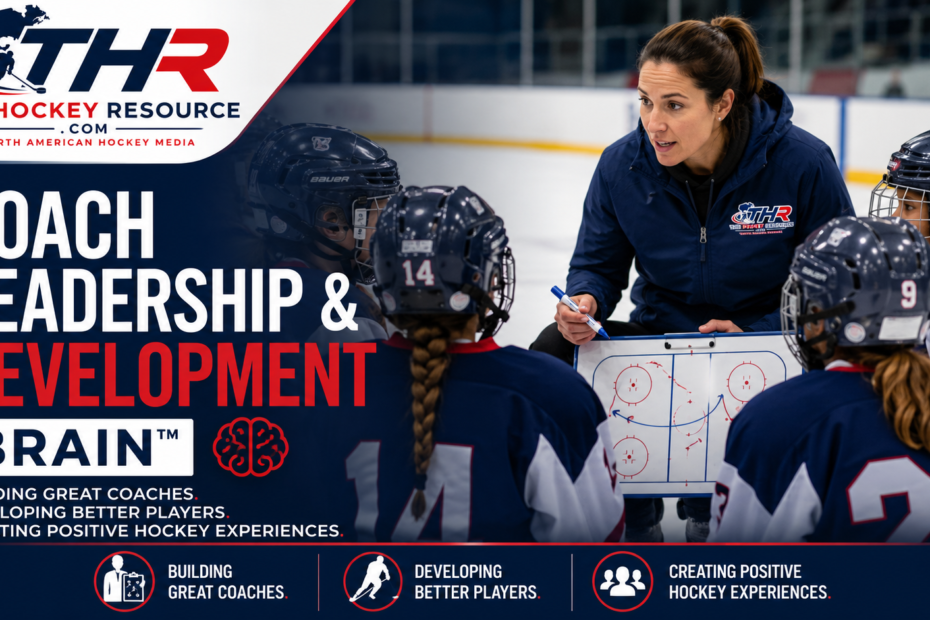
Coaching – Leadership & Development BRAIN™
Coaching – Table of Contents
- Coaching – Why Practice Planning Matters
- Start with a Clear Objective
- Build Every Practice Around Game Situations
- Maximize Repetitions and Minimize Standing
- Teach Progressively
- Include Competitive Small-Area Games
- Finish with Reflection and Reinforcement
- Common Practice Planning Mistakes
- Final Thoughts
How to Plan Hockey Practices That Develop Every Player
The difference between an average coach and a great coach often isn’t found behind the bench on game day.
It’s found in how they prepare practice.
Every hour of ice is valuable. Parents invest significant time and money, players arrive eager to improve, and organizations trust coaches to use that ice effectively. The best coaches don’t simply fill sixty minutes—they build practices that make every player leave the rink better than when they arrived.
Successful practices are organized, purposeful, energetic, and player-centered. Every drill has a reason. Every transition has a purpose. Every player remains engaged.
As discussed in our cornerstone article, The Complete Guide to Becoming a Great Hockey Coach (Internal Link: /coach-leadership-development-brain/), preparation is one of the defining habits of elite coaches. Practice planning is where that preparation becomes visible.
Hockey Canada emphasizes structured practice planning through its coach education programs, encouraging coaches to align every session with player development objectives rather than simply running familiar drills.
External Link: https://www.hockeycanada.ca
Coaching – Start with a Clear Objective
One mistake many coaches make is trying to teach everything in one practice.
Instead, begin by answering one simple question:
“What should my players be better at when they leave the ice today?”
Examples include:
- Improving passing accuracy
- Better puck support
- Stronger defensive positioning
- Quicker transitions
- Offensive zone awareness
- Communication
- Skating efficiency
When your objective is clear, every drill naturally supports that goal.
Players also appreciate understanding the purpose behind each activity. Explaining what they are learning increases focus and engagement.
If you’re building a culture where learning is valued, be sure to read How to Build a Positive Team Culture in Hockey (Internal Link: /coach-leadership-development-brain/how-to-build-a-positive-team-culture/), where we discuss how consistent teaching creates confident athletes.
Build Every Practice Around Game Situations
Players don’t compete in isolated drills.
They compete in hockey games.
Whenever possible, design practices that resemble situations players will encounter during competition.
Examples include:
- 2-on-1 rushes
- Corner battles
- Net-front positioning
- Breakouts under pressure
- Offensive zone cycling
- Neutral zone transitions
- Quick puck movement after turnovers
Players retain skills more effectively when they understand how drills connect to actual game situations.
The USA Hockey American Development Model (ADM) recommends using game-based learning environments that encourage creativity, decision-making, and problem solving rather than repetitive, isolated drills.
External Link: https://www.usahockey.com/adm
Maximize Repetitions and Minimize Standing
Standing in line is not development.
Every minute waiting is a minute lost.
Great coaches organize practices so players are constantly moving.
Strategies include:
- Multiple stations
- Small groups
- Continuous-flow drills
- Rotating coaches between stations
- Using every section of the ice
- Keeping explanations short and visual
More puck touches.
More skating.
More decisions.
More learning.
Our upcoming Player Development BRAIN™ collection (Future Internal Link: /player-development-brain/) will include age-specific practice templates designed to maximize repetitions at every level.
Teach Through Progression
Learning should happen step by step.
Instead of introducing a difficult skill immediately under full pressure, build confidence through progression.
A typical progression might include:
- Demonstrate the skill.
- Practice individually.
- Add a partner.
- Add movement.
- Introduce passive pressure.
- Introduce active competition.
- Finish with a game-like scenario.
Players gain confidence because each step builds naturally on the previous one.
Confidence leads to better execution under pressure.
Include Competitive Small-Area Games
Small-area games may be the most valuable part of modern hockey practice.
Why?
Because they naturally develop:
- Decision making
- Puck protection
- Communication
- Awareness
- Creativity
- Compete level
- Conditioning
Instead of repeating isolated drills for long periods, finish many teaching segments with a competitive game that reinforces the skill you’ve just introduced.
Small-area games also make practices more enjoyable, increasing player enthusiasm and retention.
The Positive Coaching Alliance encourages coaches to create challenging yet enjoyable learning environments where athletes remain engaged and develop confidence.
External Link: https://positivecoach.org
Communicate Throughout Practice
Instruction should be continuous—not constant.
Players don’t need lengthy speeches every five minutes.
Instead:
- Give one teaching point.
- Let players execute.
- Provide immediate feedback.
- Encourage improvement.
- Repeat.
Positive communication keeps athletes engaged while reinforcing accountability.
For additional strategies on building trust through effective communication, read How Great Hockey Coaches Build Trust Through Communication (Internal Link: /coach-leadership-development-brain/build-trust-through-communication/).
Coaching – Finish with Reflection and Reinforcement
Great practices don’t end with the final whistle.
They end with learning.
Take two or three minutes to review:
- What improved today?
- What challenged the team?
- What should players focus on before the next practice?
Celebrate effort.
Recognize improvement.
Reinforce team standards.
These conversations strengthen both player confidence and team culture.
Coaching – Common Practice Planning Mistakes
Even experienced coaches occasionally fall into habits that limit player development.
Avoid these common mistakes:
- Running drills simply because you’ve always used them.
- Spending too much time explaining instead of teaching through repetition.
- Allowing players to stand in long lines.
- Ignoring individual skill differences.
- Focusing only on systems instead of fundamentals.
- Forgetting to make practices enjoyable.
The Coaching Association of Canada encourages coaches to regularly evaluate every session and adjust future practices based on player progress rather than routine.
External Link: https://coach.ca
Final Thoughts – Coaching
Players rarely remember every drill.
They remember how practices made them feel.
Were they challenged?
Were they encouraged?
Did they improve?
Did they enjoy coming to the rink?
Great coaches answer “yes” to all four questions.
Purposeful practice planning creates confident players, stronger teams, and a culture where development becomes part of every season.
As always, thank you for being part of The Hockey Resource Community.
AMAZON Hockey
NEW Tournament Search APP
https://play.google.com/store/apps/details?id=com.hockeyresource.hockeytournamentapp&hl=en_CA&pli=1
NEW!!! The Hockey Moments Cards
GUMROAD – eBooks
https://thehockeyresource.gumroad.com
SEE My Interview with the Mental Health Academy
SEE My Interview on Podcast with Constant Sports
https://www.youtube.com/watch?v=_8VJUTfAGp
The Hockey Resource

https://thehockeyresource.com/category/blog/search-for-the-answer