
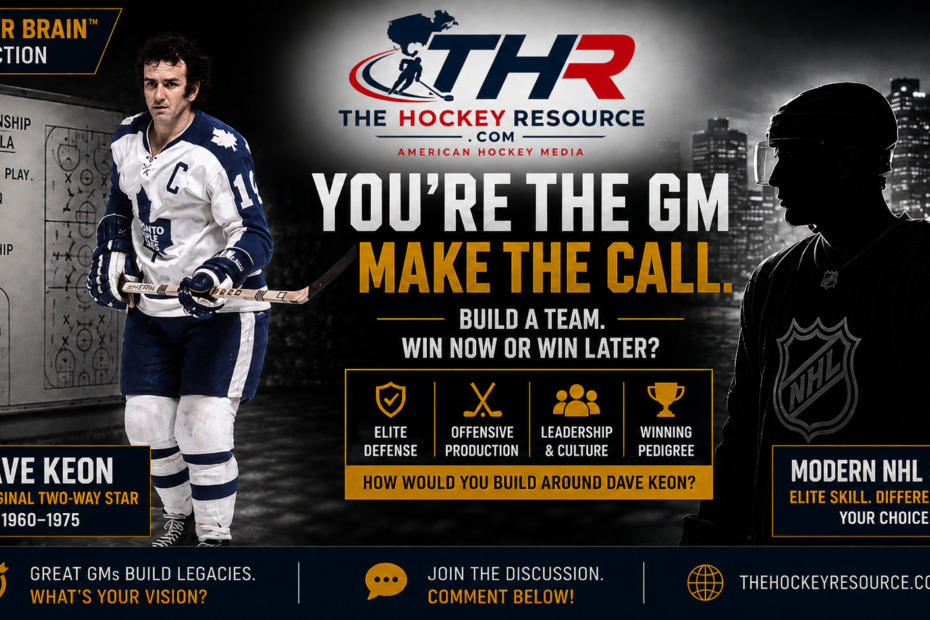
Would You Build a Modern NHL Team Around Maple Leafs Dave Keon?
Career BRAIN™ Collection | The Intelligence Behind Hockey Value™
If Maple Leafs Dave Keon entered the NHL today in his prime, would you build your team around him?
That is the question.
Not whether Dave Keon was great. His career settled that argument decades ago.
The harder question is whether the qualities that made Keon one of the most important players in Toronto Maple Leafs history would be valuable enough in today’s NHL to make him a franchise cornerstone.
Our Career BRAIN™ answer?
Absolutely. But perhaps not for the reason people immediately think.
Maple Leafs Keon’s value was never based solely on goals, assists or highlight-reel offence. His value came from how many different ways he helped a team win.
That is exactly what makes this GM decision interesting.
Maple Leafs Dave Keon Was More Than an Offensive Star
Keon joined the Maple Leafs in 1960 and immediately established himself as an elite NHL player, winning the Calder Trophy as rookie of the year in 1960-61. He later won consecutive Lady Byng Trophies and became a central figure in Toronto’s Stanley Cup championships of 1962, 1963, 1964 and 1967. In 1967, he won the Conn Smythe Trophy as playoff MVP.
At 5-foot-9 and approximately 165 pounds, Keon was undersized even for his era, but speed, anticipation and intelligence allowed him to control situations against larger opponents. NHL.com describes him as often being faster than anyone else on the ice.
That distinction matters when imagining Keon in today’s game.
He didn’t need to overpower opponents.
He needed to outthink them, outskate them and outperform them.
The Career BRAIN™ GM Test
Forget the era for a moment.
Imagine you are building an NHL organization today and a 20-year-old Dave Keon becomes available.
Your scouting department gives you this report:
Elite Two-Way Play
Keon could influence possession at both ends of the rink.
He wasn’t simply a scorer who happened to defend. Defensive responsibility was part of his identity as a player.
His 1967 Conn Smythe performance is particularly important to the Career BRAIN™ evaluation. Toronto defeated Chicago and Montreal to win the Stanley Cup, and Keon’s defensive work was central to his playoff impact.
For a general manager, that means something important:
Keon could remain valuable even when he wasn’t scoring.
That is one of the strongest characteristics a franchise player can possess.
Hockey IQ
Some players react to the game.
Others anticipate it.
Keon belonged in the second category.
Speed was part of his advantage, but the intelligence behind that speed mattered just as much.
Where should he be?
Which opponent represents the greatest threat?
When
should he attack?
should he protect the puck?
should he pressure defensively?
That ability to repeatedly make useful decisions is difficult to capture in a traditional box score.
It is also one of the reasons the Career BRAIN™ concept evaluates hockey value, not simply statistics.
Offensive Production
Here is where the GM conversation becomes more complicated.
If you were selecting between Keon and a modern superstar capable of enormous offensive totals, would Keon still be your choice?
That depends on what you are building.
A team cannot win without scoring.
But a championship team also needs players capable of producing offense without demanding that every tactical decision revolve around their offense.
Keon provided substantial scoring while maintaining his defensive identity. Across his NHL career, he recorded 396 goals and 590 assists, according to NHL.com.
That creates an attractive roster-building proposition:
You don’t have to sacrifice one part of the game to obtain another.
Leadership and Culture
This may be Keon’s greatest modern value.
General managers don’t simply acquire hockey players.
They build environments.
The best player on a team inevitably establishes standards, whether intentionally or unintentionally.
How does he prepare?
How hard does he compete without the puck?
Does he accept defensive responsibility?
How does he respond when things go badly?
Does winning matter more than individual recognition?
Keon eventually captained the Maple Leafs, but leadership in this exercise isn’t about having a C sewn onto a sweater.
It is about whether the player you build around reinforces the behaviour you want throughout the organization.
That is a major Career BRAIN™ consideration.
Winning Pedigree
Four Stanley Cups.
Three consecutive championships from 1962 through 1964.
Another championship in 1967.
And a Conn Smythe Trophy in the final one.
Winning doesn’t automatically make every player great, and championships should never be treated as an individual statistic.
But repeated success does provide evidence.
Keon wasn’t simply present on winning teams.
He occupied a major role on them.
That distinction matters.
Would Maple Leafs Dave Keon Translate to Today’s NHL?
This is where Career BRAIN™ goes beyond nostalgia.
We should not assume that every legendary player from another era would automatically dominate today.
Equipment changed.
Training changed.
Goaltending changed.
Systems changed.
Player size changed.
The speed of decision-making changed.
But the underlying attributes that made Keon exceptional are remarkably transferable:
Speed.
Hockey intelligence.
Defensive awareness.
Puck responsibility.
Competitive consistency.
Leadership.
Playoff performance.
Those characteristics remain valuable in every era.
In fact, an argument can be made that a player capable of performing multiple roles becomes even more useful in a salary-cap league because one roster position solves several problems.
The Modern NHL Star or Maple Leafs Dave Keon?
Now we arrive at the question in the image.
You have two choices.
One is a modern NHL superstar possessing elite offensive skill.
The other is Dave Keon in his prime.
You know Keon gives you:
Elite defence
Strong offensive production
Leadership and culture
Championship pedigree
Who do you take?
There is no automatic answer.
If your roster desperately lacks game-breaking offence, the modern superstar may be the correct decision.
But if you are starting an organization from zero?
The Career BRAIN™ case for Keon becomes extremely strong.
Because the first player you choose doesn’t merely occupy your first-line centre position.
He establishes what your organization values.
The Career BRAIN™ Verdict
Build around Dave Keon.
Not because he played for the Toronto Maple Leafs.
Not because he won championships generations ago.
And not because nostalgia should outweigh modern hockey analysis.
Build around Keon because his underlying hockey characteristics solve problems.
He could
play against elite opponents.
contribute offensively.
defend.
skate.
lead.
perform when the stakes increased.
And perhaps most importantly, his game did not require the organization to choose between individual production and team responsibility.
There is a reason the Maple Leafs’ centennial selection committee ranked Dave Keon as the greatest player in the first 100 years of franchise history.
That is the profile of a player around whom a general manager can build.
Now You’re the GM
You have the first building block of your franchise.
Do you choose:
Dave Keon — the complete two-way cornerstone
or
a modern offensive superstar — elite skill from a different era?
And here’s the harder question:
If you choose Dave Keon, what type of players would you put around him?
A pure goal scorer?
An elite puck-moving defenceman?
Another two-way forward?
A power forward?
A franchise goaltender?
There is no trade to hide behind.
No salary-cap excuse.
No owner making the decision.
You’re the GM. Make the call.

As always, thank you for being part of The Hockey Resource Community.
AMAZON Hockey
https://thehockeyresource.com/discount-hockey-products-amazon/
NEW Tournament Search APP
https://play.google.com/store/apps/details?id=com.hockeyresource.hockeytournamentapp&hl=en_CA&pli=1
NEW!!! The Hockey Moments Cards
thehockeytournamentresource.com
Little Laslo is worth the watch
https://www.facebook.com/reel/3577382982556655
GUMROAD – eBooks
https://thehockeyresource.gumroad.com/
SEE My Interview with the Mental Health Academy
https://www.buzzsprout.com/1824112/episodes/13519482
SEE My Interview on a Podcast with Constant Sports
https://www.youtube.com/watch?v=_8VJUTfAGp
The most remarkable speech in Hockey History
https://www.youtube.com/shorts/Y6GiyAkTZzQ
Actor Jeff Daniels Hockey Father about the drive home.