
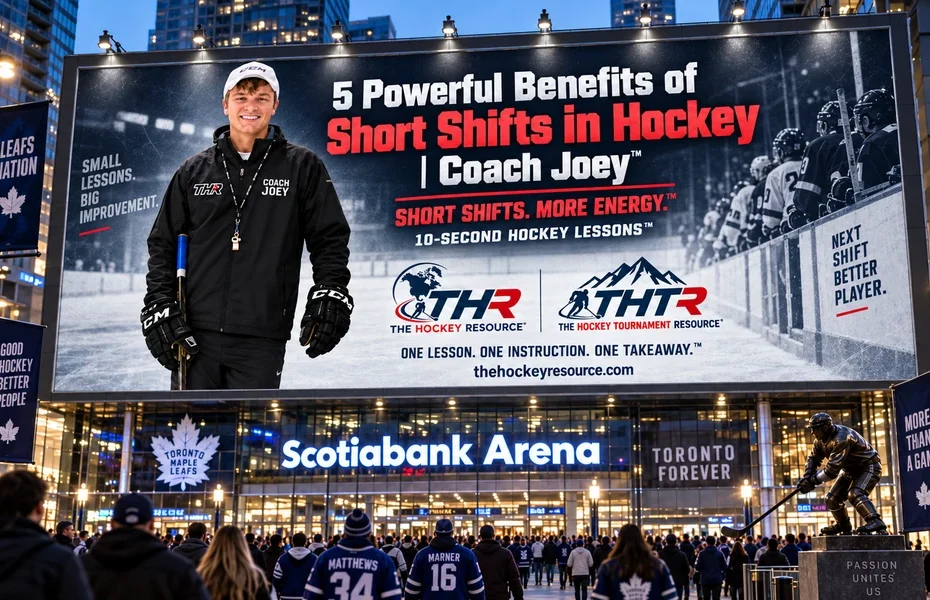
SHORT SHIFTS. MORE ENERGY.™ Short shifts in Hockey help Players bring a strong effort to the ice and give a fresh teammate the chance to do the same.
COACH JOEY™ BY AGE
U5-U7 • U8-U10 • U11-U14 • U15-U18 • Junior
U5-U7 + U8-U10 — Skate Hard, Change Safely
Young Players do not need to count seconds. Skate hard, listen to the Coach, and make a safe change when it is time.
WHAT DID YOU LEARN?
What matters most for a young Player’s shift?
U11-U14 — Learn the Right Time to Change
Start recognizing when your energy is dropping and when the play gives you a safe chance to change. Do not leave during immediate danger.
WHAT DID YOU LEARN?
When should you avoid changing?
U15-U18 + Junior — Manage High-Tempo Shifts
At competitive levels, strong shifts are often short, frequently around 40–50 seconds depending on role, pace, and Team system. Change before fatigue takes away your ability to contribute.
WHAT DID YOU LEARN?
Why should an older Player change before becoming exhausted?
A good shift has a purpose: compete, support the play, and make a smart change. For U15+ competitive Players, learning when to leave the ice is part of learning how to help the Team.
Today’s Coach Joey™ 10-Second Hockey Lessons™ topic is simple: skate hard, recognize the right moment to change, and be ready for your next turn.
1. Short Shifts Help You Maintain Your Effort
Hockey asks Players to accelerate, stop, turn, and compete for space. However, as a shift stretches on, keeping that same effort can become harder.
Therefore, plan to change while you still have enough energy to get back to the bench with purpose. This helps you avoid reaching the point where you are chasing the play and struggling to recover your position.
Think about the quality of your work. For example, strong skating, useful support, and a timely change can all make a shift valuable.
2. Fresh Legs Help You Stay Involved
Effective Hockey includes the work you do away from the puck. For instance, you may need to close a passing lane, support a teammate, or get back into position when possession changes.
Short shifts give you a chance to recover between those efforts. Then, when your turn comes again, focus on moving your feet and staying involved in the play.
Similarly, practice the same habit when your Team has possession. Coach Joey’s lesson on getting open and making a target explains how teammates can offer useful passing options.
3. Timely Changes Keep Your Team Moving
Your shift is one part of your Team’s rhythm. When you make a timely change, the next Player can enter with a clear role and fresh energy.
However, the game situation still matters. For example, if the other Team is attacking your net, stay with your responsibility until there is an appropriate opportunity to change.
Follow your Coach’s instructions and look at the play before heading to the bench. The aim is to make a change that helps your Team keep its shape and coverage.
4. Good Shift Habits Build Better Communication
A clean change takes awareness from both the Player leaving the ice and the teammate getting ready to enter. Know who you are replacing, listen to the bench, and communicate clearly.
For example, let your teammate know when you are coming off. Meanwhile, the incoming Player should be ready, watch the play, and follow the substitution rules used in that competition.
Build this habit alongside Coach Joey’s five ways to communicate better in Hockey. Simple, useful communication helps everyone understand the next job.
5. Short Shifts Show Trust in Your Teammates
Making a good change shows that you trust the next Player to contribute. It also shows your Coach that you understand how your choices affect the whole Team.
After you return to the bench, stay engaged. Listen, watch the opposition, and prepare for your next assignment.
A disciplined Player can help the Team on the ice and on the bench. Encourage the next line and get ready to bring another strong effort.
How Long Should a Hockey Shift Be?
For this U15+ lesson, use 30–45 seconds as a target to discuss with your Coach. However, your Coach may adjust that target for your level, position, role, and the demands of the game.
Treat the target as a planning guide. Keep reading the play, do your job, and look for a good chance to change before your effort drops.
Younger Players may use different game formats and Coach-directed rotations. Therefore, follow the instructions for your age group and competition.
A Simple Shift Checklist for Players
- Start ready. Know your assignment before you step onto the ice.
- Work with purpose. Skate, support, and compete throughout your shift.
- Read the play. Check possession, coverage, and your Coach’s direction.
- Make a smart change. Communicate and get to the bench with purpose.
- Reset. Listen, watch, and prepare for your next turn.
How Coaches Can Teach Short Shifts
Set clear expectations before practice and games. For example, explain what a good change looks like, where Players should look, and how they should communicate with the bench.
In a small-area game, practice short work periods followed by organized changes. Then pause when needed to show how a change affects the Players still on the ice.
Reinforce effort, awareness, and teamwork. Afterward, ask Players what they noticed before changing and how they helped the next teammate enter the play. Then recognize smart changes as part of a strong shift, alongside a good pass, a hard backcheck, or useful support.
Coach Joey’s Takeaway
SHORT SHIFTS. MORE ENERGY.™ Skate hard, make a smart change, and let a fresh teammate take over.
ONE LESSON. ONE INSTRUCTION. ONE TAKEAWAY.™
Part of Coach Joey™ 10-Second Hockey Lessons™.
Presented by The Hockey Resource™.
Visit TheHockeyResource.com for more Coach Joey™ lessons, Player development information, Coach Leadership™, Hockey Parent Intelligence™, and practical Hockey answers.
More From The Hockey Resource™
Explore Hockey products on Amazon, browse The Hockey Resource’s eBooks, and find the Tournament Search app on Google Play.
Discover Hockey career resources and hear the Mental Health Academy interview.
As always, thank you for being part of The Hockey Resource Community.