
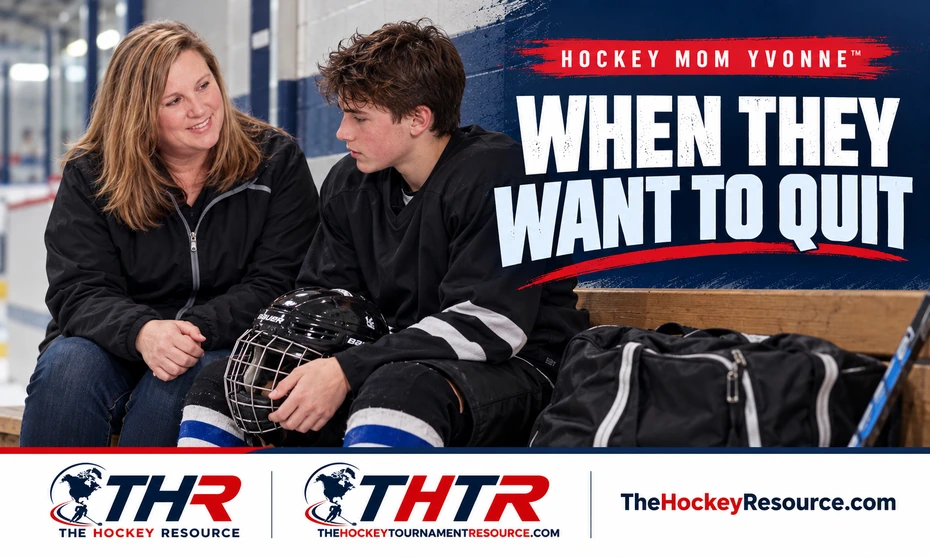
FIND OUT WHAT THEY WANT TO QUIT.™ When a child wants to quit Hockey, that can mean many things: I am tired, I hate this Team, I am embarrassed, I am bored, or I truly do not want Hockey anymore. Therefore, Hockey Mom Yvonne™ starts by finding the real reason.
Quit Hockey: HOCKEY MOM YVONNE™ BY AGE
U5-U7 • U8-U10 • U11-U14 • U15-U18 • Junior
U5-U7 + U8-U10 — Quit Hockey: Look for the Immediate Cause
Young children can make permanent-sounding statements after one bad practice.
WHAT WOULD YOU DO?
What should you find out first?
U11-U14 — Quit Hockey: Separate Team Problems From Hockey Problems
A Player may dislike the current Coach, role, social environment, travel, or level while still loving Hockey.
WHAT WOULD YOU DO?
What is the key distinction?
U15-U18 + Junior — Respect Ownership and Commitments
Older Players should understand commitments, fees, teammates, and future options while having increasing ownership of whether they continue.
WHAT WOULD YOU DO?
What should guide the conversation?
Quitting Is a Symptom Before It Is a Decision
Burnout, social conflict, fear, lack of playing time, injury, and loss of interest require different responses.
Do Not Make One Bad Day Permanent
A cooling-off period can help. That does not dismiss the Player’s feelings; it avoids a major decision while everyone is still upset.
Commitment Matters, But So Does the Child
Families teach responsibility by honouring commitments. They also teach judgment by recognizing when circumstances have genuinely changed.
5 Questions Before Your Child Quits Hockey Mid-Season
When a child says they want to Quit Hockey, the sentence may be describing exhaustion, Team conflict, embarrassment, reduced ice time, fear, or a genuine desire to leave the game. Parents need the reason before they need the answer.
1. What Do You Actually Want to Quit?
Ask whether the Player wants to leave Hockey, this Team, this Coach, this level, or simply the current pressure. Those are very different decisions.
2. Is This a Bad Week or a Repeated Feeling?
Do not make a permanent decision from one miserable practice if the Player usually enjoys the game. On the other hand, months of dread deserve more attention than one emotional night.
3. Is There a Safety or Wellbeing Issue?
If the desire to Quit Hockey is connected to bullying, harassment, injury, extreme exhaustion, or serious distress, the family should treat the underlying issue as more important than finishing the season.
4. What Commitment Was Made?
Older Players can learn that joining a Team creates responsibilities to teammates. That lesson still needs to be balanced against health, safety, and legitimate family circumstances.
5. What Would the Next Version of Hockey Look Like?
Leaving one environment does not always mean leaving the sport. A lower level, local program, different Coach, shorter season, or recreational option may fit the Player better.
Hockey Mom Yvonne’s Takeaway
Before asking whether they should quit Hockey, ask what they are actually trying to escape. FIND OUT WHAT THEY WANT TO QUIT.™
Quit Hockey: Find the Reason First
When a Player wants to quit Hockey, the reason matters more than the first emotional reaction. First, identify whether the problem is fatigue, Team fit, confidence, pressure, or a true loss of interest. Then make the quit Hockey decision with better information.
For another parent decision, read what to do about Hockey ice time. Hockey Canada also provides official resources for Hockey parents.
Part of Hockey Mom Yvonne™ and Hockey Parent Intelligence™. Presented by The Hockey Resource™.