
BUY A PURPOSE. NOT JUST MORE ICE.™ Private Hockey training can help, but more training is not automatically better training. Therefore, Hockey Mom Yvonne™ wants families to know what problem they are trying to solve before paying for another program.
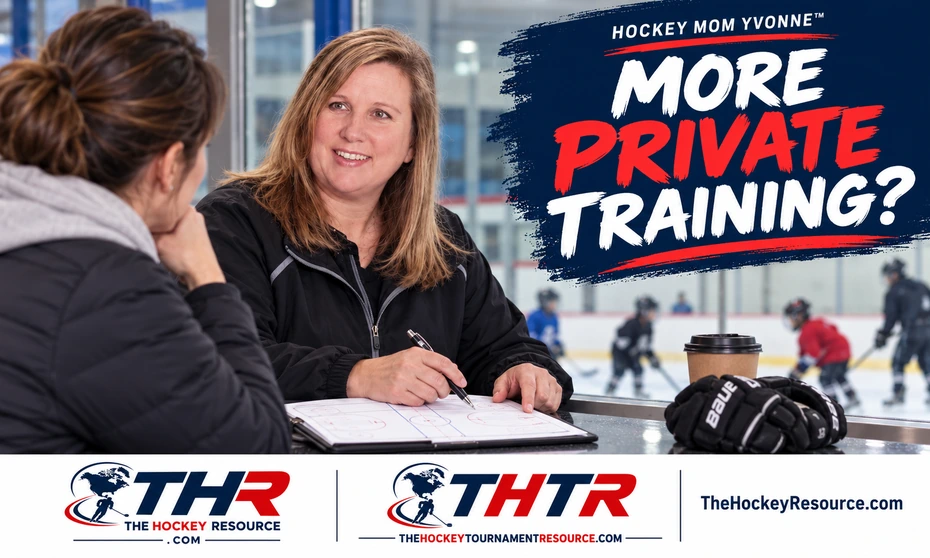
Private Hockey Training: HOCKEY MOM YVONNE™ BY AGE
U5-U7 • U8-U10 • U11-U14 • U15-U18 • Junior
U5-U7 + U8-U10 — Private Hockey Training: Skill and Enjoyment First
Skating quality, puck confidence, and enjoyment usually matter more than stacking specialized sessions.
WHAT WOULD YOU DO?
What should extra training support first?
U11-U14 — Private Hockey Training: Identify the Skill Gap
Ask what the instructor is teaching, why it matters, and how the Player will practice it outside the lesson.
WHAT WOULD YOU DO?
What should families know before paying?
U15-U18 + Junior — Ask About Evaluation and Advocacy
Older Players may value honest evaluation, video feedback, and credible references.
WHAT WOULD YOU DO?
What should families ask beyond lesson content?
More Is Not a Development Plan
Identify whether the Player needs skating, shooting, puck handling, position-specific work, or simply more repetitions.
Evaluate the Instructor
Look at teaching quality, communication, age fit, safety, and whether the instructor can explain what the Player is working on.
Watch the Total Load
Private training sits on top of practices, games, school, sleep, travel, and other activities.
5 Questions Before Paying for More Private Hockey Training
Private Hockey Training can be valuable, but more lessons are not automatically better development. Families should know what problem the training is supposed to solve before adding another expense and another calendar commitment.
1. What Specific Skill Needs Work?
Ask whether the Player needs skating help, shooting mechanics, puck skills, strength, Goalie instruction, confidence, or something else. A clear objective makes the value easier to judge.
2. Is the Instructor Qualified for That Need?
A great former Player is not automatically the right teacher. Look for evidence that the instructor can explain, correct, progress, and adapt the skill for the Player’s age and level.
3. Is the Player Already Overloaded?
More Private Hockey Training can become counterproductive if the Player is exhausted, injured, overwhelmed with school, or no longer enjoying the game.
4. How Will Improvement Be Measured?
Families should know what progress looks like. Better edge control, quicker release, improved save selection, or cleaner passing are more useful than vague promises of “elite development.”
5. What Support Exists Beyond the Lesson?
Before spending heavily, ask whether the instructor provides honest feedback, references, evaluations, or introductions when appropriate. Those should be earned and truthful, never purchased automatically.
Hockey Mom Yvonne’s Takeaway
Extra training should have an answer to one question: why are we doing this? BUY A PURPOSE. NOT JUST MORE ICE.™
Private Hockey Training: Buy a Purpose
Private Hockey training should solve a defined development need, not simply add more ice. First, identify the skill or decision that needs work. Then compare the instructor, teaching plan, cost, and Player readiness before buying more private Hockey training.
For another parent decision, read how to recognize Hockey burnout and fatigue. Hockey Canada also provides official resources for Hockey parents.
Part of Hockey Mom Yvonne™ and Hockey Parent Intelligence™. Presented by The Hockey Resource™.