
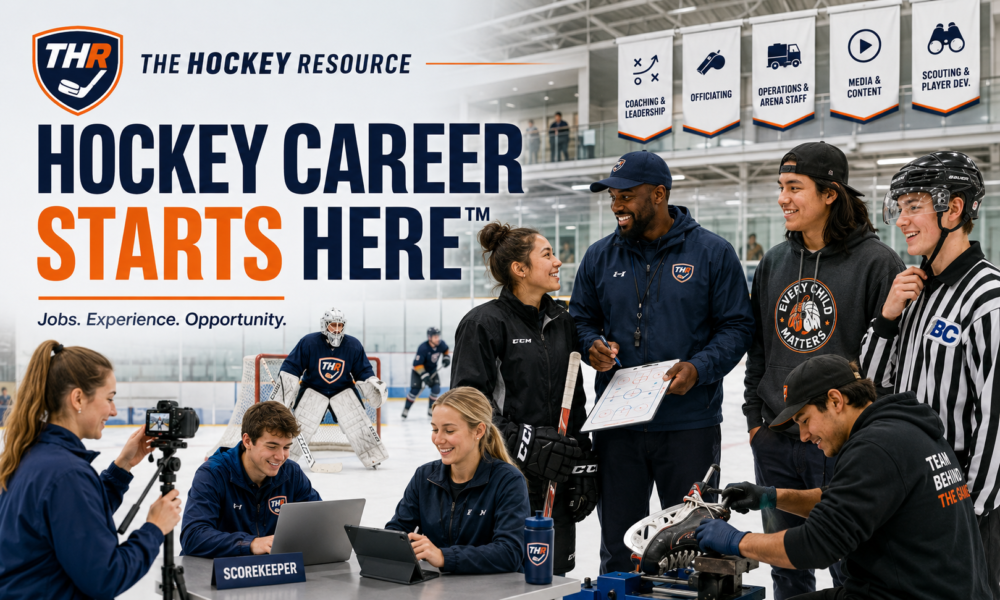
Teenage Hockey Players – For many teenage hockey players, coaching younger athletes is one of the easiest ways to begin working in hockey.
Teenage Hockey Players – They already know the rink.
They understand practices.
They have spent years watching coaches teach.
Most importantly, younger players often look up to older players in a way adults sometimes cannot replicate.
That does not mean every good player automatically becomes a good coach.
Far from it.
Playing and coaching are different skills.
However, with proper supervision, training and mentorship, a teenage player can begin learning how to teach, communicate and lead while still playing the game.
Teenage Hockey Players – That makes youth coaching an important pathway in Hockey Career Starts Here™.
Teenage Hockey Players – The Question: Can Teenage Hockey Players Help Coach Younger Players?
Yes, in many hockey programs they can.
However, the role depends on:
- The teenager’s age
- The age of the players being coached
- The governing body’s rules
- Local association policies
- Certification requirements
- Safeguarding requirements
- Adult supervision
A teenager should not simply walk onto the ice and become an unofficial coach because someone needs an extra body at practice.
The opportunity should be structured.
That protects the younger players.
It also gives the teenage coach a much better learning experience.
How Young Can Someone Start Coaching Hockey?
There is no single North American answer.
In Canada, Hockey Canada’s NCCP policy states that the minimum age for designation as NCCP Certified is 16. However, young people aged 14 or 15 may participate in certain NCCP or qualifying development opportunities where they are offered within the approved framework.
That distinction matters.
A 14- or 15-year-old may be able to begin learning about coaching without being treated as a fully certified adult coach.
In the United States, USA Hockey has a specific Student Coach pathway for registered players aged 13 through 17. Student Coaches must work under the supervision of a properly screened adult coach and are subject to specific limitations.
The larger principle is the same:
Teenagers can begin learning to coach before adulthood, but they should do so within a formal, supervised structure.
A Teenage Coach Should Not Replace an Adult Coach
This is one of the most important boundaries.
A teenage player helping with a younger team should not be treated as cheap labour replacing a qualified adult.
The teenager’s role should be developmental.
They might:
- Demonstrate a drill
- Help run a station
- Work with a small group
- Pass pucks
- Encourage younger players
- Help explain a skill
- Assist with warmups
- Support individual players
- Learn how a practice is organized
They should not be expected to independently manage:
- Discipline
- Serious player conflicts
- Parent complaints
- Medical decisions
- Dressing-room supervision
- Team administration
- Major coaching decisions
Those responsibilities belong with properly qualified adults.
Why Younger Players Often Respond Well to Teen Coaches
Imagine being eight years old.
Your adult coach tells you how to perform a skill.
You listen.
Then a 16-year-old player from an older team demonstrates it.
Suddenly, the younger player may be completely fascinated.
Older players can have tremendous influence because younger athletes often see them as someone they might realistically become.
They are closer in age.
They use familiar language.
They remember what learning the skill felt like.
That can make teenage assistant coaches very effective role models.
Being a Good Player Does Not Automatically Make You a Good Coach
This is where hockey occasionally becomes confused.
A player may be able to execute a skill beautifully without understanding how to teach it.
For example:
A skilled player may perform a tight turn automatically.
A younger player asks:
“How do you do that?”
The older player responds:
“You just turn.”
Technically accurate.
Educationally useless.
Coaching requires the ability to break a skill into parts and explain those parts in a way someone else understands.
That requires learning.
Coaching Teaches You to See Hockey Differently
Players often experience hockey from one perspective.
Their own.
Coaches cannot do that.
They have to watch everyone.
A teenage coach begins noticing:
- How different players learn
- Why some drills work
- Why others fail
- How confidence affects performance
- How instructions are interpreted
- How much practice organization matters
- How differently children develop
That broader perspective can improve hockey intelligence.
It can even help the teenager as a player.
Teaching a Skill Can Improve Your Own Understanding
One of the strange things about teaching is that explaining something often exposes how well you actually understand it.
A teenager might know how to shoot.
Then someone asks:
“Why do you move your hands that way?”
Now the player has to think about:
- Hand position
- Weight transfer
- Blade angle
- Puck position
- Release
- Follow-through
Teaching forces the player to understand the skill more deeply.
That can benefit both coach and student.
Step 1: Start With a Younger Age Group
Teenage coaches generally make the most sense working with children significantly younger than themselves.
USA Hockey, for example, requires Student Coaches to work with players at least one full playing-age level below them, subject to certain exceptions.
For a U16 or U18 player, helping with U7, U9 or another younger group can provide an appropriate introduction.
The difference in age creates a clearer mentor relationship.
It also reduces the awkwardness that could come from trying to coach players almost the same age.
Step 2: Work Under an Experienced Coach
The quality of the adult coach matters.
A good mentor can teach the teenager:
- How to plan a practice
- How to organize stations
- How to give feedback
- How to correct without embarrassing
- How to explain skills
- How to communicate with children
- How to manage different ability levels
This is where the experience becomes real coaching education rather than simply helping move pucks.
The teenager should be able to ask:
“Why did you run that drill?”
That question can lead to valuable learning.
Step 3: Learn Age-Appropriate Coaching
You do not coach a six-year-old the same way you coach a 17-year-old.
Hockey Canada specifically structures coaching education around the age and developmental stage of players. Its Coach 1 program, for example, is designed around coaching the youngest athletes and emphasizes leadership, communication, teaching and lesson planning.
That is important for teenage coaches to understand.
Young children need:
- Simple instructions
- Repetition
- Encouragement
- Movement
- Fun
- Short explanations
- Developmentally appropriate expectations
A teenager who has spent years in competitive hockey may initially try to explain far too much.
The U7 player staring at the arena ceiling during your detailed lecture on neutral-zone structure is providing useful feedback.
Step 4: Learn How to Communicate
Good coaching is largely communication.
A teenage coach needs to learn how to:
- Speak clearly
- Give short instructions
- Demonstrate
- Encourage effort
- Correct respectfully
- Ask questions
- Listen
- Adjust explanations
Different children respond differently.
One player may immediately understand a demonstration.
Another needs the skill explained.
Someone else needs to try it three times before it makes sense.
That is coaching.
Step 5: Learn How to Give Feedback
Teenagers sometimes copy the coaching language they have heard.
That can be good.
It can also be disastrous.
Young coaches need to understand that yelling:
“Come on! That’s easy!”
does not magically make something easier.
Useful feedback is specific.
Instead of:
“That was bad.”
Try:
“Keep your knees bent a little more on the turn.”
Instead of:
“Shoot harder.”
Try:
“Try getting your weight onto the front leg.”
Good feedback tells the player what to change.
Step 6: Understand Safeguarding
Working with children creates responsibilities.
This is not optional.
Associations and governing bodies may have requirements involving:
- Registration
- Screening
- Safe-sport education
- Dressing-room policies
- Supervision
- Communication with minors
- Appropriate conduct
USA Hockey’s Student Coach rules specifically require supervision by a properly screened adult coach during practices, clinics, tryouts and in the locker room.
Hockey Canada also requires standardized education, certification and training within its sanctioned system, with screening requirements applying to adult coaches and bench personnel.
Teenage coaches and their parents should understand the local rules before beginning.
Should Teenage Coaches Be Paid?
Sometimes they may be.
Other opportunities may begin as volunteering or mentoring.
The arrangement can depend on:
- Age
- Organization
- Role
- Hours
- Employment law
- Certification
- Level of responsibility
A teenager helping with one practice each week as part of a leadership program is different from someone working 30 hours at a summer hockey camp.
When the role becomes regular employment, applicable youth-employment and wage rules should be followed.
Experience is valuable.
So is being paid appropriately when you are actually doing a job.
Hockey Schools Can Be a Natural Next Step
A teenager who enjoys helping a younger team may eventually find paid work at:
- Hockey schools
- Skills camps
- Summer programs
- Development clinics
- Learn-to-play programs
That creates a progression:
Player → Volunteer helper → Assistant coach → Camp instructor → Skills coach
Not everyone will follow that exact path.
However, it demonstrates how a small first opportunity can develop into something much larger.
Coaching Can Build Leadership Skills
Teenagers are often told to become leaders.
Coaching actually gives them somewhere to practise leadership.
They learn to:
- Be responsible
- Communicate clearly
- Help others
- Stay patient
- Prepare
- Solve problems
- Manage groups
- Give feedback
- Set an example
Those skills matter in hockey.
They also matter in almost every future career.
Young Coaches Learn Patience Very Quickly
A drill that seems simple to an experienced teenage player may be completely new to a six-year-old.
That produces a useful lesson.
Development takes time.
The teenage coach may need to demonstrate the same skill repeatedly.
One child may learn immediately.
Another may struggle for weeks.
A good coach learns not to measure every player’s progress against the same timetable.
That lesson can shape how the teenager thinks about their own development too.
Coaching Can Change How You View Your Own Coaches
There is a side benefit nobody advertises.
After trying to organize ten young players, explain a drill, collect pucks, answer questions and keep everyone moving, a teenager may suddenly develop a fascinating new appreciation for previous coaches.
Some former criticisms become:
“Okay, I understand now.”
Not all of them.
Let’s not get carried away.
But perspective is useful.
What Should a Teenage Coach Never Do?
A young coach should not:
- Humiliate players
- Swear at children
- Use physical punishment
- Bully
- Threaten
- Try to become everyone’s friend
- Ignore adult supervision
- Contact young players privately outside approved channels
- Enter inappropriate dressing-room situations
- Pretend to know something they do not
When unsure, ask the supervising adult coach.
That is what mentorship is for.
What Makes a Great Teenage Assistant Coach?
Not playing level.
Not scoring statistics.
Not whether they were drafted.
The best young assistants are often those who are:
- Patient
- Enthusiastic
- Reliable
- Positive
- Prepared
- Humble
- Comfortable talking with children
- Willing to learn
A talented AAA player who spends the whole practice looking bored may provide very little value.
A hardworking AA player who remembers every child’s name and celebrates their improvement may become an outstanding coach.
That distinction matters.
Parents: Do Not Arrange the Entire Opportunity
Parents can help.
They can make an introduction.
They can explain local requirements.
They can help with transportation.
However, the teenager should increasingly take responsibility.
A young player can approach a former coach and say:
“I’d like to learn how to coach. If you ever need help with a younger team, I’d be interested.”
That conversation is part of the development.
Coaches: Give Teenage Assistants Real Opportunities to Learn
Do not bring an older player onto the ice and use them exclusively to move cones.
Give them manageable responsibility.
For example:
“Run this passing station for eight minutes.”
Then provide feedback.
Ask:
- What did you notice?
- What was difficult?
- Did the players understand?
- What would you change?
That turns helping into education.
Organizations Should Build Junior Coaching Programs
Minor hockey associations have an opportunity here.
Instead of waiting for young people to discover coaching accidentally, associations could intentionally create programs for teenage players.
A simple program might include:
- Recruiting interested U15-U18 players
- Providing basic coach education
- Matching them with younger teams
- Assigning adult mentors
- Giving them defined responsibilities
- Reviewing their progress
- Introducing certification pathways
That develops future coaches while helping today’s teams.
Hockey organizations spend enormous energy developing players.
They should also develop the people who will eventually teach them.
Could Coaching Become a Career?
Absolutely.
A teenager who begins helping with younger players could eventually move into:
- Minor hockey coaching
- Hockey-school instruction
- Skills development
- Goaltending instruction
- Video coaching
- Player development
- Junior hockey
- College or university hockey
- Professional hockey
- National-team programs
Hockey Canada maintains formal coaching and instructional development pathways through the NCCP, including specialized instructional streams.
The teenager helping with a U7 station today may have no idea where the experience will lead.
That is precisely why starting matters.
A Teenage Coaching Starter Plan
Interested in coaching younger players?
Start here.
1. Decide Whether You Actually Enjoy Helping Younger Players
Liking hockey and liking children are not the same qualification.
Be honest.
2. Talk to Your Association
Ask whether it has opportunities for teenage players to assist younger teams.
3. Find an Adult Mentor
Look for an experienced coach willing to teach you.
4. Confirm the Requirements
Check age, registration, certification, supervision and safeguarding rules.
5. Start With One Small Responsibility
Run one station.
Demonstrate one skill.
Help one group.
6. Ask for Feedback
Ask the head coach:
“What could I do better next time?”
7. Keep Learning
Take available coaching courses when eligible.
Study practices.
Learn how children develop.
8. Decide Whether You Want More
If you enjoy it, pursue additional opportunities.
That is how a pathway begins.
The Hockey Resource Takeaway
Teenage hockey players can do much more than simply help carry pucks at younger practices.
With the right structure, they can begin learning how to coach.
They can develop:
- Communication
- Leadership
- Patience
- Hockey intelligence
- Responsibility
- Teaching ability
Some will discover coaching is not for them.
Others may discover the role they want to pursue for decades.
The important thing is giving young players an opportunity to find out.
A hockey career does not have to begin when playing ends.
Sometimes it begins when an older player turns around and helps the next player coming behind them.
YOUR FIRST STEP
If coaching interests you, do this first:
Contact a former coach, younger-team coach or your hockey association and ask whether there is an opportunity to assist at a younger team’s practice.
Then ask one more question:
“What training or requirements do I need before I can help?”
That is a much better starting point than simply showing up with a whistle.
HOCKEY CAREER STARTS HERE™
YOU DON’T HAVE TO STOP PLAYING HOCKEY TO START WORKING IN HOCKEY.
Learn to teach.
Learn to lead.
Help the next player.
Discover where hockey can take you.
THE HOCKEY RESOURCE™
WE MAKE BETTER HOCKEY PEOPLE.
WordPress SEO Package
Post Title:
Can Teenage Hockey Players Help Coach Younger Players?
Focus Keyphrase:
teenage hockey players coach younger players
SEO Title:
Can Teenage Hockey Players Coach Younger Players?
Slug:
teenage-hockey-players-coach-younger-players
Meta Description:
Can teenage hockey players coach younger players? Learn about age requirements, supervision, training, mentorship and how young players can start coaching.
Suggested Category:
Hockey Career Starts Here™
Suggested Tags:
Hockey Coaching, Teen Hockey Jobs, Youth Hockey Coaching, Hockey Careers, Student Coaches, Hockey Leadership
Featured Image Alt Text:
Teenage hockey player helping coach younger players during a youth hockey practice
Excerpt:
Teenage hockey players can begin learning to coach while they are still playing. Explore supervision, training, certification and practical ways to start helping younger players.
Schema:
Article
Suggested Internal Links:
- Hockey Career Starts Here™
- How Can a Teenager Get Their First Job in Hockey?
- How Do You Become a Youth Hockey Referee?
- Future: How Do You Start Working at a Hockey School?
- Future: What Jobs Can Teenagers Get at Hockey Tournaments?
Primary Editorial Sources:
- Hockey Canada NCCP Minimum Age Policy
- Hockey Canada Coaching FAQ
- Hockey Canada NCCP Levels and Requirements
- USA Hockey Student Coach Policy
- USA Hockey Coaching Education Program
Hockey Canada allows coaching education opportunities before 16 in certain circumstances, but NCCP Certified status begins at 16; USA Hockey formally recognizes 13-to-17-year-old Student Coaches under adult supervision.

AMAZON Hockey
https://thehockeyresource.com/discount-hockey-products-amazon
NEW Tournament Search APP
https://play.google.com/store/apps/details?id=com.hockeyresource.hockeytournamentapp&hl=en_CA&pli=1
NEW!!! The Hockey Moments Cards
thehockeytournamentresource.com
GUMROAD – eBooks
https://thehockeyresource.gumroad.com
SEE My Interview with the Mental Health Academy
SEE My Interview on Podcast with Constant Sports