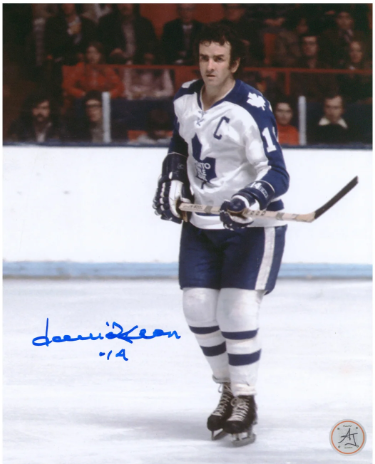

DAVE KEON PRESENTED BY – thehockeyresource.com
DAVE KEON – The Greatest Toronto Maple Leaf
Dave Keon built his Hockey Hall of Fame career through speed, intelligence, defensive excellence and remarkable discipline. He was never the largest or most physically imposing player on the ice. He became dominant by thinking faster, skating faster and competing responsibly in every situation.
DAVE KEON – Born March 22, 1940, in Noranda, Quebec—now Rouyn-Noranda—David Michael Keon developed his game at St. Michael’s in Toronto. After a brief professional introduction with the Sudbury Wolves, Keon joined the Toronto Maple Leafs for the 1960–61 NHL season.
DAVE KEON – What followed was one of the greatest careers in Maple Leafs history.
An Immediate NHL Impact
Dave Keon recorded 20 goals and 45 points in 70 games during his rookie season. His performance earned him the 1961 Calder Memorial Trophy as the NHL’s top rookie.
That season introduced Toronto to the qualities that would define his career:
- Exceptional skating speed
- Intelligent positional play
- Outstanding defensive awareness
- Puck control under pressure
- Disciplined, reliable competition
Although Keon stood only 5-foot-9 and weighed approximately 165 pounds, he could control games against much larger opponents. His intelligence and speed allowed him to create offence while also neutralizing many of hockey’s most dangerous centres.
The NHL’s official Keon profile describes him as one of the fastest players of his era.
Four Stanley Cup Championships
Keon helped Toronto win four Stanley Cups:
- 1962
- 1963
- 1964
- 1967
He was an essential part of the Maple Leafs team that won three consecutive championships from 1962 through 1964. His ability to play against top opponents, kill penalties, win important faceoffs and generate offence made him one of Toronto’s most trusted players.
Keon produced his defining playoff performance in 1967. Toronto defeated the Montreal Canadiens in six games to capture the Stanley Cup, with Keon playing a critical defensive role against Montreal captain Jean Béliveau.
For that performance, Keon received the Conn Smythe Trophy as the most valuable player of the Stanley Cup playoffs. The NHL’s official trophy record recognizes his shutdown work against the Canadiens as central to Toronto’s championship.
Keon remains the only Maple Leafs player to win the Conn Smythe Trophy.
Excellence Without Penalties
Keon combined relentless competition with extraordinary discipline.
He won the Lady Byng Memorial Trophy in 1962 and again in 1963. During each of those seasons, he received only one minor penalty.
That accomplishment reveals something important about Keon’s game. He did not require intimidation, retaliation or frequent physical confrontation to influence a hockey game. He defended through positioning, anticipation, stick work and skating.
Keon demonstrated that responsible hockey could also be highly competitive hockey.
Captain of the Maple Leafs
Keon became captain of the Maple Leafs in 1969 and held the position through the conclusion of his Toronto career in 1975.
He led through preparation, consistency and performance. Teammates could expect Keon to compete at both ends of the rink, regardless of the opponent or the standings.
His best statistical NHL season came in 1970–71, when he recorded:
- 38 goals
- 38 assists
- 76 points
- Only four penalty minutes
That combination of scoring, defence and discipline captures what made Keon so unusual. He could produce offence at an elite level without sacrificing his defensive responsibilities.
A Difficult Departure from Toronto
Keon’s relationship with the Maple Leafs deteriorated during the ownership of Harold Ballard. When Keon’s contract expired in 1975, Toronto retained his NHL rights and demanded compensation that discouraged other NHL teams from signing him.
Unable to continue elsewhere in the NHL on reasonable terms, Keon joined the World Hockey Association. He played for the Minnesota Fighting Saints, Indianapolis Racers and New England Whalers.
Keon’s departure from Toronto became one of the most controversial endings involving a legendary Maple Leafs captain. It also created a separation between Keon and the organization that lasted for many years.
The Final Chapter in Hartford
Keon remained with the Whalers when the franchise entered the NHL as the Hartford Whalers in 1979. He continued playing until 1982, retiring at age 42 after 22 professional seasons.
His NHL career totals were:
- 1,296 regular-season games
- 396 goals
- 590 assists
- 986 points
- 117 penalty minutes
He added 291 points in 301 WHA regular-season games. Complete statistics are available through Keon’s official NHL player profile.
His longevity was particularly impressive because his game depended on intelligence, responsibility and efficiency. Keon adapted as hockey changed around him and remained an effective professional into his forties.
Dave Keon Enters the Hockey Hall of Fame
Dave Keon was inducted into the Hockey Hall of Fame as a player on September 10, 1986.
He entered alongside defencemen Leo Boivin and Serge Savard, with Bill Hanley inducted in the builder category. His place in the Class of 1986 is confirmed by the Hockey Hall of Fame’s official induction record.
The honour recognized far more than Keon’s statistics. His Hall of Fame legacy was built upon:
- Four Stanley Cup championships
- The 1967 Conn Smythe Trophy
- The 1961 Calder Memorial Trophy
- Two Lady Byng Memorial Trophies
- Eight NHL All-Star Game appearances
- Two selections to the NHL Second All-Star Team
- Elite two-way performance
- Exceptional consistency and discipline
Recognized as the Greatest Maple Leaf
In 2016, a panel and fan vote selected Keon as the greatest player in Toronto Maple Leafs history.
On October 15, 2016, Toronto officially retired his No. 14. Keon was also honored with a statue on Legends Row outside Scotiabank Arena.
The NHL subsequently selected him as one of its 100 Greatest NHL Players during the league’s centennial celebration.
These honors helped restore Keon to his rightful position within the history of the franchise he had served for 15 seasons.
The Meaning of Dave Keon’s Legacy
Keon’s career offers a timeless hockey lesson: leadership does not need to be loud to be powerful.
He competed against the opposition’s best players. He delivered in championship situations. He accepted responsibility at both ends of the rink and rarely placed his team at a disadvantage through penalties.
Keon represented complete hockey.
His statistics established him as a great player. His championships made him a Toronto legend. His intelligence, discipline and accountability made him a Hockey Hall of Famer.
Career Snapshot
Full name: David Michael Keon
Born: March 22, 1940
Birthplace: Noranda, Quebec
Position: Centre
Shoots: Left
NHL teams: Toronto Maple Leafs, Hartford Whalers
NHL career: 1960–1982
NHL totals: 1,296 games, 396 goals, 590 assists, 986 points
Stanley Cups: 1962, 1963, 1964 and 1967
Hockey Hall of Fame: Class of 1986
Maple Leafs number: No. 14, retired in 2016
The Hockey Resource Career BRAIN™ Collection: Toronto Maple Leafs Features Hockey History, Hockey Leadership, Stanley Cup Stories
As always, thank you for being part of The Hockey Resource Community.
AMAZON Hockey
NEW Tournament Search APP
https://play.google.com/store/apps/details?id=com.hockeyresource.hockeytournamentapp&hl=en_CA&pli=1
NEW!!! The Hockey Moments Cards
GUMROAD – eBooks
https://thehockeyresource.gumroad.com
SEE My Interview with the Mental Health Academy
SEE My Interview on Podcast with Constant Sports
https://www.youtube.com/watch?v=_8VJUTfAGp
The Hockey Resource
https://thehockeyresource.com/category/blog/hockey-career-starts-here