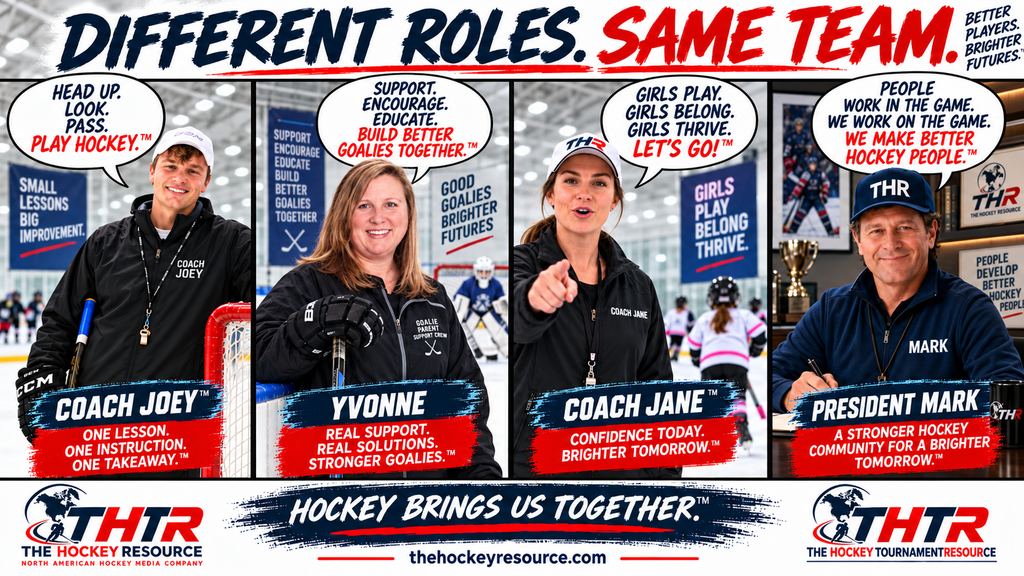
President Mark — Even in the NHL: Coach the Next Play — Parent Quiz.
Choose the Parent questions for your age group
The eight foundation questions below introduce NHL perspective. Each age-specific lesson has its own Parent question, giving eight additional questions for each age group.
U5–U7
1. Look Up Before Passing
2. Shoot and Find the Puck
3. Keep Playing After the Drop
4. Get Ready With Support
5. Watch the Puck Cross
6. Wait for the Clear Call
7. Talk About Trying
8. Keep the Game Inviting
U8–U10
1. Look Before the Puck Arrives
2. Stay Ready After a Shot
3. Learn Your Next Position
4. Build a Simple Reset
5. Adjust Speed Near the Line
6. Know Who You Replace
7. Notice One Learned Skill
8. Give a Teammate a Target
U11–U14
1. Read the Passing Lane
2. Choose the Useful Chance
3. Notice the Opponent’s Move
4. Find the Shot Through Traffic
5. Time Support With the Carrier
6. Confirm the Change Signal
7. Review the Actual Play
8. Choose One Job This Shift
U15–U18
1. Use the Team’s Outlet
2. Shoot With Support
3. Agree on the Faceoff Plan
4. Review Depth and Coverage
5. Keep Entry Spacing Useful
6. Prepare Before Entering
7. Connect Numbers to Context
8. Stay Within the Team Plan
Junior
1. Prepare a Second Option
2. Review Chance and Execution
3. Adjust to the Matchup
4. Own the Reset and Review
5. Agree on Line Entry Cues
6. Review Bench Communication
7. Agree on Useful Evidence
8. Manage the Game Situation
Eight questions help Parents apply NHL perspective to youth Hockey. Choose one answer per question, then open the explanation.
The series approach is to put the play in perspective, understand what happened, teach one adjustment and practice the recovery.
Use the explanations to start a conversation with your Player or Coach.
The quiz checks understanding of these examples and this teaching approach; it is not an assessment of your child’s ability.
1. When a Pass Goes Wrong
Brett Kulak’s failed pass led to a Dallas goal during Game 1 of the 2024 Western Conference Final. NHL report.
Johnny’s pass is intercepted. The Coach says NHL Players make this mistake too. Under this series’ approach, what should come next?
A. Demand that Johnny stop trying passes.
B. Ask what he saw and teach one adjustment.
C. Tell Johnny that the mistake needs no review.
D. List every mistake from the entire game.
Show answer and explanations
Answer B.
A. Avoiding all passes does not teach him how to recognize an available lane.
B. Listening to the read and choosing one useful adjustment connects the NHL perspective to learning.
C. Normalizing a mistake does not remove the opportunity to understand and improve it.
D. An immediate list can obscure the single action the Player needs to practice.
2. When a Good Chance Does Not Score
Alex Ovechkin recorded 65 goals on 446 shots on goal in 2007–08. That leaves 381 shots on goal that did not score. Capitals statistical record.
Ovechkin recorded 65 goals on 446 shots on goal in 2007–08. What do the remaining 381 shots on goal represent?
A. 381 shots that missed the net.
B. 381 proven poor shooting decisions.
C. 381 shots blocked before reaching the Goalie.
D. 381 shots on goal that did not score.
Show answer and explanations
Answer D.
A. Missed shots are not included in shots on goal.
B. The outcome alone does not establish whether the decision was poor.
C. Blocked attempts are recorded separately from shots on goal.
D. Subtracting 65 goals from 446 shots on goal gives 381 non-goal shots on goal.
3. After a Lost Faceoff
In 2022–23, Patrice Bergeron won 1,043 of 1,706 faceoffs, a 61.1% win rate. Subtraction gives 663 faceoffs lost. NHL career retrospective.
Bergeron won 1,043 of 1,706 faceoffs in 2022–23. What does that example demonstrate?
A. A strong faceoff Player can still lose many draws.
B. Every child should win at least 61.1% of draws.
C. A lost faceoff proves poor effort.
D. Only the center has a job after the drop.
Show answer and explanations
Answer A.
A. The difference is 663 lost draws despite a 61.1% winning rate.
B. An NHL percentage is not a development threshold for every child.
C. The result does not by itself establish effort or the cause of the loss.
D. The lesson asks the whole unit to understand its next assignment.
4. Helping a Goalie After a Goal
Sergei Bobrovsky allowed five goals before being replaced in Game 4 of the 2024 Stanley Cup Final. NHL Game 4 report. He later made 23 saves in Florida’s Cup-winning Game 7. NHL Game 7 report.
Bobrovsky’s difficult Game 4 and later Cup-winning Game 7 provide perspective for young Goalies. Which claim goes beyond that evidence?
A. A difficult game can be followed by a better performance.
B. One game does not describe a whole career.
C. A difficult game guarantees a win in the next appearance.
D. The next preparation is still worth attention.
Show answer and explanations
Answer C.
A. The sequence provides a real example of that possibility.
B. The example shows why a single performance is an incomplete judgment.
C. A later recovery does not guarantee any Goalie’s next result.
D. The THR lesson directs attention toward an action the Goalie can control.
5. Learning From an Offside
An Ovechkin goal was disallowed for offside in Washington’s October 2023 game against Minnesota. NHL review, published October 28.
An offside call frustrates a U9 Player. Which Coach response connects NHL perspective to one useful action?
A. “It happens in the NHL. Next time, watch the puck near the line.”
B. “It happens in the NHL. Forget the rule and skate faster.”
C. “It happens in the NHL. You must never make that mistake again.”
D. “It happens in the NHL. Let’s review every rule before your next shift.”
Show answer and explanations
Answer A.
A. This response gives perspective and a specific cue suited to the situation.
B. Ignoring the rule does not solve the entry-timing problem.
C. A demand for perfection gives no action to practice.
D. A full rules review distracts from the immediate timing cue.
6. Fixing a Line-Change Mistake
Colorado took two too-many-men penalties against Dallas in Game 2 of their 2024 second-round playoff series. NHL Game 2 analysis.
After a line-change penalty, a Parent says Johnny did not listen. What should the Coach check before drawing that conclusion?
A. Whether another Player can take the blame.
B. Whether Johnny scored earlier in the game.
C. Whether the call was clear and what Johnny understood.
D. Whether the Parent was disappointed with the score.
Show answer and explanations
Answer C.
A. Assigning blame does not establish what was communicated.
B. An earlier goal does not explain the line-change exchange.
C. Reviewing both the instruction and the response helps locate the actual problem.
D. The Parent’s disappointment does not establish what happened on the bench.
7. When a Number Hurts Confidence
Ovechkin scored 51 goals and finished minus-35 in 2013–14. NHL historical comparison.
A Player finishes minus-three. What can plus/minus alone establish about that Player’s mistakes?
A. Exactly three individual defensive errors occurred.
B. The Player’s full responsibility cannot be determined from that number.
C. The Player was the Team’s weakest defender.
D. The Player’s offensive effort caused all three goals.
Show answer and explanations
Answer B.
A. Plus/minus is not an individual error count.
B. The relevant plays, assignments and Team context are needed to assess responsibility.
C. One statistic cannot establish that comparison.
D. The number alone does not identify the actions that caused the goals.
8. Giving the Next Shift a Purpose
Boston overcame a three-goal third-period deficit in Game 7 against Toronto in 2013; Bergeron scored the tying goal and overtime winner. NHL career retrospective.
A Coach uses an NHL comeback to speak to a Team that is behind. Which response follows the series’ recovery approach?
A. “That comeback proves we will win this game.”
B. “Our best Player must rescue the entire game.”
C. “If we lose, it proves we did not care enough.”
D. “A comeback is possible. Focus on your next job.”
Show answer and explanations
Answer D.
A. A past NHL result cannot guarantee this Team’s result.
B. That places the whole outcome on one Player rather than giving useful Team tasks.
C. A loss alone does not establish effort or commitment.
D. This preserves perspective while directing attention to an action the Players can control.
Return to the Even in the NHL series guide.
The Hockey Resource™ — We Make Better Hockey People.™