
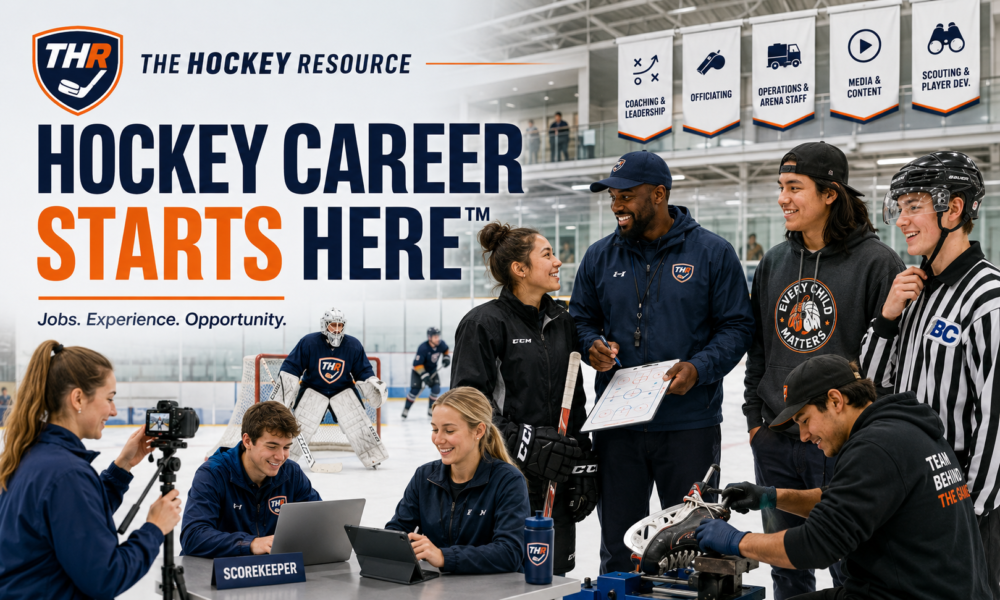
You Don’t Have to Stop Playing Hockey to Start Working in Hockey
Most young hockey players grow up thinking about one career path.
Keep playing.
Make the next team. Reach Junior. Play college. Chase professional hockey.
There is nothing wrong with that ambition.
But hockey offers another opportunity that often begins long before a player’s final game.
You can start building a career in hockey while you are still playing it.
A U16 or U18 player might help coach younger players. Another may begin refereeing. Someone else may run the clock, work tournaments, sharpen skates, create social media, film games, track statistics or assist at a hockey school.
Those experiences may begin as part-time jobs, volunteer positions or simply helping someone at the rink.
Sometimes they become careers.
That is why The Hockey Resource created Hockey Career Starts Here™.
Hockey Is Much Bigger Than the Players on the Ice
Every hockey game requires people working behind the scenes.
Think about everything required to put two teams on the ice.
Someone has to:
- Coach the players
- Officiate the game
- Run the clock
- Keep score
- Manage the arena
- Prepare the ice
- Organize the tournament
- Schedule the games
- Maintain equipment
- Sharpen skates
- Film games
- Manage statistics
- Recruit players
- Communicate with families
- Operate team websites
- Create social media
- Sell sponsorships
- Scout players
- Manage teams and leagues
Professional hockey adds even more possibilities.
There are careers in:
- Hockey operations
- Player development
- Scouting
- Analytics
- Sports medicine
- Strength and conditioning
- Equipment management
- Broadcasting
- Journalism
- Photography
- Video production
- Marketing
- Sales
- Sponsorship
- Communications
- Arena management
- Event operations
The hockey business does not begin and end with becoming an NHL player.
Your First Hockey Job May Already Be Around You
Young players do not necessarily need to wait until graduating from college to gain experience.
Some opportunities can begin during high school.
A player might help with a U7 practice once a week.
Another could referee younger age groups.
Someone interested in media might film games for a Junior team.
A student interested in business could help a tournament operator with registration or social media.
The first opportunity does not need to be glamorous.
In fact, it probably will not be.
Careers have an irritating habit of beginning with carrying equipment, arriving early and doing jobs nobody puts on Instagram.
But those experiences teach something important.
How hockey actually works.
Coaching
One of the most natural opportunities for older players is coaching younger athletes.
A current player already understands:
- Practices
- Dressing-room culture
- Skills development
- Team dynamics
- Game preparation
- What young players worry about
That does not automatically make the player a great coach.
However, with training and mentorship, an older player can become an excellent role model for younger athletes.
Coaching also develops leadership, communication and hockey intelligence.
Officiating
Refereeing gives players a completely different view of the game.
Officials develop:
- Decision-making
- Confidence
- Communication
- Conflict management
- Rule knowledge
- Skating ability
A player who learns officiating may even become a smarter player because they begin understanding how officials see plays develop.
For some young people, officiating becomes a significant hockey career of its own.
Tournament and Arena Jobs
Hockey tournaments require enormous amounts of operational help.
Young people may find opportunities involving:
- Registration
- Scorekeeping
- Timekeeping
- Tournament headquarters
- Team check-in
- Arena assistance
- Awards
- Game reporting
- Social media
- Photography
- Video
- Statistics
These jobs teach organization and customer service while exposing young people to the business side of hockey.
Equipment and Rink Operations
Some players love equipment almost as much as they love playing.
That interest can lead toward:
- Skate sharpening
- Equipment repair
- Pro-shop work
- Team equipment management
- Arena operations
- Ice maintenance
Professional teams employ equipment managers and arena professionals whose careers often began in local rinks.
Media, Video and Social Media
Today’s hockey organizations need people who can tell their stories.
Players interested in technology and media may begin by:
- Photographing games
- Editing highlights
- Creating graphics
- Producing short videos
- Running team social accounts
- Writing game reports
- Managing websites
- Recording interviews
A teenager creating content for a local hockey team today may eventually work in communications, broadcasting or digital marketing.
Statistics and Hockey Analytics
Some young people love numbers.
Hockey increasingly does too.
A student interested in mathematics, statistics, programming or data may begin by tracking:
- Shots
- Faceoffs
- Zone entries
- Scoring chances
- Special teams
- Player usage
- Game results
That can become an introduction to hockey analytics, scouting and performance analysis.
Hockey Schools and Skill Development
Experienced teenage and college players can also assist instructors at hockey schools.
They may:
- Demonstrate drills
- Help younger players
- Retrieve pucks
- Operate stations
- Assist with off-ice activities
Over time, some become instructors themselves.
Again, the pathway usually starts by helping.
You Do Not Have to Be the Best Player
This may be the most important message in Hockey Career Starts Here™.
The best player on the team does not automatically become:
THE
- greatest coach
- best scout
- best referee
- greatest manager
- best broadcaster
- best hockey executive
Playing ability is only one skill.
Hockey needs people who are:
- Reliable
- Curious
- Organized
- Creative
- Patient
- Good communicators
- Comfortable with technology
- Willing to learn
- Willing to work
Sometimes the player who realizes that the NHL is unlikely becomes the person who spends the next 40 years working in hockey.
That is not failure.
That is another hockey career.
Playing Hockey Can Help Build Your Résumé
Young players sometimes underestimate what hockey has already taught them.
Years of playing can develop:
- Teamwork
- Discipline
- Time management
- Communication
- Resilience
- Accountability
- Leadership
- Working under pressure
Those skills matter in almost every workplace.
Adding early coaching, officiating, tournament or hockey-business experience makes that background even stronger.
Parents Can Help Open Doors
Parents should not choose a career for their child.
They can, however, help young players recognize opportunities.
If your teenager loves hockey, ask:
What part of hockey interests you besides playing?
Maybe
coaching.
equipment.
officiating,
they love photography.
statistics.
business.
broadcasting.
The answer can provide the first clue toward a future career.
Hockey Organizations Should Create Opportunities
Organizations also have a responsibility.
Instead of constantly saying:
“We need volunteers.”
Ask:
“Who are we developing to run hockey ten years from now?”
Invite older players to help.
Train them.
Mentor them.
Give them meaningful responsibility.
Organizations can develop not only the next generation of players but also the next generation of:
- Coaches
- Officials
- Managers
- Administrators
- Tournament directors
- Hockey professionals
That strengthens the entire game.
Start Small
Your first hockey job does not need a five-year career plan.
Start somewhere.
Help coach a practice.
Take a referee course.
Run the clock.
Volunteer at a tournament.
Ask the equipment manager if they need help.
Learn how to sharpen skates.
Film a game.
Write a team story.
Track statistics.
Help with social media.
Every experience teaches you something.
Some teach you what you love.
Others teach you what you never want to do again, which is also suspiciously useful career information.
The Hockey Resource Takeaway
For most players, competitive hockey eventually ends.
A relationship with hockey does not have to.
The game needs coaches, officials, organizers, equipment specialists, marketers, broadcasters, analysts, managers and thousands of other people who understand and care about hockey.
Some of tomorrow’s hockey leaders are playing today.
They simply have not discovered their other role yet.
That is what Hockey Career Starts Here™ is designed to help them discover.
HOCKEY CAREER STARTS HERE™
YOU DON’T HAVE TO STOP PLAYING HOCKEY TO START WORKING IN HOCKEY.
Explore opportunities.
Learn new skills.
Help younger players.
Build leadership.
Discover where hockey can take you.
THE HOCKEY RESOURCE™
WE MAKE BETTER HOCKEY PEOPLE.
As always, thank you for being part of The Hockey Resource Community.
AMAZON Hockey
NEW Tournament Search APP
https://play.google.com/store/apps/details?id=com.hockeyresource.hockeytournamentapp&hl=en_CA&pli=1
NEW!!! The Hockey Moments Cards
GUMROAD – eBooks
https://thehockeyresource.gumroad.com
SEE My Interview with the Mental Health Academy
SEE My Interview on Podcast with Constant Sports
https://www.youtube.com/watch?v=_8VJUTfAGp
The Hockey Resource
https://thehockeyresource.com/category/blog/hockey-career-starts-here