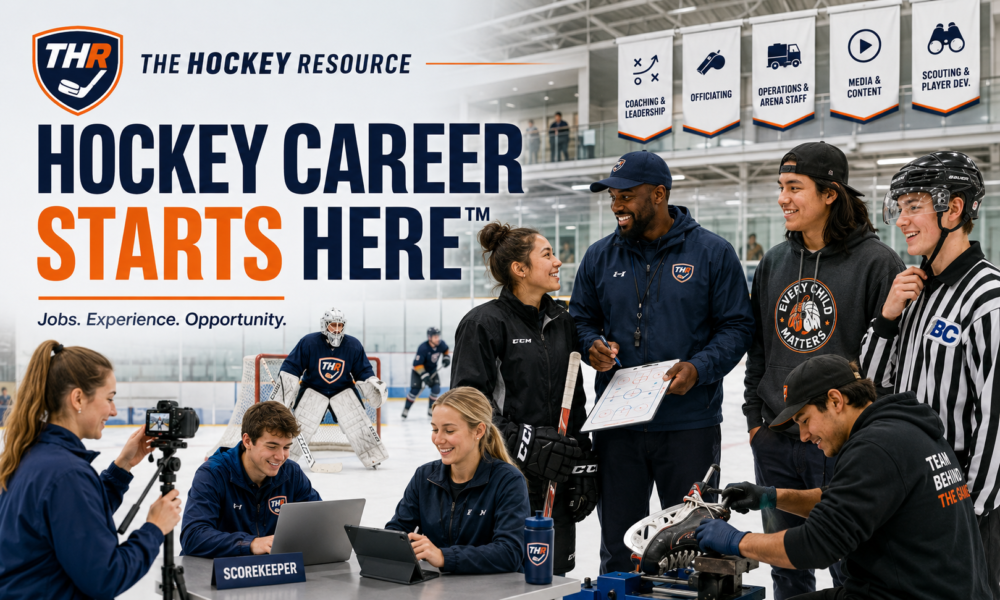
A teenager who loves hockey does not have to wait until playing days are over to start working in the game.
In fact, some of the best first opportunities may already exist at the rink where they practice every week.
Youth teams need help.
Hockey schools need instructors and assistants.
Tournaments need workers.
Games need officials, scorekeepers and timekeepers.
Pro shops need staff.
Teams need photography, video, statistics and social media.
The challenge is usually not finding something that exists.
It is knowing where to start.
That is the first question in Hockey Career Starts Here™.
The Question: How Can a Teenager Get Their First Job in Hockey?
For most teenagers, the first hockey job will not come with an impressive title.
It might involve:
- Running the clock
- Refereeing younger players
- Helping at a hockey school
- Assisting a younger team
- Working tournament registration
- Taking photographs
- Filming games
- Entering statistics
- Helping in a pro shop
- Sharpening skates
- Working at an arena
- Posting scores or social media
- Setting up equipment
- Carrying boxes and doing whatever else needs doing
That last category deserves more respect than it usually receives.
A surprising number of careers begin with somebody becoming known as:
The young person who always shows up and helps.
Your First Hockey Job Probably Already Exists at Your Rink
Before searching job websites, start with the hockey world you already know.
Think about your regular arena.
Who
works there?
runs the pro shop?
sharpens skates?
operates the scoreboard?
organizes tournaments?
teaches younger players?
takes team photographs?
runs the hockey school?
manages the association?
updates the website?
produces the team’s social media?
Someone is doing every one of those jobs.
That means there may already be an opportunity to learn.
Start With People Who Already Know You
A young hockey player has one advantage over many other teenagers looking for their first job.
They may already know people working in the industry.
That could include:
- Coaches
- Managers
- Association volunteers
- Arena employees
- Referees
- Hockey-school instructors
- Tournament operators
- Equipment managers
- Pro-shop employees
- Team photographers
- Junior hockey staff
- Skills coaches
Do not approach them by saying:
“Can you get me a job?”
Try something closer to:
“I’m interested in learning more about working in hockey. If you ever need someone to help with practices, tournaments, games or other work around the rink, I’d like an opportunity to learn.”
That is a very different conversation.
You are not asking someone to create a career for you.
You are asking for a chance to start.
What Do Hockey Employers Want From a Teenager?
Probably not a ten-page résumé.
For most entry-level hockey jobs, employers and organizations are looking for much simpler qualities.
Show Up
If the shift starts at 7:00 a.m., arriving at 7:08 with a coffee and a complicated explanation will not create much confidence.
Reliability matters.
Be Early
Hockey operates on schedules.
Games start.
Practices start.
Teams arrive.
Ice rentals do not wait because somebody’s alarm clock negotiated an extension.
Being early immediately separates a young worker from many applicants.
Communicate
If something changes, tell the person responsible.
Respond to messages.
Ask questions when you do not understand something.
Confirm schedules.
Communication is one of the most transferable skills in hockey and in business.
Be Willing to Do Basic Work
Your first job may involve tasks nobody dreams about when imagining a career in professional sports.
You may carry equipment.
Move nets.
Hand out tournament packages.
Collect pucks.
Update scores.
Clean something.
Enter data.
Work an early morning.
That is normal.
The person who performs small jobs well is much more likely to be trusted with larger ones.
Learn
Ask why things are done.
Watch experienced people.
Notice how tournaments operate.
Observe how coaches communicate.
Pay attention to how arena staff solve problems.
Your first hockey job is also an education.
You Do Not Need to Stop Playing
One of the biggest advantages of starting young is that hockey work can often fit around playing.
A U16 or U18 player might:
- Help coach U7 once a week
- Referee younger games
- Run the clock between games
- Work occasional tournaments
- Assist at summer hockey schools
- Film games
- Help with social media
- Work weekend shifts at a pro shop
The objective is not necessarily to replace playing.
It is to begin developing another side of your hockey experience.
You can be a player and start learning the business at the same time.
Path #1: Help Coach Younger Players
Coaching is one of the most natural starting points for an older player.
A teenager may already understand:
- Basic skills
- Practice structure
- Dressing-room routines
- Hockey terminology
- What younger players find difficult
- What helped them when they were younger
That does not mean every teenager is ready to become a head coach.
It does mean they can potentially become a useful assistant or mentor under qualified adult supervision.
Depending on the organization and jurisdiction, formal training, registration, screening or certification requirements may apply.
In Canada, Hockey Canada’s coaching pathway includes formal NCCP training. Hockey Canada currently states that coaches can be designated NCCP Certified beginning at age 16, while some development opportunities can be available to 14- and 15-year-olds. Requirements also depend on the level being coached and the provincial or territorial Member.
Your First Step
Ask your association, former coach or local hockey school:
“Do any younger teams need an older player to help at practices?”
You are not asking to run the team.
You are asking to learn.
Path #2: Become an Official
Officiating may be one of the best ways for a young player to earn money while developing valuable skills.
Officials learn:
- Decision-making
- Confidence
- Rule knowledge
- Communication
- Conflict management
- Positioning
- Responsibility
They also see hockey differently.
Once you have stood in the middle of a game trying to make an immediate decision while coaches, players and several remarkably well-informed spectators offer conflicting legal opinions, you may develop a new appreciation for officiating.
Certification and age requirements vary.
For example, USA Hockey currently has no overall minimum age for officials, although state child-labour rules may affect younger officials. New USA Hockey officials begin through its registration and certification process.
Canadian officials should check their provincial Hockey Canada Member and local association for the applicable pathway.
Your First Step
Search your local hockey association or governing body’s website for:
Become a hockey official
Then find the next certification opportunity.
Path #3: Work Hockey Tournaments
Tournaments can be excellent entry points because they need many people during concentrated periods.
Possible jobs include:
- Registration
- Scorekeeping
- Timekeeping
- Team check-in
- Tournament headquarters
- Game reporting
- Awards
- Photography
- Video
- Social media
- Statistics
- Arena support
Tournament work can also expose a teenager to something players rarely see.
The business behind the games.
Someone has to organize schedules, employees, officials, facilities, teams, payments, communications and problems.
Watching that system operate can be valuable career experience.
Your First Step
Contact a local tournament operator several weeks before its next event.
Do not wait until Friday afternoon of tournament weekend.
Ask whether they use student workers or volunteers.
Path #4: Work at a Hockey School
Hockey schools often need additional help, particularly during summer and school breaks.
An older player may begin by:
- Demonstrating drills
- Helping younger players
- Moving pucks
- Setting up stations
- Supervising activities
- Assisting instructors
- Helping players get organized
These jobs can eventually lead toward coaching or skills instruction.
They also teach something many talented players initially underestimate:
Knowing how to perform a skill and knowing how to teach it are different abilities.
Your First Step
Contact hockey schools you have attended or instructors who already know you.
Ask about assistant opportunities for upcoming camps.
Path #5: Start in Equipment
Some players know more about sticks, skates and equipment than any reasonable person should.
Fortunately, hockey has managed to turn that obsession into employment.
Entry points can include:
- Pro-shop work
- Skate sharpening
- Equipment repair
- Inventory
- Team equipment assistance
- Dressing-room preparation
Learning proper skate sharpening requires training and supervision.
So does equipment repair.
Do not watch three videos and announce yourself as the area’s new blade technician unless you would like to become extremely unpopular with your teammates.
Your First Step
Talk to the manager of your local pro shop.
Ask whether they hire students and whether they train employees in equipment service.
Path #6: Use Your Phone or Camera for Something Productive
Young players have grown up around video and social media.
That can become an advantage.
Teams, leagues, tournaments and hockey schools increasingly need people who can:
- Take photographs
- Film games
- Edit video
- Produce highlights
- Create graphics
- Write captions
- Update websites
- Conduct interviews
- Publish scores
- Create short-form content
You do not need to begin with an NHL team.
Start with a local one.
Your First Step
Create three or four examples of your work.
Then approach a team or hockey organization and show them what you can produce.
A small portfolio is more convincing than saying:
“I’m really good at social media.”
Path #7: Work With Statistics and Analytics
Not every hockey career requires being the loudest person in the room.
Some begin with a spreadsheet.
Young people interested in mathematics, statistics, data or programming can learn by tracking things such as:
- Shots
- Scoring chances
- Faceoffs
- Zone entries
- Special teams
- Player usage
- Possession
- Game results
Advanced hockey analytics is much more complicated than counting shots.
But counting accurately is still a reasonable place to begin.
Your First Step
Choose one measurable part of a hockey game.
Track it accurately for several games.
Then learn how more advanced analysts measure and interpret that area.
Should Your First Hockey Job Be Paid?
Sometimes.
Sometimes not.
There is an important distinction between volunteering to gain legitimate experience and organizations continually expecting young people to provide valuable labour for nothing.
A teenager might reasonably volunteer occasionally to:
- Learn a role
- Help a younger team
- Build experience
- Support a community organization
- Explore whether they enjoy the work
However, regular work that would normally be performed by an employee may be subject to employment laws, minimum-age requirements and wage rules.
Those requirements vary considerably by province, state and type of work.
Parents and teenagers should check the applicable employment rules before accepting ongoing work.
The goal is to gain experience.
It is not to become hockey’s smallest unpaid operations department.
Do You Need a Résumé?
Eventually, yes.
For a very first informal opportunity, a connection and conversation may be enough.
However, creating a simple one-page résumé is worthwhile.
Include:
Contact Information
Use appropriate personal contact information.
For younger teenagers, parents should remain involved where necessary.
Hockey Experience
Include:
- Teams
- Levels played
- Years in hockey
- Relevant camps or programs
Do not turn this into a statistical argument proving you deserved more power-play time.
The employer wants to understand your hockey background.
Work or Volunteer Experience
Include any experience involving:
- Coaching
- Officiating
- School activities
- Community work
- Tournaments
- Camps
- Customer service
- Technology
- Media
Skills
Examples might include:
- Video editing
- Photography
- Social media
- Microsoft Office or Google Workspace
- Graphic design
- Statistics
- Skate sharpening
- First aid
- Second languages
Certifications
Include relevant qualifications such as officiating, coaching, first aid or other training.
The Most Important Hockey Career Skill May Be Your Reputation
Hockey is a surprisingly small world.
People talk.
That can work against you.
It can also become an enormous advantage.
A teenager who earns a reputation for being:
- Reliable
- Respectful
- Hard-working
- Curious
- Honest
- Helpful
- Prepared
may begin receiving opportunities without constantly searching for them.
A tournament director tells an arena manager.
A coach recommends you to a hockey school.
An instructor introduces you to another team.
One job leads to another.
That is networking before anybody starts calling it networking.
Do Not Expect Your Hockey Connections to Carry You
Knowing someone can open a door.
It cannot make you useful once you walk through it.
A coach might provide your first opportunity because they know your family.
After that, your performance matters.
Be careful about approaching hockey employment with the attitude:
“I’ve played at a high level, so I already know hockey.”
Playing hockey teaches you part of the business.
It does not automatically teach you:
- Management
- Coaching
- Customer service
- Finance
- Marketing
- Leadership
- Officiating
- Facility operations
- Communication
Those are separate skills.
Respect the people who already know how to do the job.
Parents: Help Without Taking Over
Parents can help teenagers recognize opportunities.
They
can make introductions.
help with transportation.
can review a résumé.
can make sure working conditions are appropriate.
What parents should avoid doing is conducting the entire job search themselves.
A teenager asking:
“Do you ever hire students to help with your hockey school?”
is beginning to develop confidence.
A parent conducting the entire conversation while the teenager stands silently beside them is developing something else.
Whenever age and circumstances allow, let the young person speak.
Hockey Organizations: Stop Asking Only for Volunteers
There is another side to this question.
Hockey organizations constantly need people.
Yet many do very little to develop the people who may eventually run the game.
Older players could be introduced to:
- Coaching
- Officiating
- Tournament operations
- Communications
- Equipment
- Administration
- Statistics
- Player development
Instead of simply asking:
“Who can volunteer Saturday?”
organizations should sometimes ask:
“Who are we developing to run hockey ten years from now?”
Those are very different questions.
Your First Hockey Job Does Not Determine Your Career
A teenager who begins scorekeeping does not have to become a professional scorekeeper.
Someone who starts refereeing does not have to become an NHL official.
Your first job simply exposes you to another side of hockey.
Maybe you discover you love coaching.
Perhaps tournament operations interests you.
Media might become your thing.
Equipment could lead somewhere unexpected.
You may discover that working at 6:00 a.m. hockey schools is absolutely not your life’s calling.
That information has value too.
A Seven-Step Hockey Job Starter Plan
If you are a teenager interested in working in hockey, start here.
1. Pick Three Areas That Interest You
For example:
- Coaching
- Officiating
- Media
Do not try to investigate 25 careers simultaneously.
2. Identify Five Local Hockey Contacts
Think about:
- Your association
- Your arena
- A hockey school
- A tournament operator
- A pro shop
3. Ask About Entry-Level Opportunities
Explain that you are looking to learn.
4. Check Required Training
Some positions require certification, registration, screening or minimum ages.
Confirm those requirements before assuming you are eligible.
5. Create a Simple Résumé
Keep it to one page.
6. Accept a Reasonable First Opportunity
Do not reject a useful learning opportunity because the title is unimpressive.
7. Build Your Reputation
Show up.
Work.
Learn.
Ask what else needs doing.
That last step is where careers often begin.
The Hockey Resource Takeaway
The first hockey career decision does not have to happen after Junior, college or professional hockey ends.
It can begin much earlier.
A teenager can play hockey while also learning how the game operates beyond the ice.
Coach younger players.
Become an official.
Work tournaments.
Help at a hockey school.
Learn equipment.
Create media.
Track statistics.
Work around the arena.
Start small.
Become useful.
Build relationships.
Learn how hockey actually works.
The first job might last one weekend.
The experience could influence the next 40 years.
You don’t have to stop playing hockey to start working in hockey.
That is why your Hockey Career Starts Here™.
YOUR FIRST STEP
Before the end of this week:
Choose one area of hockey that interests you besides playing.
Then contact one person already doing that job and ask:
“How did you get started, and what could someone my age do to begin learning?”
One conversation can open the first door.
HOCKEY CAREER STARTS HERE™
YOU DON’T HAVE TO STOP PLAYING HOCKEY TO START WORKING IN HOCKEY.
Explore opportunities.
Learn new skills.
Build experience.
Develop leadership.
Discover where hockey can take you.
THE HOCKEY RESOURCE™
WE MAKE BETTER HOCKEY PEOPLE.
As always, thank you for being part of The Hockey Resource Community.
AMAZON Hockey
NEW Tournament Search APP
https://play.google.com/store/apps/details?id=com.hockeyresource.hockeytournamentapp&hl=en_CA&pli=1
NEW!!! The Hockey Moments Cards
GUMROAD – eBooks
https://thehockeyresource.gumroad.com
SEE My Interview with the Mental Health Academy
SEE My Interview on Podcast with Constant Sports
https://www.youtube.com/watch?v=_8VJUTfAGp
The Hockey Resource
https://thehockeyresource.com/category/blog/hockey-career-starts-here