THE HOCKEY RESOURCE – A Bad Outcome Does Not Automatically Mean a Bad Decision.™
THE HOCKEY RESOURCE – Mistakes are unavoidable in hockey. Players lose pucks, miss assignments, choose the wrong passing option, mishandle rebounds and occasionally make decisions that lead directly to goals against.
The mistake itself, however, does not guarantee development.
A mistake becomes valuable only when the player can understand what happened, examine the available options and return to the same situation better prepared.
THE HOCKEY RESOURCE – That transformation is the coach’s responsibility.
Great coaches do not remove accountability. They create an environment where accountability produces understanding instead of embarrassment—and where players remain confident enough to keep thinking, competing and attempting difficult plays.
Players Cannot Develop While Trying to Avoid Every Mistake
A player who is afraid of making mistakes may appear disciplined, but fear can quietly remove creativity from the player’s game.
The player may:
- Move the puck before reading the play
- Avoid carrying it through pressure
- Stop attempting difficult passes
- Remain outside competitive areas
- Look toward the bench after every decision
- Play to avoid criticism instead of trying to create an advantage
That is not intelligent hockey. It is protective hockey.
THE HOCKEY RESOURCE – Our Player Positive™ article on building confidence makes the same essential point: confidence develops when players experience challenges, attempt solutions and discover that one unsuccessful play does not define them.
Coaches must create enough emotional safety for players to experiment while maintaining enough structure to help them learn.
Mistakes Are Information
THE HOCKEY RESOURCE – A mistake tells the coaching staff that something requires further attention. It does not automatically reveal why the play failed.
The player may have:
- Misread the situation
- Failed to see an opponent
- Executed the right idea poorly
- Received incomplete information
- Chosen a reasonable option that produced an unfortunate result
- Misunderstood the team’s expectations
- Lacked sufficient practice in that situation
Those possibilities require different coaching responses.
Calling a decision “careless” assumes the player was not paying attention or did not care enough. That may be completely inaccurate. It also assigns a negative personal quality before the coach understands what the player actually saw.
Describe the play. Do not negatively define the player.
Evaluate the Decision Before Judging the Outcome
Before criticizing a player’s decision, the coach should ask:
- What information was available to the player?
- What was the player trying to accomplish?
- Were reasonable alternatives available?
- Was the decision consistent with the team’s plan?
- Would we still criticize the decision if the outcome had been favourable?
THE HOCKEY RESOURCE – That final question matters.
Hockey people frequently judge identical decisions differently based entirely on what happened next. A pass through the middle may be praised as creative when it produces a breakaway and condemned as irresponsible when it is intercepted.
The outcome deserves attention, but it cannot be the only evidence used to evaluate the decision.
One difficult game also does not define a player. That principle is explored further in Why One Hockey Game Never Defines a Player.
Ask Before You Correct
Instead of immediately telling the player what went wrong, begin with a question:
“What did you see on that play?”
Then listen.
The player’s answer may reveal that the player:
- Recognized the correct opportunity
- Missed an important piece of information
- Misunderstood the team’s plan
- Saw something the coach could not see from the bench
- Had the right idea but lacked the skill to execute it
- Panicked because of pressure or fear of criticism
USA Hockey recommends using questions to draw understanding from players, rather than constantly supplying instructions from the bench.
Once the coach understands the player’s thinking, the feedback becomes more accurate.
Three Better Coaching Responses
When the decision was reasonable
“That was a reasonable decision. The outcome didn’t work, but I want you to continue recognizing that opportunity.”
This protects the player’s decision-making confidence while acknowledging the result.
When another option may have been better
“I understand what you saw and what you were trying to accomplish. Let’s review the other option that was available and when you might recognize it next time.”
This introduces another choice without humiliating the player.
When the player missed important information
“Now that we’ve reviewed it, what could you look for earlier next time?”
This asks the player to identify the future cue. The player becomes involved in solving the problem instead of merely receiving criticism.
Record the Player’s Response
The coach or assistant coach should take a few seconds to record the player’s answer.
A simple note might say:
Second period breakout: player did not see the weak-side winger. Review shoulder checks and early scanning during practice.
This accomplishes two things.
First, it prevents the coaching staff from repeatedly criticizing a player without providing meaningful practice opportunities.
Second, it helps identify patterns. If the same issue continues, the staff knows what must be taught—not simply what must be mentioned again.
If the head coach must continue managing the game, the player can speak with an assistant coach. The assistant records the response and brings the learning point back to the staff.
The mistake then becomes part of the development plan.
Not Every Correction Belongs During the Game
Coaches should ask whether immediate feedback will improve the player’s next shift.
For younger players, particularly from U7 through U13, too much bench instruction can create confusion. The player may still be processing one correction while the game presents several new situations.
Some older players also find that constant in-game correction damages their confidence and prevents them from playing naturally.
A player should be able to tell the coach:
“During the game, too much feedback makes me overthink. Could we review those plays in practice?”
That is not necessarily resistance to coaching. It may be useful information about how the player learns.
Immediate feedback remains appropriate when:
- Safety is involved
- The player does not understand the rules
- The team requires one short tactical adjustment
- The same urgent issue is affecting the next shift
- The player asks for clarification
Otherwise, the coach can record the play and return to it later.
Use Video and Practice to Complete the Lesson
Many youth games are now recorded by parents, team volunteers or coaching staff. That makes practice a better environment for reviewing complicated decisions.
Video allows the coach and player to pause the play and examine:
- The player’s position
- Available passing lanes
- Pressure from opponents
- Teammate support
- The team’s tactical plan
- What became visible as the play developed
The coach can then recreate the situation during practice.
This is where real development occurs:
Game situation → player explanation → video review → practice activity → improved recognition
A speech identifies the problem. A properly designed practice teaches the solution.
USA Hockey’s article on correcting young players’ mistakes similarly emphasizes that correction must match the child and the situation.
Feedback Must Change With the Player’s Age
U7 and U9
Keep feedback short, positive and specific.
“Good try. Next time, look up before passing.”
Avoid long tactical explanations. Young players need repetition, encouragement and opportunities to try again.
Hockey Canada’s U9 development model emphasizes active, age-appropriate, skill-centred environments that provide children with more opportunities to participate and learn.
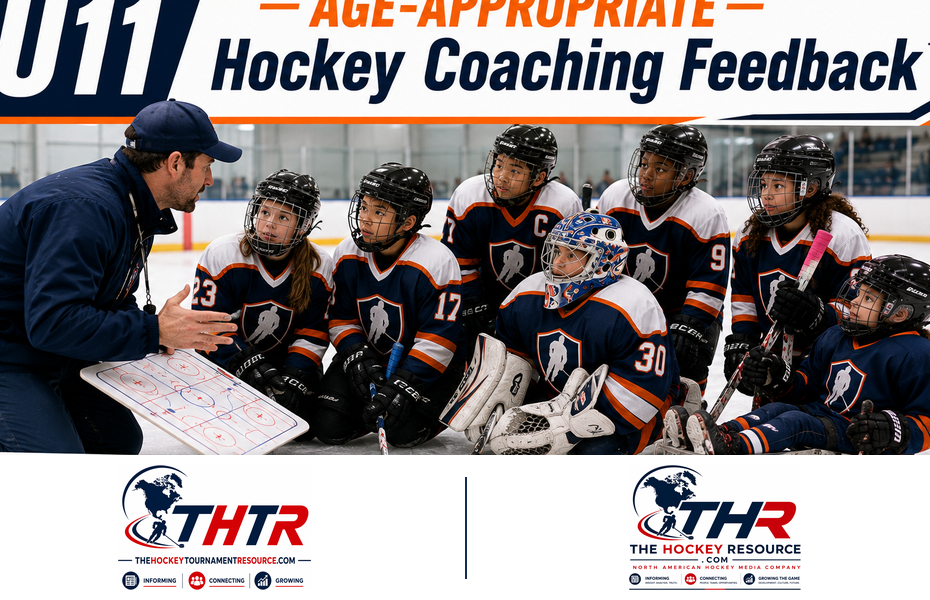
U11 and U13
Begin asking simple decision questions.
“What did you see?”
“What other option was available?”
“What could you check before receiving the puck?”
Players at these ages can begin connecting information, options and outcomes—but the conversation should remain brief and understandable.
U15 and U18
Players can participate in deeper tactical review.
Ask them to examine:
- Risk and reward
- Time and score
- Teammate positioning
- Opponent pressure
- Team structure
- Repeated decision patterns
Older players should gradually become capable of evaluating their own performances. The coach’s objective is not to make players dependent on instructions; it is to develop players who can recognize and solve problems themselves.
USA Hockey publishes additional age-specific skill progressions that coaches can use when turning game errors into appropriate practice activities.
Emotional Safety Is Not an Absence of Standards
Creating a safe learning environment does not mean ignoring repeated mistakes, poor effort, disrespect or failure to follow team expectations.
Players still require:
- Clear standards
- Honest feedback
- Appropriate consequences
- Repetition
- Individual responsibility
- Commitment to improvement
The difference lies in how those standards are communicated.
A strong coach can say:
“We have reviewed this situation before. Tell me what prevented you from applying what we practised.”
That is direct accountability.
Public embarrassment, sarcasm and personal labels are not accountability. They distract from learning and may teach players to conceal mistakes rather than confront them.
Hockey Canada’s Fair Play Code for Coaches specifically directs coaches not to ridicule or yell at players for making mistakes or performing poorly.
Coaches Must Model the Same Standard
If players are expected to learn from mistakes, coaches must demonstrate the same behaviour.
After a difficult game, a coach should ask:
- Did I prepare the team properly?
- Were my instructions clear?
- Did I provide too much information?
- Did practice recreate the decisions players faced?
- Did my bench communication help or create anxiety?
- Did I judge a decision only by its outcome?
- What should I change before the next game?
This aligns with our wider leadership principle that resilient organizations develop people without emotionally exhausting them.
When coaches acknowledge their own errors, they do not surrender authority. They demonstrate what responsible improvement looks like.
Strong Players Help Teammates Recover
Mistake-friendly cultures cannot depend entirely on the coach.
Players should learn to respond constructively when a teammate makes an error:
- Stay engaged in the play
- Help repair the situation
- Avoid negative gestures
- Offer useful communication
- Encourage the next effort
- Discuss the play respectfully afterward
This strengthens team connection and supports the sense of belonging described in People Need to Feel They Belong.
Strong players do not merely recover from their own mistakes. They help teammates recover too.
The Hockey Resource™ Leadership Position
Mistakes do not automatically build hockey players.
Well-coached mistakes build hockey players.
Growth happens when the player:
- Feels safe enough to attempt the play.
- Receives an opportunity to explain the decision.
- Understands why the outcome occurred.
- Identifies another available option.
- Practices recognizing the situation again.
- Returns to competition with confidence and greater awareness.
Great coaching does not eliminate mistakes.
It turns mistakes into information, information into practice and practice into improvement.
Don’t teach players to fear the next mistake. Teach them how to make a better next decision.