
Top 5 Mistakes That Could Cost Your Team the Game
Whether you play Hockey at the novice level or in the NHL, no Player ever wants to make a mistake that could cost your team the game.
Hockey is one of the best Team sports around, and unfortunately, one mistake can determine the outcome of the game.
Some of these mistakes are out of your control, so this article will focus on the mistakes that you can prevent. Here are the top 5 mistakes that could cost your Team the game, in no particular order:
Taking Shifts That Are Too Long
It’s one of the first things we learn in minor Hockey: keep your shifts short! There is a reason why NHL players keep their shifts between 45 and 90 seconds. We all know what it feels like to hit the ice in a close game. We want to be the hero or the difference maker.
This might mean we push a little harder and end up staying out on the ice a bit longer than usual. An extra 30 seconds or even a minute can’t hurt, can it?
The rest of your Team may stay out a bit longer each shift, resulting in a tired bench. Nobody can catch their breath and recover for their next shift.
You might be thinking, “Let the kids play!”. And you’re probably right. But minor Hockey is also where we built routines and good habits on and off the ice.
Learning to be disciplined with your shifts at a young age will only make it easier at more competitive levels later on!
Over/Under Passing the Puck
Passing is the quintessential skill that is learned at an early age in hockey. Without good passing skills, it’s difficult to succeed in this ultimate Team sport.
So what do we mean by over- or under-passing the puck? Over-passing the puck is something we see more in older players.
We all see the fancy tic-tac-toe plays that the pros can pull off and want to emulate that on the ice. But too many passes in tight space will usually lead to an interception, a wayward pass, or a failed shot.
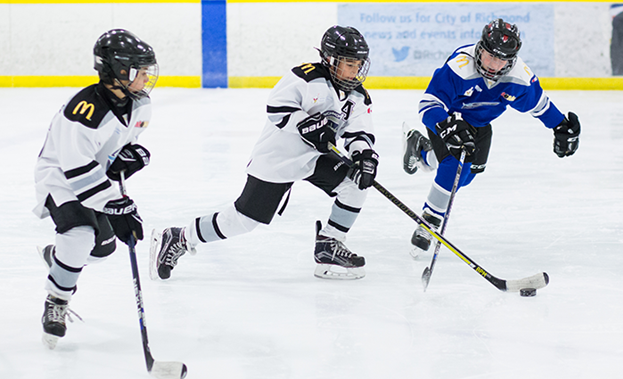
Under-passing the puck is much more common among younger players. Inexperienced Hockey players can panic more when holding the puck, and their first instinct is to just fire it at the net.
This is a great example of under-passing, which can lead to predictable offensive sequences. If the goalie and defense know that each possession will just be an immediate shot, they don’t have to worry about defending against passes.
This makes it much easier for them to block the shot or to allow the goaltender a clear path to see it and make an easy save.
Lack of Communication
Another thing that can plague younger or inexperienced players is a lack of communication. If you aren’t confident on the ice, there’s a good chance you won’t be too vocal either. This includes calling for the puck and warning your teammates about the other Team’s players.
In any Team sport, communication with your teammates is integral to success, and Hockey is no different. A little communication can go a long way.
Whether it is facilitating a breakout or calling out to your defenseman to reverse the puck to an empty wing, it is these simple things that can make or break the outcome of the game.
Unlike passing, there is no such thing as over-communication, so always be vocal with your teammates both on the ice and on the bench.
Stay Disciplined
Discipline on the ice can affect us at any level. What do we mean by discipline? Usually in Hockey, it refers to keeping your emotions in check and not retaliating against an opponent.
How many times have we seen an undisciplined penalty sway the momentum of a game?
Is it possible to stay disciplined and steer away from taking unnecessary penalties?
Yes, but of course, we’re all wired differently. In a tight game, emotions can always get the better of us. But when it comes to kids, it’s important to explain that taking penalties can be detrimental to the Team’s success.
Again, it might not mean as much at the novice or atom level, but once you get to competitive levels, a bad penalty can not only result in a goal against but also emotionally deflate your entire team.
Trust Your Teammates
Finally, we get to one of the more important lessons to learn in Hockey: trust your teammates.
If you don’t trust one of your teammates, it can be a serious handicap against your Team when they are on the ice. Remember, at the end of the day, minor Hockey is about balancing fun with skill development.
What’s a good example of this? Even at the lowest levels of minor Hockey, some players excel from a young age. Now what if this Player does not feel confident in passing to a particular teammate who might not be as skilled?
If these two are ever on the ice together, it effectively makes it a 5-on-4 for the other team. Your Team will always be one Player short because they won’t be passed to.
This is a simple example, but not trusting your teammates in any situation can lead to costly giveaways and mistakes. It can also hurt the team psychologically and, worst of all, undermine that teammate’s confidence and enjoyment.
There will always be stronger and weaker players on the ice. It’s important to include all of your teammates and trust them with the puck, just as they would trust you.
Part of being a good teammate is forgiving them for making a mistake, not preventing them from ever getting the puck in the first place.
As always, thank you for being part of The Hockey Resource Community.
AMAZON Hockey
NEW Tournament Search APP
https://play.google.com/store/apps/details?id=com.hockeyresource.hockeytournamentapp&hl=en_CA&pli=1
NEW!!! The Hockey Moments Cards
GUMROAD – eBooks
https://thehockeyresource.gumroad.com
SEE My Interview with the Mental Health Academy
https://thehockeyresource.com/category/blog/hockey-career-starts-here
SEE My Interview on Podcast with Constant Sports