
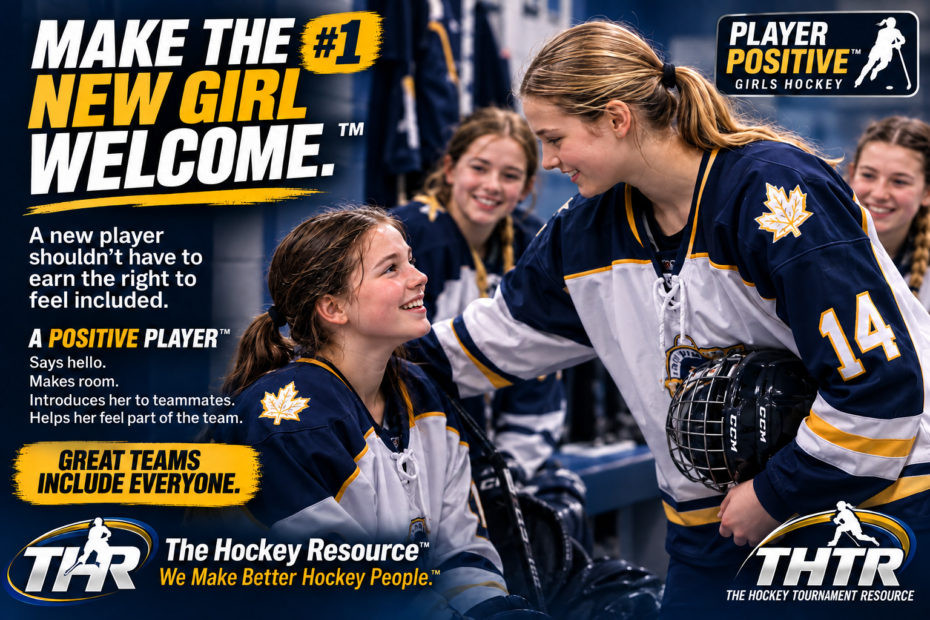
Girls Hockey inclusion can begin with something as simple as noticing a new teammate and making sure she does not feel alone.
For a U7–U10 player, joining a new Hockey Team can be exciting and intimidating at the same time. Other girls may already know one another from school, previous Teams or earlier seasons. The dressing room may feel familiar to everyone except the newest player.
A Positive Player™ can change that experience quickly.
Sometimes it starts with four simple words:
“Come sit with us.”
This lesson fits directly into The Hockey Resource™ PLAYER POSITIVE™ collection, which focuses on helping young Hockey players develop confidence, character, resilience and positive Team habits.
Girls Hockey inclusion starts with belonging
At U7–U10, girls are learning much more than skating, passing, shooting and positioning.
They are also discovering how to become teammates.
Imagine arriving at the rink and seeing other players talking together, sitting beside friends and following Team routines that you do not yet understand. Even choosing where to put your equipment can feel uncomfortable when everything is new.
Hockey Canada’s Esso Fun Days program was specifically designed to introduce girls and women to Hockey in a fun, positive and welcoming environment while helping participants experience Team spirit and develop confidence.
That welcoming attitude should continue after the introductory program ends and a girl becomes part of a Team.
What can a Positive Player™ do?
Young players do not need a complicated lesson in social behavior.
A Positive Player™ can introduce herself when someone new arrives, make room beside her in the dressing room, explain a Team routine or invite her to join an activity before practice.
During a drill, she might help the new player understand where to line up. Away from the ice, simply including her in conversation can make the rink feel less unfamiliar.
These small actions support the same Team-first principles discussed in PLAYER POSITIVE™ – Teamwork Turns Talent Into Success. Strong Hockey Teams become better when players encourage one another, communicate and help teammates gain confidence.
Girls Hockey inclusion does not require everyone to be best friends
Friendships are one of the great benefits of youth Hockey.
Players naturally become closer to certain teammates. Some attend the same school, live nearby or have already played together for several seasons.
There is nothing wrong with close friendships.
The problem begins when friendship becomes exclusion.
At U7–U10, the lesson can remain very simple:
You can have your best friends and still include everyone.
A new teammate does not need every girl on the Team to become her closest friend. She does need to feel that she is welcome, respected and part of the group.
USA Hockey describes its inclusion work as building a welcoming Hockey community for participants across different races, genders and backgrounds.
For young players, that broad principle can begin with one teammate noticing another girl.
Small actions can create a better Hockey experience
Welcoming a new player usually does not require a grand gesture.
Say hello.
Make room.
Ask her a question.
Show her where the Team goes before practice.
Invite her to join the group.
Help her understand something she has not seen before.
Young players may forget the score of a game very quickly, but feeling accepted or excluded can stay with them much longer.
That is one reason girls Hockey inclusion matters at the youngest ages. The objective should not only be getting girls onto the ice. We also want them enjoying the experience enough to keep coming back.
Hockey Canada tells associations hosting Esso Fun Days to create a fun, safe and positive Hockey experience, encourage new friendships and provide participants with a pathway toward continued registration.
Players can help create that pathway too.
Coaches should notice welcoming behavior
At U7–U10, leadership should never be defined only by Hockey ability.
The fastest skater is not automatically the best leader.
Neither is the highest scorer.
A Coach should also notice the girl who welcomes someone new, encourages a nervous teammate, helps another player understand a drill or recognizes when somebody is standing alone.
Those actions matter because Team culture begins forming at very young ages.
They also reinforce an important lesson in PLAYER POSITIVE™ – Character Shows When Nobody Is Watching: leadership can be demonstrated through everyday behavior rather than titles or recognition.
No captain’s letter is required to say:
“Come with us.”
Parents can help without giving a lecture
Parents can reinforce girls Hockey inclusion with one simple question.
After practice, try asking:
“If a new girl joined your Team and didn’t know anybody, what could you do to make her feel welcome?”
Then listen.
Your daughter might suggest sitting beside her, introducing her to another player, helping with equipment or inviting her to join an activity.
There does not need to be a perfect answer.
The purpose is to encourage a young player to begin noticing how somebody else might be feeling.
Parents looking for more support around the decisions and experiences surrounding youth Hockey can also explore Hockey Parent Intelligence™, which focuses on helping families make better-informed Hockey decisions.
Girls Hockey inclusion can begin before the first puck drops
Not every important Hockey lesson happens during a game.
Sometimes character appears while players are getting dressed.
Sometimes leadership happens in the hallway.
Sometimes Teamwork begins when someone moves her equipment bag six inches and makes room for another girl.
None of those moments appear on a scoresheet.
They still matter.
A young player who learns to notice other people is developing something Hockey can help teach for life.
The PLAYER POSITIVE™ challenge
At the next practice, encourage your young player to look around.
Is somebody new?
Does a teammate seem nervous?
Is anyone standing by herself?
Does someone appear unsure about what happens next?
A Positive Player™ does not need an adult to organize every act of kindness.
She can simply take the first step.
Say hello.
Make room.
Invite her in.
Then go play Hockey together.
The Hockey Resource™ answer
At U7–U10, girls Hockey inclusion does not need to be complicated.
Young players can begin learning that wearing the same jersey means looking out for one another.
The new girl should not have to prove she deserves to belong.
She joined the Team.
Help her feel like part of it.
Make the new Girl Welcome™
Because great teammates do more than play together.
They make each other want to come back.
PLAYER POSITIVE™
The Hockey Resource™
We Make Better Hockey People.™
FAQ
Why is girls Hockey inclusion important at U7–U10?
Young players are developing friendships and learning Team behavior at the same time they are developing Hockey skills. Feeling welcomed can help a new player become comfortable and enjoy participating.
Does every player need to be friends with every teammate?
No. Close friendships naturally develop within Teams. Positive Team culture means treating every teammate respectfully and avoiding deliberate exclusion.
How can a young player welcome a new teammate?
Say hello, make room beside her, introduce her to teammates, explain Team routines and invite her to participate.
What can Coaches do to encourage inclusion?
Recognize players who demonstrate kindness, encouragement and leadership instead of rewarding only Hockey performance.
What can parents do?
Ask age-appropriate questions that encourage a child to think about how a new teammate might feel.