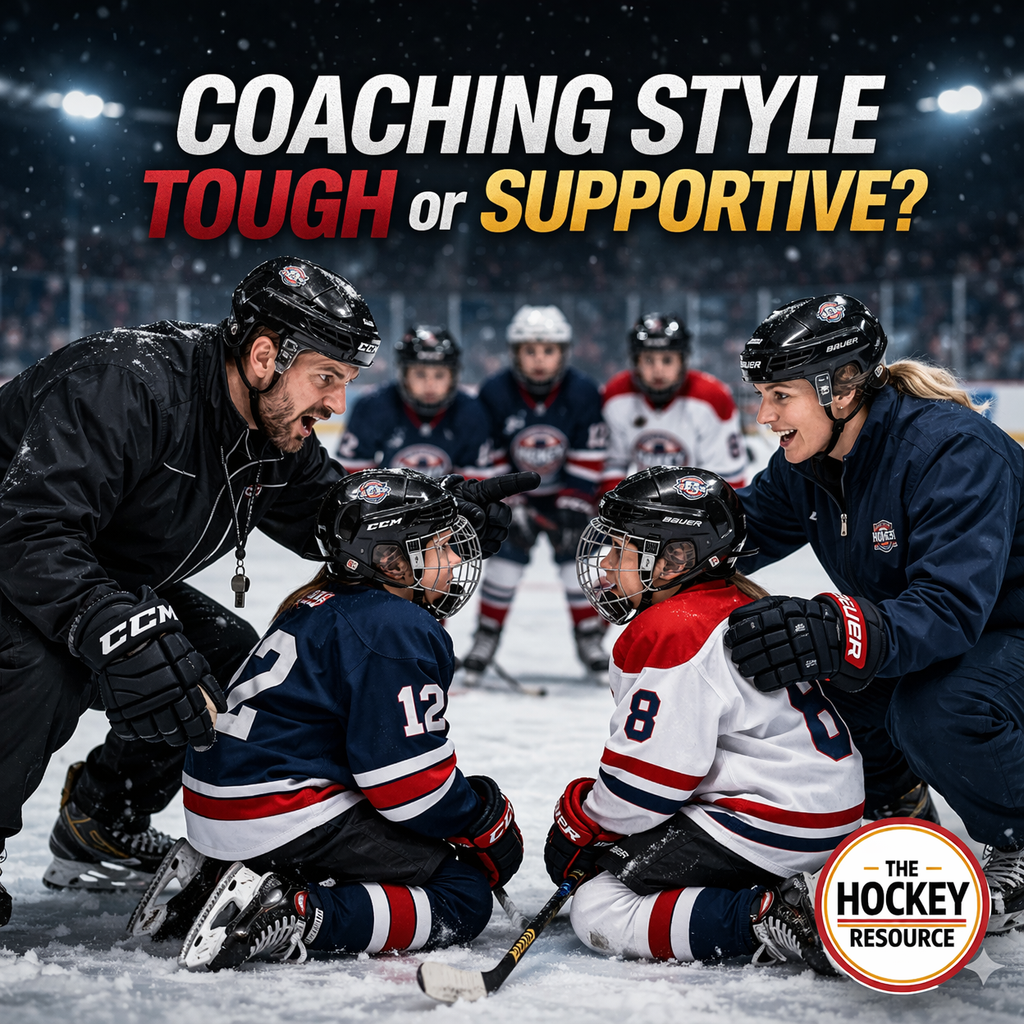

COACHING Leadership BRAIN™ – Turning Hockey Adversity Into Growth
COACHING – Winning can temporarily hide weaknesses in leadership. Losing exposes them.
After a difficult game, players watch their coach closely. They notice the coach’s expression, tone, body language, words, and decisions. Before the coach delivers any lesson, the players are already learning from how that coach responds.
A youth hockey coach therefore has two responsibilities after a loss:
- Help the team understand what happened.
- Demonstrate how responsible leaders respond to disappointment.
COACHING – The Post-Loss Leadership Framework™
1. Regulate Before You Respond
The coach’s first responsibility is emotional control.
Do not address the team while angry, embarrassed, or focused on the officials. Take a moment, lower the emotional temperature, and decide what the players actually need.
Calm leadership is not passive leadership. It allows the coach to be direct without becoming destructive.
2. Protect the Person—Correct the Performance
Mistakes must be addressed, but the player must not be personally diminished.
The leadership distinction is simple:
- “You are careless” attacks the player.
- “That was a careless decision with the puck” identifies the behavior.
- “Here is the better option” begins the teaching.
Strong leaders create accountability while preserving dignity.
3. COACHING – Separate Results From Standards
A team can lose while meeting important development standards. It can also win while playing below their standards.
After every game, coaches should evaluate controllable standards:
- Did we compete?
- Did we communicate?
- Did we support teammates?
- Did we respond appropriately to mistakes?
- Did we maintain discipline?
- Did we execute what we practiced?
- Did we remain connected when momentum changed?
The score matters, but it is not the complete evaluation.
4. Share Responsibility
Leadership credibility grows when coaches evaluate themselves honestly.
The coach should ask:
- Did I prepare the players properly?
- Were my expectations clear?
- Did I manage the bench effectively?
- Did I make useful adjustments?
- Did my communication help the team remain composed?
- What must I teach better?
Saying, “I need to prepare us better for that situation,” does not surrender authority. It models accountability.
5. Convert the Loss Into a Plan
The postgame conversation should be short. The meaningful response comes through the next practice.
A productive sequence is:
Observe → Identify → Teach → Practise → Reassess
If the team struggled with defensive zone exits, teach and practice them. If players lose composure, create controlled-pressure situations that require communication and decision-making. If compete level declined, use purposeful competitive drills.
The loss supplies information. Leadership turns that information into development.
6. Reconnect the Team
Losing can produce blame, fear, frustration, and division. Coaches must deliberately reconnect the group.
Players should leave the experience understanding:
- We are still one team.
- Mistakes will be corrected.
- Responsibility belongs to everyone.
- Nobody will be publicly sacrificed.
- Tomorrow provides another opportunity to improve.
That is how a healthy culture survives adversity.
The 24-Hour Leadership Rule™
This could become a practical tool inside the program.
Immediately after the game:
Stabilize emotions and communicate one or two clear observations.
Later that day:
Review the game objectively. Separate facts from frustration.
Before the next practice:
Choose no more than two development priorities.
At the next practice:
Teach the correction and give players an opportunity to succeed.
After practice:
Close the loss. Carry the lesson forward—not the emotional baggage.
Age-Specific Leadership Adjustments
| Age | Post-loss leadership priority |
|---|---|
| U7–U9 | Reassurance, enjoyment, effort and belonging |
| U11 | Simple lessons, positive correction and emotional control |
| U13 | Accountability, team habits and learning from decisions |
| U15 | Honest review, shared responsibility and resilience |
| U18 | Performance analysis, preparation, ownership and recovery |
The same speech should not be delivered to every age group. Leadership must match the players’ developmental and emotional readiness.
As always, thank you for being part of The Hockey Resource Community.
AMAZON Hockey
NEW Tournament Search APP
https://play.google.com/store/apps/details?id=com.hockeyresource.hockeytournamentapp&hl=en_CA&pli=1
NEW!!! The Hockey Moments Cards
GUMROAD – eBooks
https://thehockeyresource.gumroad.com
SEE My Interview with the Mental Health Academy
https://thehockeyresource.com/category/blog/hockey-career-starts-here
SEE My Interview on Podcast with Constant Sports
https://www.youtube.com/watch?v=_8VJUTfAGp
The Hockey Resource
As always, thank you for being part of The Hockey Resource Community.
AMAZON Hockey