
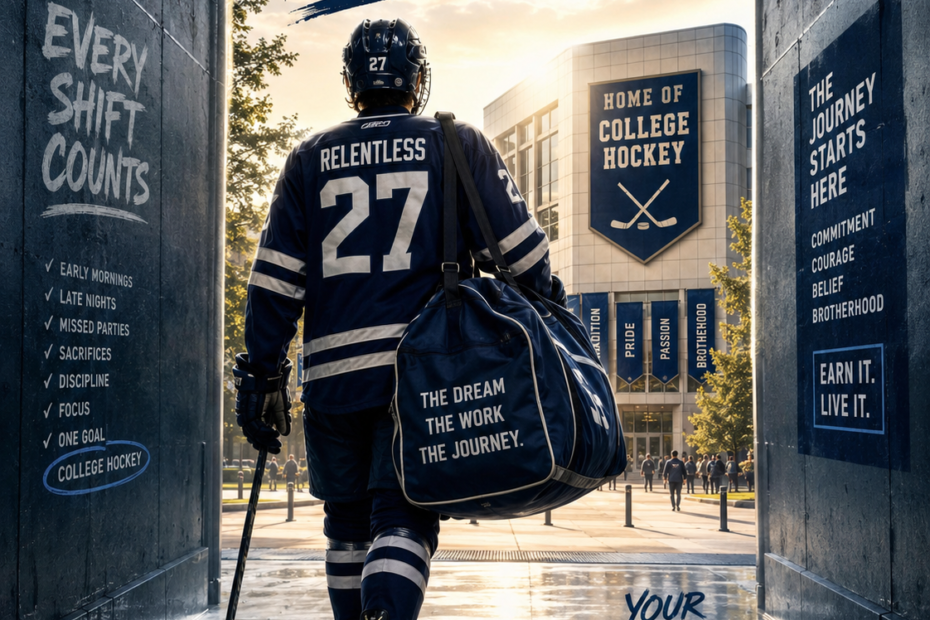
For many Hockey families, a College commitment feels like the destination.
The years of early mornings, travel, development, and uncertainty finally led to a moment that looks like success. A coach calls. An offer is made. A commitment is announced.
- It feels like security.
- It feels like the path is set.
- But here is the reality most families only fully understand later:
A commitment is not the finish line. It is a conditional opportunity.
And the difference between those two things matters more than anything that comes after.
The First Truth: A Commitment Is Not a Guarantee
- This is the most important concept for parents to understand.
- Even after a verbal commitment — and sometimes even after signing — nothing about college hockey is guaranteed in the way families often assume.
Players still have to:
- continue developing
- stay healthy
- perform consistently
- meet academic standards
- fit into the program’s evolving needs
Programs also change.
- Coaches change.
- Recruiting classes change.
- The roster needs to change.
- Team direction changes.
What felt certain at 16 or 17 can look very different by the time a Player actually arrives on campus.
Verbal Commitments Are Built on Trust, Not Protection
- Most NCAA Hockey commitments begin as verbal agreements.
- They are based on mutual trust between the Player and the program.
- But they are not binding.
- This creates a reality that many families underestimate:
A verbal commitment can change on either side.
- Programs may adjust recruiting priorities. Players may reconsider their options. Situations evolve over time.
- While many commitments hold, families need to understand that until an NLI is signed and the player arrives on campus, the situation can still shift.
The Second Truth: Decommitments Happen More Than Families Think
This is one of the most uncomfortable parts of the process, and it is rarely discussed openly.
Decommitments happen.
Sometimes the player chooses to move in a different direction. Sometimes the program changes its plan. Sometimes the fit simply no longer works.
For families, this can feel shocking, especially if they believed the commitment was locked in.
But within college hockey, it is not unusual.
The key is understanding that development is not linear. Players change. Programs change. Timing changes.
The families who handle this best are the ones who stay flexible rather than assuming the process is complete too early.
The Third Truth: Scholarships Are Not Always What They Seem
One of the biggest misconceptions in hockey is around scholarships.
Unlike some sports, NCAA hockey operates with limited scholarship distribution. Most programs divide scholarships across the roster.
That means:
- many players receive partial scholarships, not full rides
- scholarship amounts can change year to year
- aid is often tied to performance, role, and team needs
- Families sometimes hear “scholarship” and assume full financial coverage.
- In reality, the financial structure can be far more nuanced.
- This is why it is critical to understand:
- exact scholarship percentage
- duration of the offer
- renewal conditions
- academic aid vs athletic aid
Clarity upfront prevents confusion later.
The Fourth Truth: You Are Committing to a Situation That Will Change
- When a player commits, they are often committing years in advance.
- At that moment, the program looks a certain way.
But by the time the player arrives:
- the roster may be different
- the coaching staff may have changed
- the team’s style may have evolved
- the depth chart may be deeper than expected
- This is one of the biggest adjustments families face.
- They commit to a vision, but they arrive in a reality that has shifted.
That does not mean the decision was wrong. It means the environment is dynamic.
The Fifth Truth: Playing Time Is Never Promised
- Every recruit is valued during the process.
- But once players arrive on campus, the environment changes immediately.
- Everyone was a top player somewhere.
- Everyone was recruited.
- And now everyone is competing for ice time.
- Parents sometimes expect that a commitment includes a clear role or guaranteed opportunity
- It does not!
- Ice time is earned daily.
- Lineups change.
- Development takes time.
- Some players adjust quickly. Others need longer.
- Understanding this ahead of time helps families avoid unnecessary frustration.
The Sixth Truth: Development Does Not Stop After Commitment
One of the biggest mistakes players make after committing is subconsciously relaxing.
The thinking becomes:
“I made it.”
But in reality:
The real work is just beginning.
Committed players still need to:
- improve skating and pace
- build strength
- refine decision-making
- adapt to higher levels of competition
- Programs are constantly evaluating.
- The gap between junior hockey and NCAA hockey is significant.
- Players who continue to push their development arrive ready.
- Players who plateau often struggle early.
The Seventh Truth: Fit Matters More Than Status
Families are often drawn to:
- program reputation
- division level
- brand recognition
Those factors matter, but they should not outweigh fit.
The most successful players usually choose environments where:
- their playing style matches the system
- they have a realistic development path
- the coaching staff aligns with their needs
- the academic environment fits their goals
A “smaller” program with the right fit often leads to a better experience than a “bigger” program where the player struggles to find a role.
What Smart Families Do Differently
The families who navigate NCAA commitments successfully tend to approach the process with a different mindset.
They do not treat a commitment as the end.
They treat it as a transition.
They:
- ask detailed questions before committing
- understand scholarship structure clearly
- evaluate long-term fit, not just short-term excitement
- stay flexible as situations evolve
- continue prioritizing development after committing
Most importantly, they stay grounded.
They celebrate the opportunity without assuming everything is locked in.
What Parents Should Be Asking Before Committing
Strong families ask direct, specific questions.
Not confrontational — but clear.
Examples include:
- Where does my player realistically fit in your lineup?
- What is your development plan for this position?
- How is the scholarship structured over time?
- What happens if coaching staff changes?
- How do players typically progress in your program?
- What support exists academically and off the ice?
These conversations help remove ambiguity.
Clarity reduces risk.
The Emotional Reality Families Experience
This process is emotional.
- Pride.
- Relief.
- Excitement.
- Pressure.
- Uncertainty.
Parents often feel all of it at once.
The key is managing that emotion without letting it drive decisions.
A commitment should feel exciting — but it should also feel right.
Those are not always the same thing.
Final Thoughts
NCAA hockey commitments are one of the most important milestones in a player’s career.
- But they are also one of the most misunderstood.
- They are not guarantees.
- They are not final outcomes.
- There are opportunities within a system that continues to evolve.
- Families who understand that — who approach the process with clarity, patience, and long-term thinking — are far better positioned to navigate what comes next.
Because the truth is simple:
The commitment is just the beginning. What happens after matters far more.
https://thehockeyresource.com/about-us/
https://thehockeyresource.com/your-advisors/
As always, thank you for being part of The Hockey Resource Community.
AMAZON Hockey
NEW Tournament Search APP
https://play.google.com/store/apps/details?id=com.hockeyresource.hockeytournamentapp&hl=en_CA&pli=1
NEW!!! The Hockey Moments Cards
GUMROAD – eBooks
https://thehockeyresource.gumroad.com
SEE My Interview with the Mental Health Academy
https://thehockeyresource.com/category/blog/hockey-career-starts-here
SEE My Interview on Podcast with Constant Sports
https://www.youtube.com/watch?v=_8VJUTfAGp