
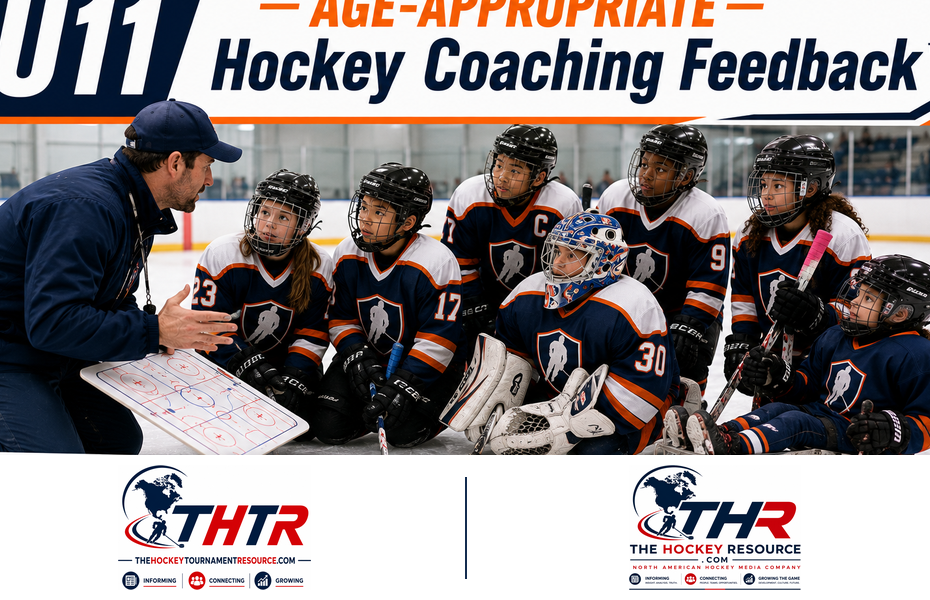
The Hockey Resource – Ask What the Player Saw Before Correcting
The Hockey Resource – A Bad Outcome Does Not Automatically Mean a Bad Decision.™
The Hockey Resource U11 represents an important transition in hockey development.
Players are becoming capable of recognizing teammates, opponents, pressure and available space. They can begin explaining what they were trying to accomplish—but they still need guidance connecting what they saw with the decision they made.
This is where coaches must resist immediately supplying the answer.
Before saying what the player should have done, ask:
“What did you see?”
That simple question can reveal whether the player made a poor decision, missed important information, attempted the right play unsuccessfully or made a reasonable decision that produced an unfortunate outcome.
At U7, coaches correct less and encourage more. At U9, players begin recognizing what happened.
The Hockey Resource – At U11, the coach begins exploring the player’s thinking.
U11 Players Are Beginning to Read the Game
The Hockey Resource – U11 players are nine and ten years old. They are still refining fundamental skills, but their understanding of team play is expanding.
They can begin recognizing:
- Where pressure is coming from
- Which teammates are available
- Where open ice may develop
- Whether to pass, carry or protect the puck
- When to support the puck carrier
- Where a rebound may travel
- How one decision affects the next play
The Hockey Resource AND Hockey Canada identifies U11 as a Learn to Play stage focused on progressive and meaningful skill development.
The objective is not to make every U11 player think exactly like the coach.
The objective is to help players gather information and make increasingly informed decisions.
The Hockey Resource “What Did You See?” Must Be a Genuine Question
Coaches sometimes ask questions after already deciding the player was wrong.
The conversation may sound like this:
“What did you see there?”
The player begins answering.
“Because you obviously didn’t see the defender.”
That was not a question. It was criticism disguised as a question.
If coaches want honest answers, they must listen before correcting.
The player may say:
- “I saw our winger moving.”
- “I thought the defender was going toward the middle.”
- “I didn’t see anyone open.”
- “I was trying to pass before I got checked.”
- “I thought I could skate around the defender.”
- “I panicked.”
- “I didn’t know what to do.”
Each response gives the coach different information.
USA Hockey describes this player-centred approach as pulling understanding from players instead of continually pushing instructions toward them.
The U11 Feedback Method: Ask, Listen, Clarify, Retry
1. Ask
Begin with one neutral question:
“What did you see?”
Do not include the expected answer inside the question.
2. Listen
Allow the player to finish.
Do not interrupt because the player’s explanation differs from the coach’s interpretation.
3. Clarify
Ask one useful follow-up:
“What were you trying to accomplish?”
Or:
“Where was the pressure coming from?”
4. Retry
Create another opportunity during practice.
“Let’s recreate it. This time, look over your shoulder before the puck arrives.”
Ask. Listen. Clarify. Retry.
The conversation identifies the learning need. Repetition turns it into development.
The Player May Have Made a Reasonable Decision
A completed play is not automatically a good decision. An unsuccessful play is not automatically a bad one.
Imagine a U11 player sees an open teammate and attempts the correct pass. The puck bounces, the teammate cannot control it and the opposition gains possession.
The outcome was unsuccessful, but the player may have:
- Looked before receiving
- Recognized the correct option
- Passed at the appropriate time
- Followed the team’s plan
The execution requires work. The decision may not.
The coach can say:
“You recognized the available teammate. That was a reasonable decision. Let’s work on delivering that pass more accurately.”
This protects the behaviour the coach wants repeated while still addressing the skill that needs improvement.
Our Player Positive™ confidence principle recognizes that players need opportunities to attempt difficult plays without believing an unsuccessful result automatically makes the attempt wrong.
Separate Four Different Coaching Problems
Before giving U11 feedback, determine what kind of problem occurred.
1. Recognition Problem
The player did not see important information.
“What could you look for before receiving the puck?”
2. Decision Problem
The player saw the information but selected an option unlikely to succeed.
“You saw the defender. What other option was available?”
3. Execution Problem
The player recognized and selected a reasonable option but could not complete the skill.
“The idea was right. Let’s practise making that pass while moving.”
4. Understanding Problem
The player did not understand the team’s expectation.
“Let’s review where our support should be during the breakout.”
These problems require different practice solutions.
Calling every unsuccessful play a “bad decision” prevents the coach from diagnosing what actually requires development.
Avoid Questions That Feel Like Blame
Some questions immediately place players on the defensive:
- “Why did you do that?”
- “What were you thinking?”
- “How did you not see that?”
- “Why won’t you listen?”
- “How many times do we need to tell you?”
These questions usually express adult frustration rather than curiosity.
Better U11 questions include:
- “What did you see?”
- “What were you trying to accomplish?”
- “Where was the pressure?”
- “Which options did you notice?”
- “What could you look for earlier?”
- “Would you make the same choice again?”
- “What would help you recognize that situation?”
The coach does not need to ask every question after one play. Select the question that will reveal the most useful information.
Keep Game Feedback Short
U11 players can understand more than U9 players, but that does not mean every shift requires a discussion.
Players returning to the bench need time to:
- Recover physically
- Watch the game
- Process the previous shift
- Communicate with teammates
- Prepare for their next opportunity
The head coach may provide one short cue:
“Before the puck arrives, check where the pressure is coming from.”
If a longer conversation is required, record the play and return to it during practice.
Constant bench correction can produce players who look toward the coach before making decisions. The objective should be the opposite: players who recognize situations independently.
Allow Players to Express How They Receive Feedback
Some U11 players appreciate immediate instruction. Others become anxious or distracted when corrected after every shift.
A player may say:
“When I get a lot of instructions during the game, I start thinking too much.”
The coach should not automatically interpret that statement as resistance.
The player may be identifying a legitimate learning preference.
The coach can respond:
“I’ll keep game feedback to one short cue. We can review the rest during practice.”
This does not allow the player to avoid accountability. It creates a more effective time and method for delivering it.
Strong organizations build resilient players without emotionally exhausting them.
Use the Assistant Coach When the Game Must Continue
The head coach may need to manage:
- Line changes
- Matchups
- Injuries
- Officials
- The next faceoff
- The rest of the bench
That is not the best moment for a detailed player conversation.
An assistant coach can ask:
“What did you see?”
The assistant should listen, record the response and return attention to the game.
A short note might say:
Player attempted middle pass because winger appeared covered. Did not see weak-side support. Recreate during practice.
The coaching staff can then decide whether the situation requires:
- Individual instruction
- A small-group conversation
- Video review
- A practice activity
- A team-wide teaching point
The mistake becomes development information rather than an emotional bench reaction.
Introduce Short Video Review Carefully
U11 players can begin benefiting from short video examples, but review sessions should remain focused.
One clip may be enough.
Pause the video before the decision and ask:
- “What information is available?”
- “Where is the pressure?”
- “Who is supporting the puck?”
- “What options can you see?”
Then allow the clip to continue.
Do not use video primarily to prove the coach was right. Use it to help the player see information that was difficult to recognize at game speed.
Video should support the conversation, not turn into a public presentation of one player’s mistakes.
Recreate the Situation in Practice
A coach who identifies a mistake but does not provide a practice solution has completed only half the job.
If the player struggled to recognize pressure, create an activity requiring shoulder checks.
If the player did not support the puck carrier, design a small-area game that rewards close support.
If the player forced a pass through traffic, create a game that provides multiple passing and possession options.
Hockey Canada reports that small-area games help players read, react and adapt to changing situations.
The learning sequence should be:
Game observation → player explanation → coaching clarification → practice recreation → another decision
Hockey Canada’s U11 framework recommends that approximately 85% of practice time focus on skills and tactics, leaving only a limited portion for team play and systems.
Give Players Choices During Practice
A drill with only one predetermined outcome teaches players to follow a route. It may not teach them to read the game.
U11 practices should include situations where players can choose to:
- Pass
- Skate
- Protect the puck
- Shoot
- Delay
- Move into support
- Recover defensively
The coach can change pressure, space and player numbers to create different information.
Hockey Canada’s small-area-game resources provide a useful framework for creating game-like repetitions with more puck involvement and decision opportunities.
Players learn decision-making by making decisions—not by memorizing the coach’s preferred answer to every situation.
Record What the Player Understood
After asking what the player saw, record the response when it reveals a recurring development need.
A simple U11 development record can include:
- Situation
- Player’s explanation
- Information recognized
- Information missed
- Practice activity
- Follow-up date
- Progress observed
Example:
Situation: Defensive-zone retrieval
Player saw: Forechecker approaching
Player missed: Teammate available behind the net
Practice focus: Shoulder check before retrieval
Follow-up: Player recognized both options in next small-area activity
This gives the coaching staff evidence of development over time.
It also prevents coaches from repeatedly making vague statements such as “improve your hockey IQ” without identifying what the player must learn to recognize.
Accountability Still Matters at U11
Listening to the player does not mean accepting every explanation without question.
If the player understood the expectation but chose not to apply it, the coach can respond directly:
“You understood the play. What prevented you from following through?”
If effort, respect or safety is involved, the coach should reinforce the standard calmly and consistently.
There is an important difference between:
- A player attempting a difficult skill
- A player making an uninformed decision
- A player lacking the skill to execute
- A player deliberately ignoring a team expectation
- A player acting unsafely or disrespectfully
Good coaching identifies the difference before deciding on the response.
Parents Should Ask About the Player’s Thinking
Parents can support U11 decision development without becoming the second coach.
Instead of saying:
“You should have passed on that two-on-one.”
Ask:
“What did you see on that play?”
Then listen without correcting every detail.
Other useful questions include:
- “Which play did you feel good about?”
- “Was there a decision you would like to try again?”
- “What did you notice as the game continued?”
- “Is there something you want to practise?”
The player may not want to analyze the game immediately. Parents should respect that.
As explained in The Scoreboard Doesn’t Define You, one result cannot provide a complete assessment of a developing player.
Signs U11 Feedback Is Working
Effective U11 feedback produces players who increasingly:
- Explain what they were trying to accomplish
- Recognize more than one option
- Separate decisions from execution
- Ask questions without fear
- Apply practice learning during games
- Recover from unsuccessful plays
- Continue attempting creative solutions
- Evaluate their own decisions honestly
- Accept accountability without losing confidence
The player will still make mistakes.
The difference is that the player will gradually understand why they happened and what information could help next time.
The Hockey Resource™ U11 Coaching Standard
Before correcting a U11 player, ask what the player saw.
Listen carefully enough to determine whether the problem involved recognition, decision-making, execution or understanding.
Then provide one useful cue and recreate the situation during practice.
Do not use questions to trap players.
Use questions to help players think.
“What did you see?”
“What were you trying to accomplish?”
“What could you look for earlier next time?”
At U11, the coach should begin transferring part of the thinking process to the player.
The objective is not to produce players who always wait for the coach’s answer. It is to develop players who increasingly recognize the answer themselves.
AMAZON Hockey
https://thehockeyresource.com/discount-hockey-products-amazon
NEW Tournament Search APP
https://play.google.com/store/apps/details?id=com.hockeyresource.hockeytournamentapp&hl=en_CA&pli=1
NEW!!! The Hockey Moments Cards
thehockeytournamentresource.com
GUMROAD – eBooks
https://thehockeyresource.gumroad.com
SEE My Interview with the Mental Health Academy
SEE My Interview on Podcast with Constant Sports