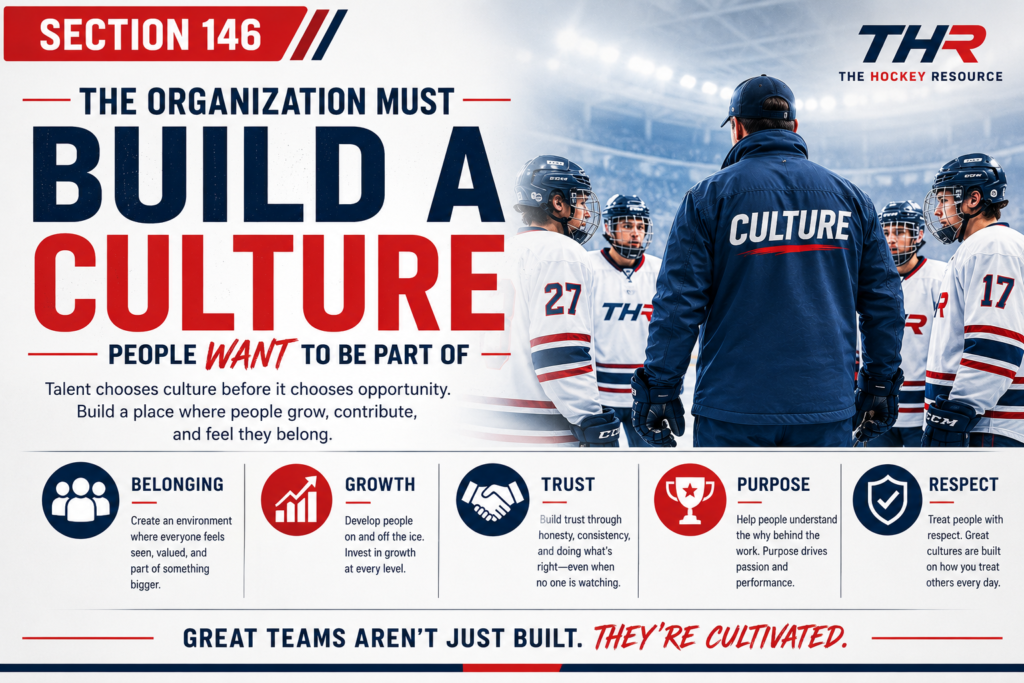
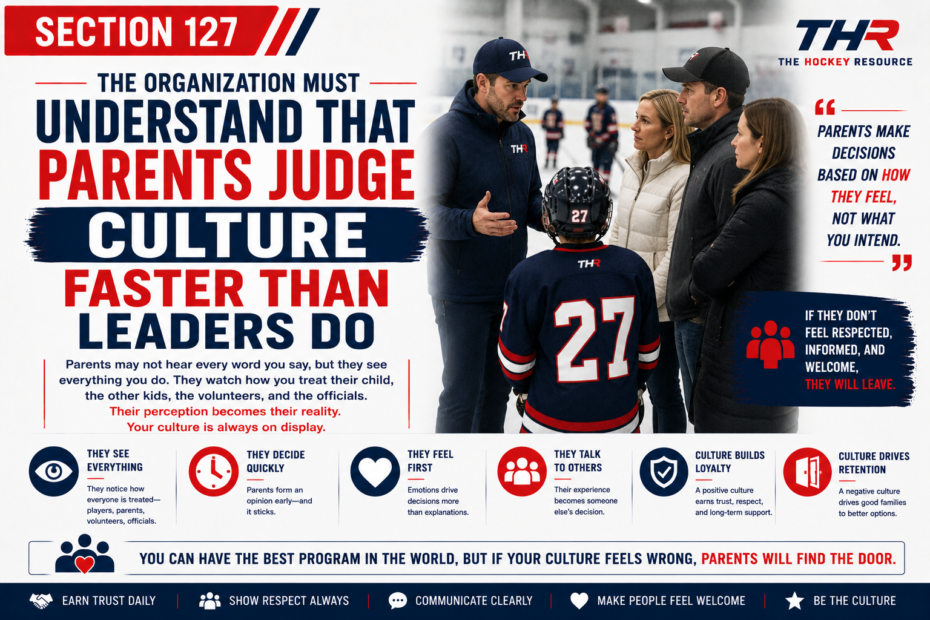
SECTION 73 — THE ORGANIZATION MUST UNDERSTAND THAT CULTURE IS WHAT PEOPLE EXPERIENCE WHEN NO ONE IS PERFORMING
One of the greatest misunderstandings in hockey organizations:
culture is not branding.
Culture is not:
slogans
posters
mission statements
social media graphics
or speeches at banquets
Real culture is:
what people experience:
when everyday organizational life is happening normally.
Culture reveals itself through:
communication
emotional behavior
leadership reactions
accountability
conflict handling
pressure situations
and daily interaction
Strong organizations understand:
culture is not:
what the organization CLAIMS to value.
Culture is:
what the organization repeatedly NORMALIZES.
WHAT CULTURE ACTUALLY MEANS
Culture is:
the emotional and behavioral operating environment people experience consistently.
Examples:
how people treat each other
how pressure is handled
how mistakes are treated
how leadership behaves
how accountability feels
and whether communication creates:
trust
or
fear
Culture shapes:
how the organization FEELS emotionally.
People experience culture long before:
they can explain it intellectually.
IN SIMPLE TERMS
Culture is:
“What is it actually like to be part of this organization?”
THE BIGGEST CULTURE FAILURE IN HOCKEY
Many organizations confuse:
image
with:
culture.
Examples:
talking about family atmosphere while people feel emotionally unsafe
promoting development while coaching through fear
promoting teamwork while leadership internally divides
or advertising professionalism while communication remains chaotic
Eventually:
people trust:
their experience —
not organizational messaging.
Strong organizations understand:
culture must be:
operationally real,
not performative.
IMPORTANT REALITY
Culture is revealed most clearly during:
pressure,
conflict,
and adversity.
THE ROLE OF DAILY BEHAVIOR
Culture is built through:
repeated daily behavior.
Examples:
emotional tone at practices
communication style
leadership consistency
volunteer treatment
player interaction
and parent experience
Small repeated behaviors eventually become:
organizational norms.
Norms become:
culture.
Culture then shapes:
future behavior automatically.
THE ROLE OF LEADERSHIP
Leadership behavior defines:
organizational culture more than:
any written document.
People study:
emotional reactions
accountability consistency
communication habits
and conflict management constantly
Leadership teaches:
what behavior is:
acceptable,
rewarded,
ignored,
or protected.
Strong leaders intentionally model:
healthy culture visibly.
IN SIMPLE TERMS
Culture follows:
what leadership repeatedly allows and demonstrates.
THE ROLE OF COACHES
Coaches are:
daily culture carriers.
Players emotionally experience:
organizational culture through:
coaching behavior every day.
Healthy coaching culture includes:
respect
accountability
emotional control
communication
challenge
and support
Toxic coaching culture often includes:
fear
humiliation
emotional unpredictability
favoritism
and instability
Players remember:
coaching culture deeply.
IMPORTANT REALITY
Players often judge organizations emotionally based on:
their daily coach experience.
THE ROLE OF PARENTS
Parents also shape:
organizational culture significantly.
Examples:
spectator behavior
communication style
emotional maturity
respect for coaches
and interaction with other families
Strong organizations actively teach:
healthy parent culture.
Without guidance:
organizations often drift toward:
comparison,
politics,
and emotional tension.
Parent culture affects:
player experience directly.
THE ROLE OF ACCOUNTABILITY
Accountability defines:
whether culture is real.
If organizations claim:
respect matters
communication matters
professionalism matters
emotional stability matters
but unhealthy behavior repeatedly goes:
unaddressed
then:
culture weakens immediately.
Strong culture requires:
behavioral reinforcement consistently.
IN SIMPLE TERMS
Culture becomes real when:
standards still matter during uncomfortable situations.
THE DANGER OF “PERFORMANCE CULTURE”
Some organizations become highly focused on:
looking healthy publicly.
Examples:
polished presentations
strong social media
public positivity
and image management
while internally:
people feel:
emotionally exhausted
politically unsafe
frustrated
unheard
or disconnected
This creates:
performative culture.
Strong organizations prioritize:
real internal health over:
external image performance.
IMPORTANT REALITY
Organizations cannot fake healthy culture long-term.
People eventually experience the truth directly.
THE ROLE OF EMOTIONAL ATMOSPHERE
Culture is deeply emotional.
Healthy cultures feel:
calm
structured
respectful
emotionally safe
accountable
and connected
Toxic cultures feel:
tense
political
emotionally exhausting
fearful
unstable
or chaotic
People remember:
how organizations felt emotionally.
That becomes:
organizational reputation.
THE ROLE OF COMMUNICATION
Communication reveals:
culture quickly.
Healthy communication feels:
respectful
direct
emotionally disciplined
and solution-focused
Toxic communication feels:
sarcastic
reactive
unclear
dismissive
or emotionally volatile
Communication patterns become:
cultural identity over time.
IN SIMPLE TERMS
Culture is often visible simply by:
listening to how people speak to each other.
THE ROLE OF PRESSURE
Pressure exposes:
true culture.
When adversity appears:
organizations reveal:
whether standards survive
whether leadership remains stable
whether accountability stays fair
and whether emotional maturity truly exists
Healthy cultures remain:
recognizable under stress.
Weak cultures emotionally collapse during:
difficulty.
IMPORTANT REALITY
Real culture is not tested during easy seasons.
It is tested during:
hard seasons.
THE ROLE OF CONSISTENCY
Culture requires:
repetition and consistency.
One healthy meeting does not create:
healthy culture.
One emotional speech does not create:
healthy culture.
Healthy culture forms through:
thousands of repeated healthy moments over time.
Consistency transforms:
behavior into:
identity.
THE ROLE OF ORGANIZATIONAL SYSTEMS
Strong culture requires:
operational support.
Examples:
leadership standards
onboarding systems
communication protocols
accountability pathways
and cultural documentation
Without systems:
culture becomes:
personality-dependent.
Healthy systems protect:
healthy culture long-term.
IN SIMPLE TERMS
Culture survives longer when:
it becomes part of:
how the organization operates daily.
THE ROLE OF TRUST
Trust and culture are deeply connected.
People trust organizations more when:
culture feels:
stable
fair
emotionally healthy
and professionally led
Distrust grows where:
culture feels:
political,
fear-based,
or inconsistent.
Culture shapes:
organizational emotional safety directly.
THE ROLE OF LONG-TERM ORGANIZATIONAL HEALTH
Strong organizations ask:
What behavior are we normalizing?
What emotional atmosphere are people experiencing?
Does pressure strengthen or weaken our culture?
Are values operationally real?
Does leadership behavior match organizational messaging?
These questions create:
organizational self-awareness.
IMPORTANT REALITY
Culture is always developing —
intentionally or unintentionally.
THE ROLE OF LEGACY
Culture becomes:
organizational inheritance.
Future players,
future coaches,
future volunteers,
and future leaders
inherit:
whatever culture current leadership builds today.
This responsibility is enormous.
Strong organizations protect culture because:
culture eventually outlives:
individual people and seasons.
IN SIMPLE TERMS
Today’s culture becomes:
tomorrow’s organizational identity.
THE MOST IMPORTANT CULTURE QUESTION
Leadership should constantly ask:
“What emotional and behavioral experience are people consistently having inside this organization when nobody is trying to perform or impress anyone?”
That question reveals:
real culture immediately.
THE HARD TRUTH ABOUT CULTURE IN HOCKEY
Many organizations unintentionally weaken:
trust,
retention,
communication,
and player experience
because:
they focused more on:
appearing healthy
than:
operating healthily.
Strong organizations understand:
real culture is built through:
daily behavior,
emotional consistency,
healthy accountability,
and leadership maturity.
HOW STRONG ORGANIZATIONS BUILD REAL CULTURE
Strong organizations:
reinforce healthy behavior consistently
protect emotional stability
align leadership standards
improve communication
support healthy accountability
reduce fear-based leadership
and operationalize organizational values daily
Over time:
people begin experiencing the organization as:
trustworthy
healthy
supportive
structured
and emotionally safe
That becomes:
real organizational culture.
FINAL PRINCIPLE — CULTURE IS WHAT PEOPLE EXPERIENCE WHEN NO ONE IS PERFORMING
Strong hockey organizations understand:
culture is not:
marketing,
branding,
or public messaging.
Culture is:
the repeated emotional and behavioral experience people have inside the organization every day.
Because ultimately:
people determine whether culture is healthy not by:
what leadership says publicly.
They determine it by:
how
people are treated
leadership behaves
communication feels
pressure is handled
and whether the environment consistently feels:
safe,
respectful,
stable,
accountable,
and emotionally healthy over time.
PRESENTED BY: thehockeyresource.com and thehockeytournamentresource.com – mark@thehockeyresource.com
As always, thank you for being part of The Hockey Resource community.
CLICK LINK FOR AWESOME HOCKEY PRODUCTS – https://thehockeyresource.com/discount-hockey-products-amazon/
CLICK TO SEE MARK ON PODCAST https://www.buzzsprout.com/1824112/episodes/13519482
Mark Hetherman
Executive Director
The Hockey Resource
thehockeytournamentresource.com
As always, thank you for being part of The Hockey Resource Community.
AMAZON Hockey
NEW Tournament Search APP
https://play.google.com/store/apps/details?id=com.hockeyresource.hockeytournamentapp&hl=en_CA&pli=1
NEW!!! The Hockey Moments Cards
GUMROAD – eBooks
https://thehockeyresource.gumroad.com
SEE My Interview with the Mental Health Academy
https://thehockeyresource.com/category/blog/hockey-career-starts-here
SEE My Interview on Podcast with Constant Sports
https://www.youtube.com/watch?v=_8VJUTfAGp