
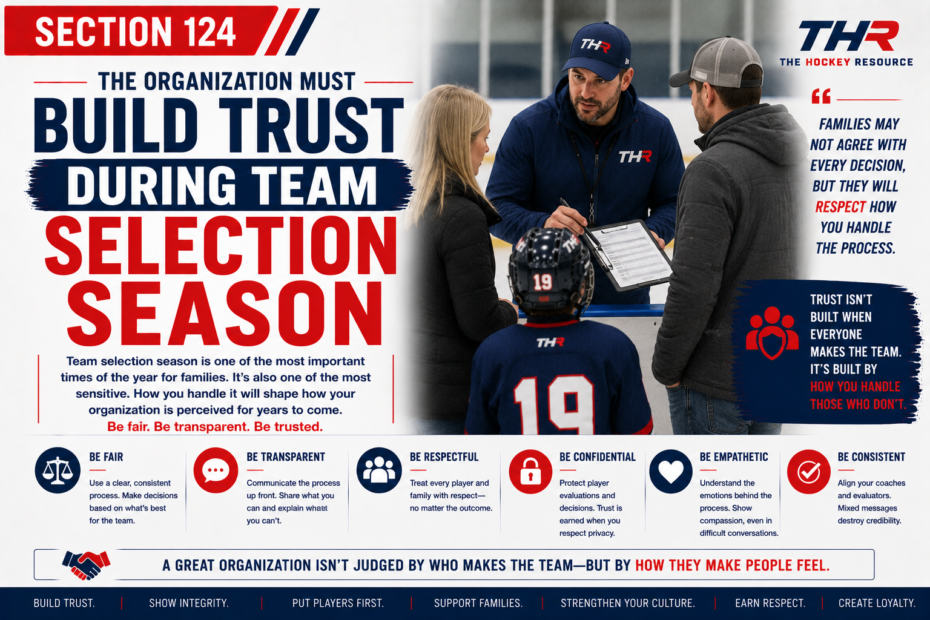
Few periods create more anxiety and Trust in youth hockey than team selection season.
Players feel pressure.
Parents feel uncertainty.
Coaches face difficult decisions.
Volunteers often find themselves answering questions from concerned families.
Regardless of how well an organization operates throughout the year, team selection season frequently becomes the moment when trust is tested.
That is why organizations should view evaluations and team formation not only as hockey decisions but also as leadership responsibilities.
The way the process is managed often influences trust long after teams have been finalized.
Most Families Want Fairness
Parents naturally hope their child will succeed.
Players want to make the team they have been working toward.
These emotions are normal.
While families may not always agree with outcomes, most want confidence that the process was fair.
Questions often arise when people do not understand how decisions were made.
For that reason, transparency matters.
Clear communication helps families understand expectations before evaluations begin rather than after disappointment occurs.
The Process Matters as Much as the Outcome
Organizations sometimes focus exclusively on final rosters.
However, many frustrations are connected to the process itself.
Were evaluation criteria communicated?
Were expectations clear?
Did participants understand how decisions would be made?
When the process feels organized and professional, trust tends to increase.
Conversely, confusion during evaluations often creates doubts about the results, even when decisions were made appropriately.
Communication Reduces Speculation
Silence creates uncertainty.
Uncertainty creates speculation.
Speculation creates frustration.
This pattern appears repeatedly during team selection season.
Families who understand timelines, procedures, and decision-making criteria are less likely to fill information gaps with assumptions.
Regular communication helps reduce anxiety while reinforcing confidence in the process.
As a result, organizations often experience fewer conflicts and fewer complaints.
Consistency Builds Credibility
Nothing damages confidence faster than inconsistency.
If evaluation standards appear different from player to player, questions emerge quickly.
If policies are applied unevenly, trust begins to weaken.
Strong organizations work hard to ensure that expectations are applied consistently throughout the evaluation process.
That consistency strengthens credibility even when difficult decisions must be made.
Respect Matters During Difficult Conversations
Not every player will receive the outcome they hoped for.
That reality makes communication especially important.
Families deserve respectful treatment.
Players deserve respectful treatment.
Difficult conversations should be handled professionally and thoughtfully.
The goal is not simply communicating a decision.
The goal is ensuring that individuals feel respected throughout the process.
Many families remember how a message was delivered long after they forget the exact details of the decision itself.
Evaluations Affect Organizational Reputation
Team selection season influences more than roster construction.
It also affects organizational reputation.
Families discuss experiences.
Players share impressions.
Community members observe how the process is managed.
Consequently, evaluations become a reflection of leadership, culture, and organizational values.
Organizations that handle team selection professionally often strengthen their reputation. Those who do not may spend months repairing damaged trust.
Leadership Must Prepare for Emotional Responses
Hockey is emotional.
Families invest significant time, energy, and resources into the game.
Because emotions are involved, disappointment should be expected.
Leadership should prepare for that reality rather than being surprised by it.
A thoughtful process, strong communication, and respectful interactions help create a foundation for productive conversations when difficult situations arise.
Preparation often prevents escalation.
Final Leadership Reality
Team selection season will never be completely stress-free.
The stakes feel important to players and families.
Disappointment is inevitable.
Questions are inevitable.
What matters is how leadership manages the process.
Organizations that communicate clearly, apply standards consistently, and treat people respectfully build trust even during difficult moments.
In the long run, trust in the process often becomes more important than agreement with every outcome.
One-Line Truth:
Families may not always agree with team decisions, but they are far more likely to trust decisions when they trust the process behind them.
This article is part of the Foundations of Modern Hockey Leadership series.
About The Hockey Resource
The Hockey Resource exists to help players, parents, coaches, teams, leagues, tournaments, and hockey organizations make better decisions through education, leadership, and community-focused resources.
For additional hockey leadership articles, hockey parent resources, tournament information, and industry insights, visit:
The Hockey Resource – https://thehockeyresource.com
The Hockey Tournament Resource – https://thehockeytournamentresource.com
Mark Hetherman
Executive Director
The Hockey Resource
As always, thank you for being part of The Hockey Resource Community.
AMAZON Hockey
NEW Tournament Search APP
https://play.google.com/store/apps/details?id=com.hockeyresource.hockeytournamentapp&hl=en_CA&pli=1
NEW!!! The Hockey Moments Cards
GUMROAD – eBooks
https://thehockeyresource.gumroad.com
SEE My Interview with the Mental Health Academy
https://thehockeyresource.com/category/blog/hockey-career-starts-here
SEE My Interview on Podcast with Constant Sports
https://www.youtube.com/watch?v=_8VJUTfAGp
TheHockeyResource.com