Most hockey organizations spend significant energy trying to attract new players.
Marketing campaigns are created.
Registration promotions are launched.
Community outreach efforts are expanded.
Meanwhile, far less attention is often given to a critical leadership question:
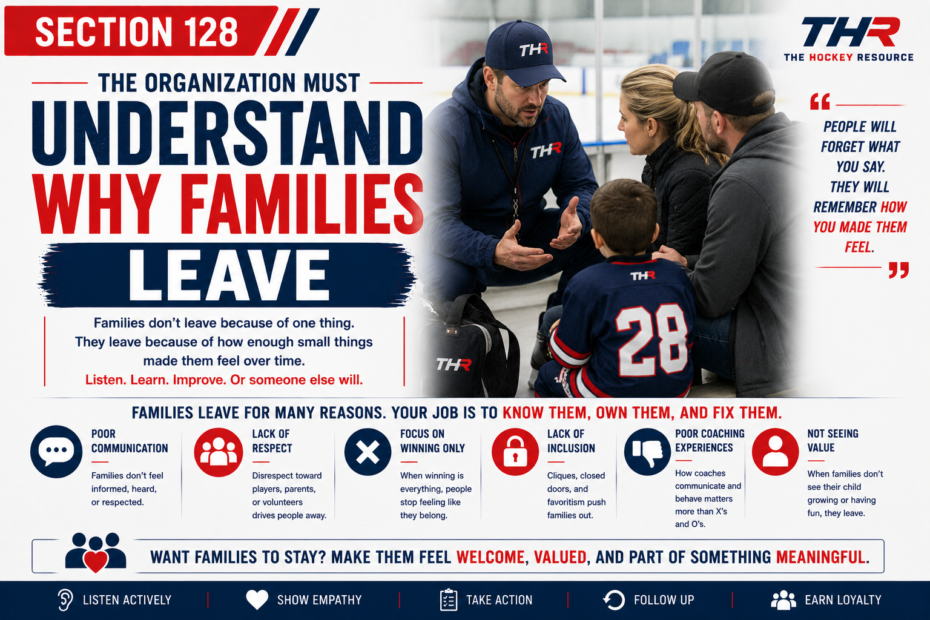
Why are families leaving?
Every player who leaves takes more than a registration fee with them.
The organization loses relationships.
It loses volunteers.
loses future coaches.
loses future board members.
loses advocates within the community.
For that reason, understanding family retention should be one of the most important priorities in organizational leadership.
Families Rarely Leave for One Reason
Leadership teams sometimes assume departures are caused by a single issue.
Ice time.
Team placement.
Costs.
Coaching decisions.
While these factors may contribute, the reality is often more complex.
Most families leave after a series of experiences that gradually influence their perception of the organization.
Communication challenges.
Cultural concerns.
Unresolved frustrations.
A lack of connection.
Over time, these experiences accumulate until the family decides it is time to move on.
Exit Decisions Usually Start Earlier Than Leaders Think
A common mistake is believing families make their decision shortly before leaving.
In many cases, the decision-making process begins months earlier.
Concerns develop.
Questions remain unanswered.
Confidence begins to decline.
The family may remain involved for a period of time while evaluating alternatives.
By the time registration is not renewed, the organization has often already lost the opportunity to address the underlying issue.
That is why ongoing engagement is so important.
Communication Plays a Major Role
Many retention problems are connected to communication.
Families want information.
They want clarity.
They want confidence that leadership is listening.
When communication is inconsistent or difficult to access, frustration often increases.
Conversely, organizations that communicate proactively tend to build stronger relationships with their members.
Those relationships contribute directly to retention.
Culture Influences Commitment
Families stay where they feel welcomed.
Players stay where they enjoy the experience.
Volunteers stay where they feel valued.
These realities are all connected to culture.
A positive culture encourages belonging.
A negative culture encourages departure.
Because culture influences so many aspects of the hockey experience, organizations should view it as a retention strategy rather than simply a leadership concept.
The Parent Experience Matters
Organizations sometimes focus exclusively on player development.
Player development is essential.
However, parents make registration decisions.
Parents volunteer.
recommend programs to other families.
influence retention.
If parents consistently feel frustrated, ignored, or disconnected, retention becomes more difficult regardless of the quality of on-ice programming.
Strong organizations pay attention to both the player experience and the parent experience.
Feedback Creates Opportunity
One of the most valuable sources of information comes from departing families.
Their perspective can reveal important insights.
Why did they leave?
What could have been improved?
What influenced their decision?
These conversations are not always comfortable.
Nevertheless, they often provide information leadership cannot obtain elsewhere.
Organizations that listen carefully are more likely to identify trends and make meaningful improvements.
Retention Is More Cost-Effective Than Recruitment
Recruiting new families requires time and resources.
Retaining existing families often requires less effort.
A positive experience.
Strong communication.
Visible leadership.
Consistent standards.
These factors strengthen retention while simultaneously improving organizational culture.
As a result, retention efforts often produce benefits far beyond registration numbers.
Final Leadership Reality
Organizations naturally focus on attracting new members.
Strong organizations also focus on keeping the members they already have.
Understanding why families leave provides valuable insight into organizational strengths and weaknesses.
More importantly, it creates opportunities for growth.
The goal should not simply be increasing registrations.
The goal should be creating an experience that families want to remain part of year after year.
One-Line Truth:
The best way to grow an organization is often to understand why people leave before they decide to go.
This article is part of the Foundations of Modern Hockey Leadership series.
About The Hockey Resource
The Hockey Resource exists to help players, parents, coaches, teams, leagues, tournaments, and hockey organizations make better decisions through education, leadership, and community-focused resources.
For additional hockey leadership articles, hockey parent resources, tournament information, and industry insights, visit:
The Hockey Resource – https://thehockeyresource.com
The Hockey Tournament Resource – https://thehockeytournamentresource.com
Mark Hetherman
Executive Director
The Hockey Resource
As always, thank you for being part of The Hockey Resource Community.
AMAZON Hockey
NEW Tournament Search APP
https://play.google.com/store/apps/details?id=com.hockeyresource.hockeytournamentapp&hl=en_CA&pli=1
NEW!!! The Hockey Moments Cards
GUMROAD – eBooks
https://thehockeyresource.gumroad.com
SEE My Interview with the Mental Health Academy
https://thehockeyresource.com/category/blog/hockey-career-starts-here
SEE My Interview on Podcast with Constant Sports
https://www.youtube.com/watch?v=_8VJUTfAGp