
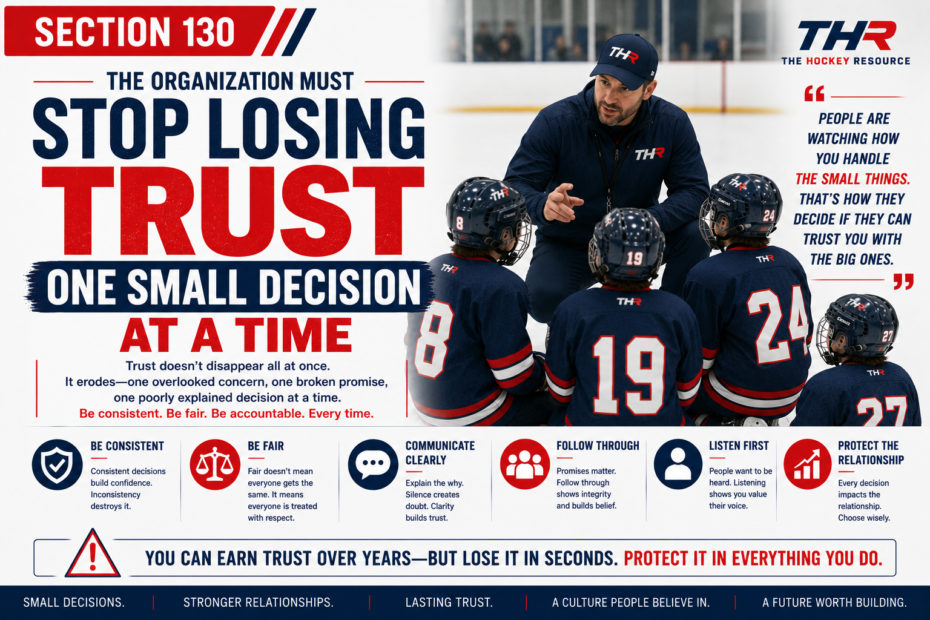
Most hockey organizations do not lose trust over a single major event.
A financial scandal may damage confidence.
Serious misconduct may raise concern.
A major organizational failure may affect reputation.
Fortunately, those situations are relatively rare.
More often, trust erodes gradually through a series of small experiences that seem insignificant on their own but become meaningful when combined.
This process is easy to miss.
That is precisely what makes it dangerous.
Trust Is Built in Small Moments
Many leaders assume trust grows through major achievements.
Winning a championship can create excitement.
Launching a new program can generate enthusiasm.
Hosting a successful event can strengthen community pride.
However, trust usually develops through everyday interactions.
A parent receives a timely response.
volunteer feels appreciated.
coach follows through on a commitment.
board member communicates openly.
Taken individually, these moments may seem minor. Together, they create confidence in the organization.
Small Disappointments Accumulate
The same principle works in reverse.
An unanswered email may not seem important.
A missed deadline may appear harmless.
A promise that is never fulfilled may feel like a small oversight.
Yet people remember these experiences.
As they accumulate, confidence begins to weaken.
Eventually, leadership may be surprised by criticism that appears sudden.
In reality, trust may have been declining for months.
Consistency Matters More Than Perfection
No organization is perfect.
Mistakes happen.
Schedules change.
Communication occasionally falls short.
Most families understand this.
What they want is consistency.
They want to know that leadership will make a genuine effort to communicate, listen, and follow through.
Organizations do not lose trust because they make occasional mistakes.
They lose trust when mistakes become patterns.
Every Decision Sends a Message
Leadership decisions communicate more than outcomes.
They also communicate priorities.
Members notice when standards are applied fairly.
They notice when volunteers are respected.
They notice when concerns are addressed professionally.
Because of this, every decision becomes an opportunity to strengthen or weaken trust.
Strong leaders understand that organizational credibility is influenced by hundreds of choices made throughout the season.
Trust Affects Everything
A high-trust organization experiences advantages in many areas.
Volunteer recruitment becomes easier.
Parent relationships become stronger.
Communication becomes more effective.
Conflict becomes easier to resolve.
When trust exists, people are more willing to give leadership the benefit of the doubt during difficult situations.
Without trust, even routine decisions can create controversy.
Repairing Trust Requires Time
Building trust is often slow.
Losing trust can happen quickly.
Rebuilding trust usually takes even longer.
That reality makes prevention especially important.
Organizations should not wait until confidence has declined before taking action.
Instead, leaders should protect trust through consistent behaviour, transparent communication, and reliable follow-through.
These habits create stability over time.
Leadership Is a Daily Responsibility
Trust is not maintained through annual reports or strategic plans alone.
It is maintained through daily actions.
The way questions are answered matters.
way concerns are handled matters.
way people are treated matters.
Each interaction contributes to the overall perception of the organization.
Strong cultures understand this principle and apply it consistently.
Final Leadership Reality
Trust is one of the most valuable assets a hockey organization can possess.
Unfortunately, it is also one of the easiest assets to damage.
Rarely is trust lost because of a single decision.
More often, it disappears one small disappointment at a time.
Organizations that recognize this reality are better equipped to protect their reputation, strengthen relationships, and build lasting confidence within their community.
One-Line Truth:
Trust is rarely lost all at once—it usually disappears one small decision at a time.
This article is part of the Foundations of Modern Hockey Leadership series.
About The Hockey Resource
The Hockey Resource exists to help players, parents, coaches, teams, leagues, tournaments, and hockey organizations make better decisions through education, leadership, and community-focused resources.
For additional hockey leadership articles, hockey parent resources, tournament information, and industry insights, visit:
The Hockey Resource – https://thehockeyresource.com
The Hockey Tournament Resource – https://thehockeytournamentresource.com
Mark Hetherman
Executive Director
The Hockey Resource