Busy organizations are often admired.
Meetings are scheduled.
Committees are active.
Projects are launched.
Emails are exchanged constantly.
At first glance, this level of activity can look like success.
However, activity and progress are not the same thing.
Many hockey organizations work extremely hard without moving meaningfully closer to their goals. Meanwhile, some organizations accomplish more with fewer meetings, fewer discussions, and greater clarity of purpose.
Leadership must understand the difference.
Motion Does Not Always Mean Advancement
A board can spend hours discussing an issue.
Several committees can review the same topic.
Multiple meetings can be held during the month.
Despite all of this effort, no decision may be made.
No action may occur.
No improvement may result.
In these situations, the organization remains busy but does not move forward.
Progress requires action, not just discussion.
Effective Organizations Prioritize Outcomes
Strong leaders focus on results.
A meeting should produce decisions.
committee should create recommendations.
project should generate measurable benefits.
Without clear outcomes, activity becomes difficult to evaluate.
Consequently, leadership should regularly ask a simple question:
What changed because of this effort?
The answer often reveals whether meaningful progress has occurred.
Time Is a Valuable Resource
Volunteers give their time freely.
Board members balance hockey with careers and family responsibilities.
Coaches invest significant energy throughout the season.
Because time is limited, organizations should use it wisely.
Unnecessary meetings reduce engagement.
Repeated discussions create frustration.
Lengthy processes slow momentum.
Respecting people’s time improves both productivity and retention.
Clear Priorities Create Better Results
Some organizations attempt to tackle too many initiatives simultaneously.
New programs are introduced.
Policies are reviewed.
Technology upgrades are discussed.
Fundraising plans are expanded.
Although ambition can be positive, excessive priorities often dilute focus.
Effective leadership identifies what matters most and directs resources accordingly.
Focused organizations typically achieve more than distracted ones.
Measurement Encourages Accountability
Progress becomes easier to identify when goals are measurable.
Registration growth can be measured.
Volunteer retention can be measured.
Communication improvements can be measured.
Member satisfaction can be measured.
Tracking results helps organizations understand whether effort is producing value.
Without measurement, activity can create the illusion of success.
Decision-Making Drives Momentum
Some organizations become trapped in endless analysis.
Every option is reviewed repeatedly.
concern is debated extensively.
decision is delayed while additional information is gathered.
Careful evaluation is important.
At the same time, organizations cannot improve without action.
Strong leaders understand when discussion has created enough information to move forward.
Culture Influences Productivity
A healthy culture encourages action.
People feel empowered to contribute.
Responsibilities are clearly defined.
Expectations are understood.
As a result, projects move more efficiently from discussion to execution.
Organizations with strong cultures often achieve greater progress because people focus on solutions rather than process alone.
Final Leadership Reality
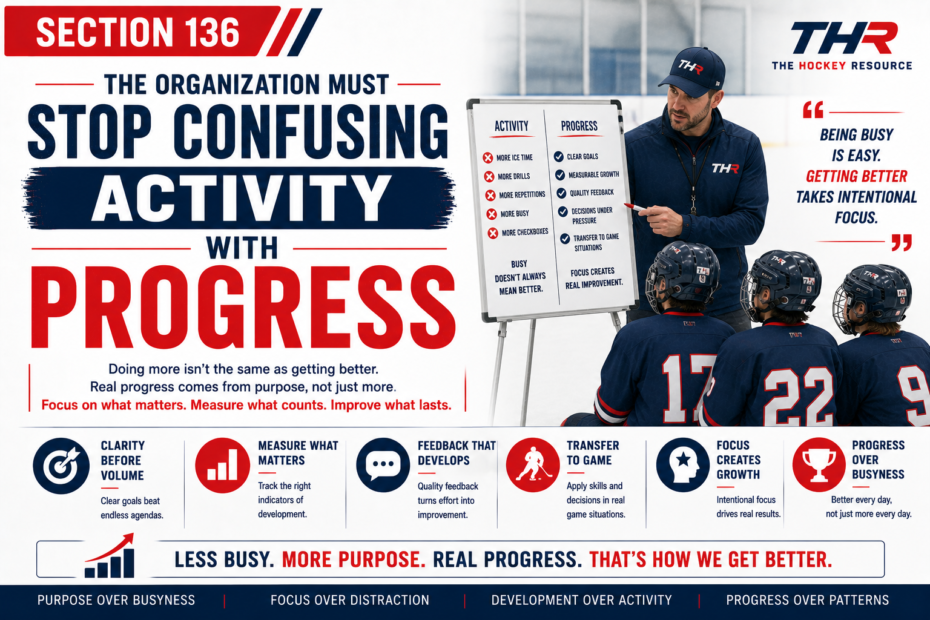
Being busy is easy.
Making progress is harder.
The strongest organizations understand that activity should support outcomes, not replace them.
Meetings should create decisions.
Discussions should create action.
Effort should create improvement.
When leadership focuses on meaningful progress instead of constant activity, organizations become more effective, more efficient, and more rewarding for everyone involved.
One-Line Truth:
An organization can be extremely busy and still stand completely still.
This article is part of the Foundations of Modern Hockey Leadership series.
About The Hockey Resource
The Hockey Resource exists to help players, parents, coaches, teams, leagues, tournaments, and hockey organizations make better decisions through education, leadership, and community-focused resources.
For additional hockey leadership articles, hockey parent resources, tournament information, and industry insights, visit:
The Hockey Resource – https://thehockeyresource.com
The Hockey Tournament Resource – https://thehockeytournamentresource.com
Mark Hetherman
Executive Director
The Hockey Resource
As always, thank you for being part of The Hockey Resource Community.
AMAZON Hockey
NEW Tournament Search APP
https://play.google.com/store/apps/details?id=com.hockeyresource.hockeytournamentapp&hl=en_CA&pli=1
NEW!!! The Hockey Moments Cards
GUMROAD – eBooks
https://thehockeyresource.gumroad.com
SEE My Interview with the Mental Health Academy
https://thehockeyresource.com/category/blog/hockey-career-starts-here
SEE My Interview on Podcast with Constant Sports
https://www.youtube.com/watch?v=_8VJUTfAGp