
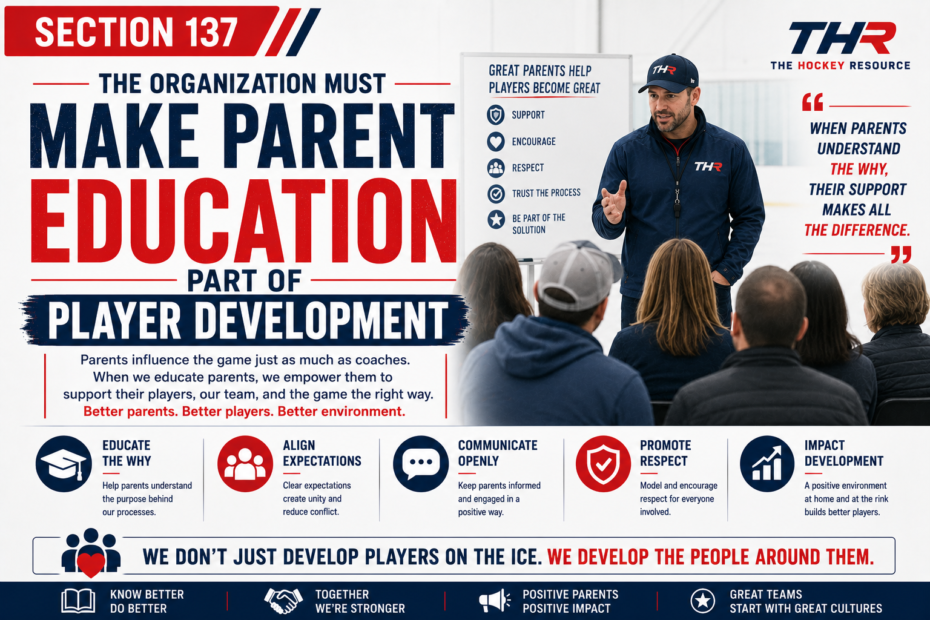
Every hockey organization invests in Player development.
PLAYER Practice plans are created.
Skills coaches are hired.
Development programs are introduced.
Training resources are provided.
These investments help players improve on the ice.
Yet one important reality is often overlooked.
Young athletes do not experience hockey alone.
Parents influence nearly every part of the journey.
Because of this, organizations that focus exclusively on player development may be missing one of their greatest opportunities.
The Parent Experience Shapes the Player Experience
A player’s environment extends far beyond the rink.
Conversations in the car matter.
Expectations at home matter.
Responses to success matter.
Reactions to disappointment matter.
These experiences influence confidence, enjoyment, and long-term development.
When parents have access to good information, they are often better equipped to support their children through the challenges that hockey inevitably presents.
PLAYER – Most Parents Are Learning Too
New hockey families face a steep learning curve.
Tryouts can be confusing.
Team selection can be emotional.
Development pathways can seem complicated.
League structures often create questions.
Many parents are doing their best while navigating unfamiliar situations.
Organizations that provide guidance help reduce uncertainty and improve the overall experience for families.
PLAYER – Education Can Prevent Problems
Many common conflicts originate from misunderstandings.
Unclear expectations create frustration.
Misinformation creates confusion.
Assumptions create tension.
Providing education early can prevent many of these issues from developing.
Topics might include organizational policies, player development principles, communication expectations, or long-term hockey pathways.
Well-informed parents are often more confident and more engaged.
Development Is More Than Skill Acquisition
Most families understand the importance of skating, shooting, and puck skills.
Far fewer discussions focus on resilience, confidence, teamwork, and emotional development.
These areas matter just as much.
Parents who understand the broader goals of youth sports are often better prepared to support healthy development both on and off the ice.
That support benefits players throughout their hockey journey.
Communication Creates Learning Opportunities
Parent education does not require formal seminars every month.
A short article can help.
newsletter can help.
preseason meeting can help.
An educational resource shared online can help.
Small efforts, delivered consistently, often create meaningful results over time.
The key is making education accessible and relevant.
Better Understanding Leads to Better Relationships
Families are more likely to trust decisions when they understand the reasoning behind them.
Coaches experience fewer misunderstandings when expectations are clear.
Leadership often spends less time managing conflict when information is readily available.
As understanding increases, relationships tend to improve.
Those stronger relationships contribute to a healthier organizational culture.
Long-Term Benefits Extend Beyond Hockey
The lessons parents learn through youth sports often apply elsewhere.
Supporting children through adversity.
Managing expectations.
Encouraging growth.
Building confidence.
These skills remain valuable long after a player’s final season.
Organizations that invest in parent education contribute to broader family development, not just athletic development.
Final Leadership Reality
Player development will always remain a central priority.
However, organizations should remember that players are supported by families.
Educated parents often become stronger partners in the development process.
They communicate more effectively.
understand challenges more clearly.
contribute positively to the overall environment.
For that reason, parent education should not be viewed as an optional program.
It should be viewed as part of player development itself.
One-Line Truth:
The better informed the parent, the better supported the player often becomes.
This article is part of the Foundations of Modern Hockey Leadership series.
About The Hockey Resource
The Hockey Resource exists to help players, parents, coaches, teams, leagues, tournaments, and hockey organizations make better decisions through education, leadership, and community-focused resources.
For additional hockey leadership articles, hockey parent resources, tournament information, and industry insights, visit:
The Hockey Resource – https://thehockeyresource.com
The Hockey Tournament Resource – https://thehockeytournamentresource.com
Mark Hetherman
Executive Director
The Hockey Resource