
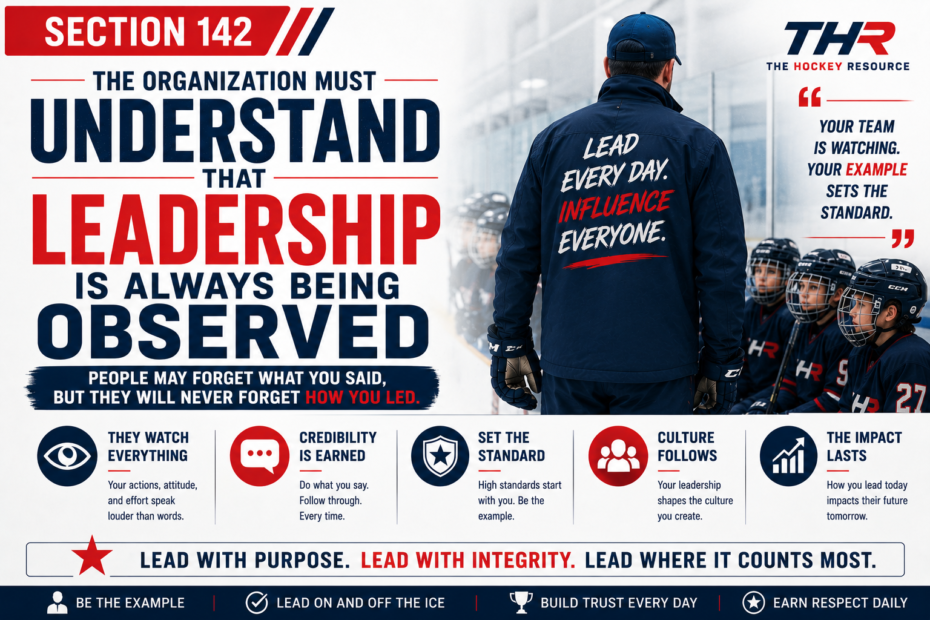
Many leaders believe their influence occurs primarily during meetings, presentations, or major decisions.
In reality, leadership is being observed every day.
Parents watch how leaders communicate.
Volunteers watch how leaders treat people.
Coaches watch how leaders respond to challenges.
Players watch how adults behave during difficult situations.
Whether leaders realize it or not, people are constantly drawing conclusions about organizational values based on what they see.
For that reason, leadership is not simply something that happens during important moments.
Leadership happens all the time.
Actions Speak Louder Than Policies
Most organizations have policies.
Many have mission statements.
Some have detailed strategic plans.
These documents serve an important purpose.
However, members pay closer attention to behavior than to written words.
A policy may promote respect.
Leadership behavior demonstrates whether respect truly exists.
A mission statement may emphasize accountability.
Daily actions reveal whether accountability is consistently applied.
Culture follows behavior more than documentation.
Difficult Moments Reveal Leadership
Success is easy to manage.
Challenges are different.
A complaint arises.
A disagreement occurs.
A mistake is made.
Pressure increases.
These situations often reveal more about leadership than periods of stability.
People observe how leaders respond under pressure because those moments provide insight into character, priorities, and values.
Consequently, difficult situations should be viewed as leadership opportunities rather than leadership interruptions.
Consistency Creates Credibility
Trust grows when behaviour remains consistent.
Members notice when leaders communicate respectfully.
They notice when commitments are honoured.
They notice when decisions align with stated values.
Consistency creates predictability.
Predictability creates confidence.
Confidence creates trust.
Strong leaders understand this chain and work hard to reinforce it through everyday actions.
Small Interactions Matter
Leadership influence is often built through simple moments.
A conversation in the arena hallway.
response to an email.
discussion after a meeting.
brief interaction with a volunteer.
Although these moments may seem insignificant, they contribute to the overall perception people develop about leadership.
Over time, countless small interactions shape organizational culture.
People Follow Examples
Organizations frequently discuss expectations.
Rules are explained.
Standards are outlined.
Guidelines are distributed.
These efforts are important.
Yet people often learn more from examples than instructions.
When leaders model professionalism, others are more likely to follow.
When leaders demonstrate accountability, others are more likely to embrace it.
When leaders communicate respectfully, those behaviours often spread throughout the organization.
Visibility Increases Responsibility
Leadership positions bring influence.
Influence creates responsibility.
People naturally pay attention to those in visible roles.
As a result, leadership behaviour carries greater weight.
Comments made casually may be remembered.
Reactions displayed publicly may be discussed later.
Decisions may influence how others behave.
Recognizing this responsibility helps leaders act with greater awareness and intention.
Strong Cultures Reflect Strong Leadership
Culture rarely develops by accident.
Leadership behaviour contributes significantly to the environment people experience.
Supportive leaders often help create supportive cultures.
Respectful leaders often help create respectful cultures.
Accountable leaders often help create accountable cultures.
Because culture reflects leadership so clearly, leaders should regularly evaluate the example they are setting.
Final Leadership Reality
Leadership is not confined to meetings, titles, or official responsibilities.
It is visible in everyday behaviour.
People watch how leaders communicate.
They watch how leaders respond.
They watch how leaders treat others.
Those observations shape trust, culture, and organizational reputation.
The strongest leaders understand this reality and lead accordingly.
One-Line Truth:
People may hear what leaders say, but they usually believe what leaders do.
This article is part of the Foundations of Modern Hockey Leadership series.
About The Hockey Resource
The Hockey Resource exists to help players, parents, coaches, teams, leagues, tournaments, and hockey organizations make better decisions through education, leadership, and community-focused resources.
For additional hockey leadership articles, hockey parent resources, tournament information, and industry insights, visit:
The Hockey Resource – https://thehockeyresource.com
The Hockey Tournament Resource – https://thehockeytournamentresource.com
Mark Hetherman
Executive Director
The Hockey Resource
As always, thank you for being part of The Hockey Resource Community.
AMAZON Hockey
NEW Tournament Search APP
https://play.google.com/store/apps/details?id=com.hockeyresource.hockeytournamentapp&hl=en_CA&pli=1
NEW!!! The Hockey Moments Cards
GUMROAD – eBooks
https://thehockeyresource.gumroad.com
SEE My Interview with the Mental Health Academy
https://thehockeyresource.com/category/blog/hockey-career-starts-here
SEE My Interview on Podcast with Constant Sports
https://www.youtube.com/watch?v=_8VJUTfAGp