
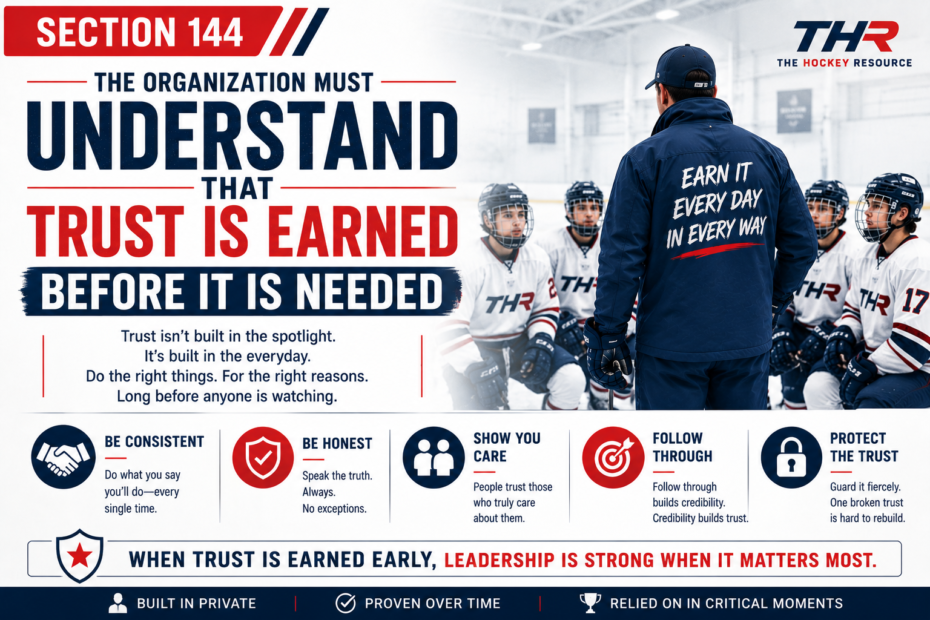
Trust is one of the most valuable assets an organization can possess.
It influences communication.
Organization trust influences relationships.
influences how people respond during challenging situations.
Despite its importance, many leaders only think about trust when a problem appears.
A difficult decision is announced.
conflict emerges.
controversy develops.
At that moment, leadership hopes members will trust the process and trust the people involved.
The challenge is that trust cannot be created on demand.
It must already exist.
Confidence Is Built Long Before Challenges Arise
Strong organizations invest in trust continuously.
Families receive clear communication.
Volunteers feel respected.
Coaches understand expectations.
Board members demonstrate consistency.
These actions may seem routine at the time.
However, they create credibility that becomes invaluable when difficult situations occur.
Trust functions much like a savings account.
Organizations make deposits over time and draw upon that trust when challenges emerge.
People Evaluate Behaviour More Than Promises
Mission statements are important.
Values statements are useful.
Strategic plans provide direction.
None of these documents matter if behaviour tells a different story.
Members pay attention to actions.
They notice how concerns are handled.
notice whether commitments are honoured.
notice whether standards are applied consistently.
Behaviour always influences trust more than words.
Transparency Strengthens Confidence
Uncertainty often creates suspicion.
Clear communication helps reduce that uncertainty.
Explaining processes builds understanding.
Providing context improves perspective.
Sharing information appropriately reinforces credibility.
People may not agree with every decision.
Nevertheless, they are far more likely to trust leaders who communicate openly and honestly.
Consistency Creates Stability
Trust grows when experiences are predictable.
Families appreciate consistency.
Volunteers appreciate consistency.
Coaches appreciate consistency.
An organization that applies standards fairly and communicates regularly creates an environment where confidence can develop naturally.
That stability becomes especially valuable during periods of change or uncertainty.
Trust Supports Better Relationships
Relationships improve when trust exists.
Conversations become more productive.
Disagreements become easier to manage.
Collaboration becomes more effective.
Without trust, even simple interactions can become difficult.
For that reason, trust should be viewed as a relationship-building tool as much as a leadership principle.
Reputation Reflects Trust
Organizations often discuss reputation.
A positive reputation is rarely built through marketing alone.
Trust plays a major role.
Families share experiences.
Volunteers discuss leadership.
Community members form opinions.
As those experiences accumulate, reputation develops.
Trust becomes one of the foundations upon which reputation is built.
Difficult Times Reveal Existing Trust Levels
Periods of success can hide weaknesses.
Challenges expose them.
When a difficult issue arises, leadership quickly learns whether trust exists.
Organizations with strong trust often receive patience and understanding.
Organizations with weak trust frequently encounter skepticism and resistance.
This difference highlights why trust should be developed continuously rather than reactively.
Final Leadership Reality
Trust cannot be manufactured during a crisis.
It cannot be demanded because of a title.
It cannot be created instantly when leadership needs support.
Trust is earned through consistency, transparency, respect, and reliability over time.
Organizations that understand this reality invest in trust every day.
Those investments often become one of their greatest strengths when challenges eventually arrive.
One-Line Truth:
Trust is earned during ordinary days and tested during difficult ones.
This article is part of the Foundations of Modern Hockey Leadership series.
About The Hockey Resource
The Hockey Resource exists to help players, parents, coaches, teams, leagues, tournaments, and hockey organizations make better decisions through education, leadership, and community-focused resources.
For additional hockey leadership articles, hockey parent resources, tournament information, and industry insights, visit:
The Hockey Resource – https://thehockeyresource.com
The Hockey Tournament Resource – https://thehockeytournamentresource.com
Mark Hetherman
Executive Director
The Hockey Resource

As always, thank you for being part of The Hockey Resource Community.
AMAZON Hockey
NEW Tournament Search APP
https://play.google.com/store/apps/details?id=com.hockeyresource.hockeytournamentapp&hl=en_CA&pli=1
NEW!!! The Hockey Moments Cards
GUMROAD – eBooks
https://thehockeyresource.gumroad.com
SEE My Interview with the Mental Health Academy
https://thehockeyresource.com/category/blog/hockey-career-starts-here
SEE My Interview on Podcast with Constant Sports