
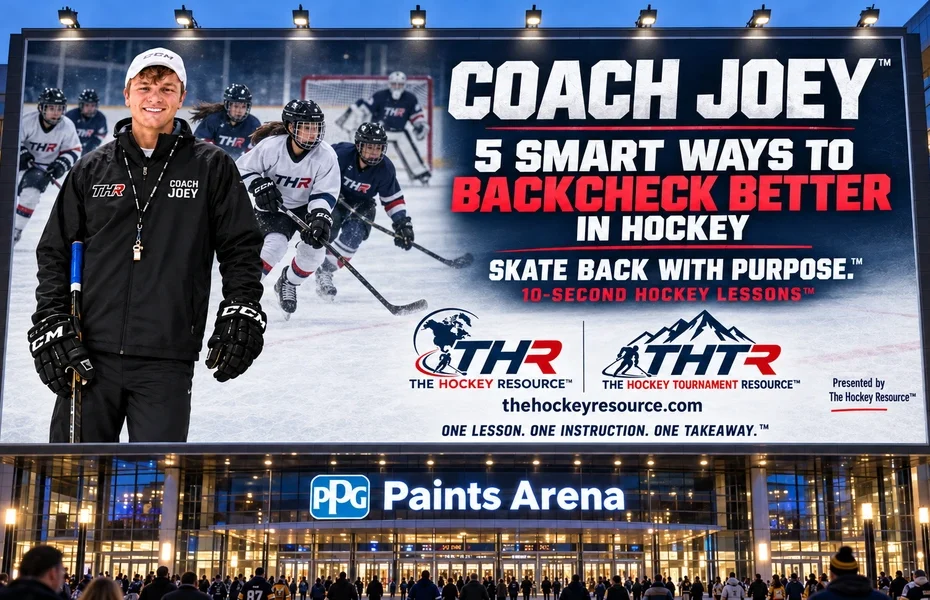
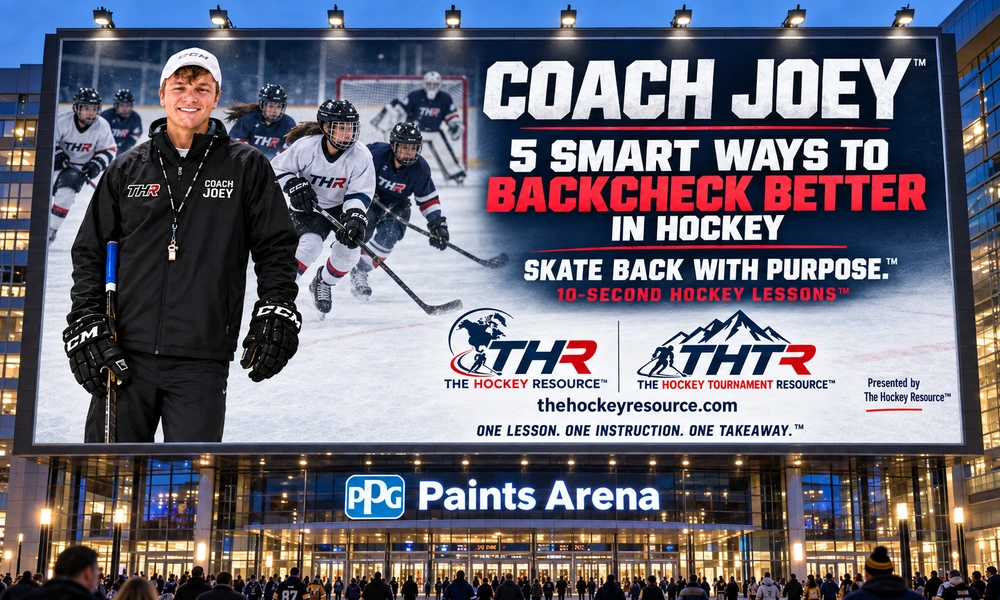
SKATE BACK WITH PURPOSE.™ Learning to backcheck starts with your response when the other Team gains possession. Turn, move your feet, and read the rush so you can help protect your own net.
A missed shot or broken pass can send the play in the opposite direction. However, your shift still matters. Recovering into a useful position may take away the pass that would have created a scoring chance.
This Coach Joey™ 10-Second Hockey Lessons™ post explains five habits Players can practice. Coaches can introduce the basic message to younger Players and build toward the coverage their Team uses.
What Does It Mean to Backcheck in Hockey?
To backcheck means to recover toward your own end while helping defend an opposing attack. It involves skating, awareness, and communication. Depending on the situation, your job could be pressuring the puck carrier, covering a receiver, or protecting a dangerous passing lane.
Your Coach’s system determines specific assignments. First, learn the shared principle: recover with a purpose and recognize where your help is needed.
1. Start Your Backcheck Immediately
Once the other Team gains clear possession, react. Push off, turn toward your own end, and accelerate while reading the play. A delayed start gives opponents more space before you can help.
For example, after your pass gets intercepted, look for the next defensive job. You may still be able to pressure the carrier. If the rush has moved beyond you, recover toward a useful defensive position.
Avoid stopping to show frustration. Instead, use the same response from Coach Joey’s lesson on resetting after a mistake: identify your next job and act.
2. Recover Toward the Middle
As you skate back, protect access to the middle of the ice. Recovering inside an attacker can help you get between that Player and your net. From there, you can better contest a pass or follow their movement.
However, inside position does not mean every Player skates to the same spot. Look at the puck carrier, available receivers, and your teammates. Then follow your Team’s coverage.
If a teammate already has the carrier, chasing that same Player may leave someone else open. In that situation, picking up the uncovered threat can be the more useful play.
3. Find the Opponent Who Needs Coverage
Keep checking the whole rush as you recover. The Player carrying the puck is only one part of the picture. An opponent arriving through the middle or on the far side may be preparing for a pass.
For instance, imagine a defender challenging the carrier near the boards. A second attacker moves toward the slot, the central area in front of the net. Your backcheck can help by getting goal-side of that receiver, between them and your Goalie.
Keep track of both the puck and your assignment. As the play changes, communicate any switch with your teammates.
4. Use Your Stick and Voice With Purpose
Place your stick where it can interfere with the pass you are responsible for. Meanwhile, keep skating to improve your position. Reaching from behind is a poor substitute for moving your feet.
Stay in control of your stick and avoid hooking or tripping. A useful backcheck reduces the opponent’s options without creating a penalty.
Use the short calls your Team practices, such as “I have the middle” or “I have 12.” Clear information helps teammates divide the work. Build that habit with Coach Joey’s communication lesson.
5. Finish Your Backcheck
Crossing your blue line does not finish the backcheck. Stay aware of your assignment until your Team secures possession, play stops, or a teammate clearly takes over.
Even after a shot, an attacker may look for a rebound. Therefore, keep your feet moving and maintain useful position around the play. Avoid drifting toward the bench while your responsibility remains uncovered.
Once your Team wins the puck, become a passing option or make the appropriate change. Managing your shift length also helps you preserve the effort needed to recover.
A Simple Backchecking Practice
Try this Coach-led progression with Players who can skate and stop under control. Adjust the space and pace to their ability.
- Start with one attacking Player and one recovering Player. Give the attacker a small head start toward a marked scoring area.
- Ask the recovering Player to move immediately and regain inside position without reaching or making contact.
- Next, add a receiver. The Coach explains which Player pressures the carrier and which Player covers the passing option.
- After each repetition, ask: “Which threat did you take away?” Give one correction, then try again.
Reward a useful recovery even when no one wins the puck. For younger Players, begin with one task: skate back toward your own net and find where you can help.
Coach Joey’s 10-Second Lesson
“Hello, this is Coach Joey. When possession changes, skate back, find your assignment, and protect the middle. Your Team needs you both ways.”
Coach Joey’s Takeaway
SKATE BACK WITH PURPOSE.™ A strong backcheck combines effort with a clear assignment. Your next useful contribution might be the passing option you take away.
ONE LESSON. ONE INSTRUCTION. ONE TAKEAWAY.™
Part of Coach Joey™ 10-Second Hockey Lessons™.
Presented by The Hockey Resource™.
Meet Coach Joey and explore more practical Player development lessons at TheHockeyResource.com.
More From The Hockey Resource™
Explore Hockey products on Amazon, browse The Hockey Resource’s eBooks, and find the Tournament Search app on Google Play.
Discover Hockey career resources and hear the Mental Health Academy interview.
As always, thank you for being part of The Hockey Resource Community.