Coaching Leadership – Presented by The Hockey Resource™
Coach Leadership – The final standings tell you where your team finished.
They do not tell you everything that happened.
A winning season may have included inconsistent communication, declining confidence, frustrated assistant coaches or players who stopped enjoying the game. A losing season may have included meaningful development, stronger relationships, improved effort and players who learned how to compete together.
Coach Leadership – Wins and losses matter. They are part of competitive hockey. But they are not a complete evaluation of coaching performance.
The first responsibility of an honest off-season review is to separate the team’s record from the quality of the coaching experience.
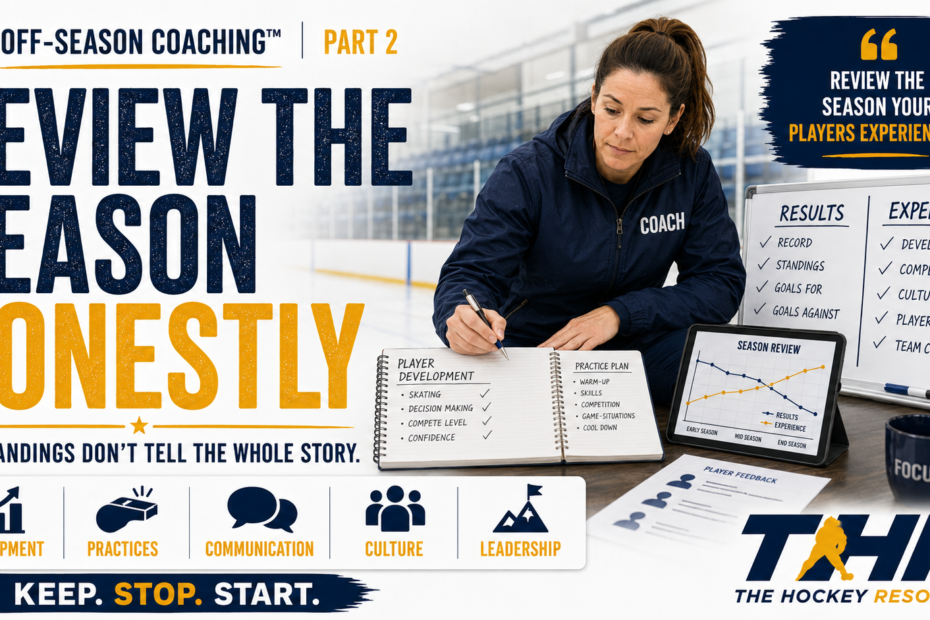
Do not review only the season you remember. Review the season your players experienced.
Wait Until the Emotion Has Settled
Coach Leadership – A season should not be evaluated immediately after its final game.
If the team lost badly, disappointment may make everything appear unsuccessful. If the team won a championship, celebration may prevent the coaching staff from recognizing problems that existed beneath the result.
Give yourself enough distance to think clearly.
This does not require waiting several months. It means allowing the immediate emotion to settle before reaching conclusions about players, staff members, parents or your own performance.
Strong leaders learn to separate personal emotion from leadership responsibility. That discipline becomes particularly important when reviewing a season involving difficult decisions, conflict or unmet expectations.
Before beginning the review, gather the information you will need:
- Preseason goals
- Practice plans
- Game notes
- Player evaluations
- Attendance records
- Team communications
- Staff meeting notes
- Development priorities
- Parent or player feedback
- Your own coaching journal, if you kept one
Memory is valuable, but memory is selective. Documentation gives the review evidence.
Begin With the Goals You Established
Coach Leadership – An honest review starts with a simple question:
What did we say we were trying to accomplish?
If the team established preseason goals, return to them. If no clear goals were established, that is already an important lesson for next season.
Goals may have included:
- Developing specific individual skills
- Improving team play
- Creating a positive culture
- Advancing players to another level
- Becoming more competitive
- Improving practice habits
- Strengthening accountability
- Teaching players to manage adversity
- Creating an environment players wanted to return to
Evaluate each goal separately.
Do not allow one outcome—especially the win-loss record—to answer every question.
The Hockey Resource™ has emphasized that hockey organizations must measure success beyond wins and losses. Coaches should apply the same standard to their teams.
A team can improve without winning a championship. It can also win without developing as much as it should have.
Review the Season Through Six Leadership Lenses
A complete review should examine six areas:
- Player development
- Practice quality
- Communication
- Team culture
- Coaching-staff performance
- Personal leadership
Each area tells a different part of the season’s story.
1. Player Development
Coach Leadership – The most important question is not whether every player became a star.
It is whether every player received a genuine opportunity to improve.
Ask: Did:
- players improve technically?
- they skate, pass, shoot and handle the puck better?
- their hockey understanding improve?
- they make better decisions under pressure?
- they become more confident?
- they learn how to practice?
- they become better teammates?
- the weakest players receive meaningful development?
- Were advanced players challenged appropriately?
- goaltenders receive proper attention?
- Were development priorities suitable for the age group?
USA Hockey’s guidance on coaching self-reflection encourages coaches to look beyond trophies and consider whether their players actually improved.
That question cannot be answered by examining only the top players.
The best player may have developed despite the coaching. The least-skilled player may reveal more about the team’s teaching environment.
Player development must be evaluated across the entire roster.
2. Practice Quality
Coach Leadership – Games reveal performance. Practices reveal coaching.
Review the structure and effectiveness of your practices:
- Were players moving enough?
- Did drills create sufficient repetition?
- Was too much time spent explaining?
- Did activities match the players’ ages and abilities?
- Did practices progress throughout the season?
- Were players required to make decisions?
- Did drills connect to game situations?
- Were practices enjoyable without becoming unstructured?
- Did every player receive useful feedback?
- Did goaltenders participate meaningfully?
- The staff arrive prepared?
- Was ice time used efficiently?
The Hockey Canada High Performance 1 field-evaluation process uses observation, documentation, self-assessment and post-session discussion when evaluating coaching performance. The principle applies at every level: coaching improves when practices are examined rather than merely completed.
Review several practices from different parts of the season. Do not judge the entire year by the best practice you designed or the worst practice you remember.
Coach Leadership – Look for patterns.
3. Communication
Many coaching problems that appear to involve attitude, commitment or parent behaviour begin with unclear communication.
Ask:
- Did players understand what was expected?
- Were roles explained clearly?
- Did feedback help players improve?
- Were difficult decisions communicated honestly?
- Did parents receive information consistently?
- Did assistant coaches know what they were responsible for?
- Were messages consistent across the staff?
- Did communication change when pressure increased?
- Did players feel comfortable asking questions?
- Were concerns addressed early or avoided until they became conflicts?
The Hockey Resource™ considers communication a fundamental leadership skill. Communication is not simply the ability to speak confidently. It includes listening, explaining decisions, asking questions and recognizing when people do not understand.
A coach may believe a message was clear because it was delivered. The more important question is whether it was understood.
4. Team Culture
Coach Leadership – Team culture should be evaluated through behaviour, not slogans.
Consider:
- How did players treat one another?
- Did every player feel included?
- How were mistakes handled?
- Did players fear failure?
- Was effort recognized?
- Were standards applied consistently?
- Did talented players receive exceptions?
- How did the team respond to adversity?
- Did the dressing room feel safe and respectful?
- Were humour and teasing allowed to become harmful?
- Did players support teammates who struggled?
- Did adults model the behaviour expected from players?
The Hockey Resource™ has established that adult behaviour defines much of the player experience. Players notice how coaches speak, react, correct, celebrate and respond when frustrated.
Culture is also built through small moments. A coach who remembers an injured player, checks on someone after a difficult game or explains a reduced role is building trust. A coach who embarrasses a player, ignores concerns or applies rules selectively is weakening it.
That is why trust is built through thousands of small moments.
An honest cultural review asks whether your daily behaviour strengthened or weakened the environment you wanted.
5. Coaching-Staff Performance
Coach Leadership – A head coach should not review assistants only as people who followed instructions.
Evaluate whether the staff functioned as a genuine leadership team.
Ask: DID
- every coach have a defined role?
- Were assistants given meaningful responsibilities?
- staff members prepare for practices?
- Were disagreements handled privately and professionally?
- coaches present consistent messages?
- assistants feel able to offer ideas?
- the staff divide player-development responsibilities effectively?
- anyone become isolated or underused?
- Were staff meetings purposeful?
- the coaches support one another during difficult periods?
- the staff model healthy accountability?
The Hockey Resource™ explains why every organizational role should include clear responsibilities. Assistant coaches cannot be evaluated fairly if their authority, duties and expectations were never defined.
The head coach must also ask a difficult question:
Did my leadership allow the other coaches to contribute fully?
Sometimes an assistant coach appears disengaged because the head coach controlled every decision, conversation and practice.
6. Personal Leadership
Coach Leadership – This is the hardest part of the review because
As always, thank you for being part of The Hockey Resource Community.
AMAZON Hockey
NEW Tournament Search APP
https://play.google.com/store/apps/details?id=com.hockeyresource.hockeytournamentapp&hl=en_CA&pli=1
NEW!!! The Hockey Moments Cards
GUMROAD – eBooks
https://thehockeyresource.gumroad.com
SEE My Interview with the Mental Health Academy
SEE My Interview on Podcast with Constant Sports
https://www.youtube.com/watch?v=_8VJUTfAGp
The Hockey Resource