
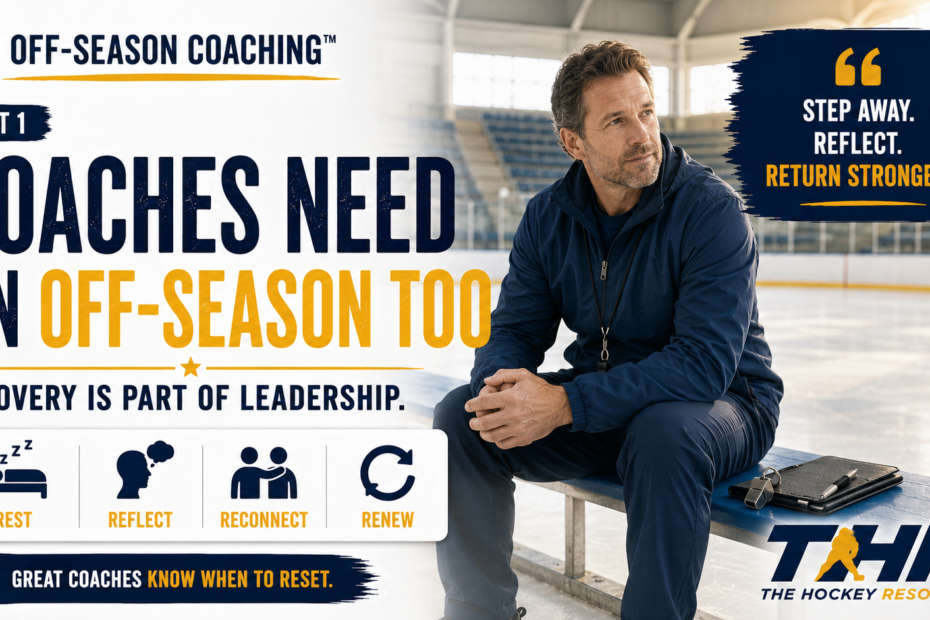
A 10-Part Coaching Leadership™ Series Presented by The Hockey Resource™
When the final game ends, coaching work changes—but it does not disappear.
Practices stop. Team meetings become less frequent. Dressing rooms empty. Players turn toward spring hockey, summer development, other sports, family vacations or simple recovery.
For coaches, the temptation is often to move immediately into the next assignment: organize tryouts, recruit players, attend spring tournaments, develop new systems and begin planning another season.
But effective coaching leadership requires more than constant activity.
The off-season provides coaches with something the regular season rarely allows: time to step back, evaluate honestly, continue learning and decide what needs to improve.
That is why The Hockey Resource™ is launching Off-Season Coaching™, a new 10-part Coach Leadership™ series built around one central principle:
The season ends. Leadership doesn’t.
Coaching Development Cannot End With the Schedule
Players are regularly encouraged to develop during the off-season. They attend camps, improve their skating, build strength, play other sports and work on individual weaknesses.
Coaches need an off-season development plan too.
A coach’s plan will not look exactly like a player’s plan. It should include recovery, but it should also include reflection, education, communication, preparation and personal growth.
The strongest coaches do not simply repeat the same season with a different group of players. They evaluate what happened, identify what needs to change and deliberately prepare to become better leaders.
The Coaching Association of Canada treats coaching education as an ongoing journey supported by training, professional development and the National Coaching Certification Program. Hockey Canada’s coaching resources also give coaches access to practice-planning tools, development materials and age-specific guidance.
Those resources matter, but meaningful development begins with a coach’s willingness to examine their own leadership.
The Coaching Off-Season Is Not Just for Systems and Drills
Many coaches begin their planning with hockey questions:
- What forecheck should we use?
- How should we organize the power play?
- Which drills should remain in our practice library?
- How can we improve our breakouts?
- What type of players should we recruit?
Those questions have value, but they are not the only questions that matter.
Coaches should also ask:
- Did every player understand their role?
- Did our practices support development or simply keep players busy?
- Did we communicate consistently?
- How did we respond when pressure increased?
- Did our actions match the standards we promoted?
- Did players feel respected, valued and included?
- Did our coaching staff work as one leadership group?
- What would our players and parents say about their experience?
The Hockey Resource™ has consistently emphasized that organizational culture is revealed through daily behaviour. The same principle applies to a team.
Culture is not created by a slogan on a dressing-room wall. It is created through decisions, conversations, expectations, consequences and the way people are treated.
The off-season gives coaches enough distance to examine that culture honestly.
Reflection Must Come Before Coaching Reinvention
A disappointing season does not mean everything failed. A successful season does not mean everything worked.
Winning can hide weak communication, unclear roles and unhealthy pressure. Losing can hide genuine development, stronger relationships and meaningful progress.
A responsible review separates results from leadership performance.
Before changing systems, replacing staff or introducing new rules, coaches should identify:
- What should continue?
- What should stop?
- What should change?
- What needs to be learned?
- What needs to be communicated more clearly?
This process supports the broader leadership principle that hockey organizations should develop leaders, not simply operators.
A coach who can schedule practices, submit lineups and manage a bench may be an effective operator. A coach who can build trust, develop people, communicate expectations and improve the environment is becoming a leader.
Coaching Needs Recovery Too
Coaching can be emotionally demanding.
During a season, coaches manage practices, games, player development, staff relationships, parent questions, roster decisions, injuries, team expectations and organizational pressure. Volunteer coaches may carry all those responsibilities while also managing careers and families.
Stepping away is not abandoning the team. It is part of preparing to lead it well again.
Recovery does not require coaches to disconnect from hockey for the entire summer. It means creating enough space to think clearly and return with renewed energy.
That may involve:
- Taking several weeks without designing practices
- Spending uninterrupted time with family
- Participating in other activities
- Reconnecting with mentors
- Reading or studying without an immediate deadline
- Reviewing the season after emotions have settled
- Deciding whether returning is the right commitment
A tired coach can still run a practice. A renewed coach is better positioned to notice players, communicate patiently and make thoughtful decisions.
The Off-Season Is a Coaching Leadership Laboratory
Once a coach has recovered and reflected, the off-season becomes an opportunity to experiment.
There is time to redesign practice templates, improve staff responsibilities, develop communication standards and study new approaches without the pressure of preparing for tomorrow’s game.
USA Hockey’s Coaching Education Program and its collection of coaching manuals and guides provide structured learning resources for coaches. Ontario coaches can also explore clinics and development information through the Ontario Minor Hockey Association’s coach education resources.
The objective is not to collect information without applying it. Coaches should connect education to specific needs identified during their season review.
IF:
practices lacked pace, study practice design.
players did not understand their roles, improve teaching and communication.
assistant coaches received unclear responsibilities, build a defined staff structure.
parent relationships became difficult, develop a preseason communication plan.
team standards were inconsistent, clarify expectations and accountability.
The Hockey Resource™ explains why every organizational role should include defined responsibilities. Coaching staffs need the same clarity. Every assistant coach should understand what they own, how decisions are made and how the staff communicates one consistent message.
The Next Season Begins Before the First Practice
Team culture begins forming before players enter the dressing room.
It begins when coaches decide:
HOW:
- What behaviour will be expected
- development will be measured
- playing-time decisions will be communicated
- assistant coaches will contribute
- parents will receive information
- concerns will be addressed
- mistakes will be treated
- every player will be included
Organizations become stronger when they create a standardized leadership operating system. Teams benefit from the same structure.
Consistency should not eliminate a coach’s personality. It should eliminate avoidable confusion.
Players and parents should not have to guess which standards matter, how decisions are made or where concerns should be directed. Expectations must be communicated before pressure exposes their absence.
The Hockey Resource™ has also identified that accountability becomes credible when expectations are visible. A coach cannot fairly hold players, parents or staff accountable to standards that were never clearly explained.
Player Development Must Guide Off-Season Planning
The purpose of coaching preparation is not to make the coach appear more organized. It is to improve the player experience.
Sport for Life promotes athlete-centred, developmentally appropriate sport through its Long-Term Development framework. That approach should influence how coaches plan for different ages and levels.
A U7 coach should not prepare the same way as a junior hockey coach. A recreational team does not require the same systems as an elite team. A first-year player and an experienced player may need different teaching methods, even when they share the same ice.
Off-season planning should therefore begin with the players the coach expects to serve:
- WHAT:
- is most important at their developmental stage?
- should they be able to do by the end of the season?
- kind of environment will help them learn?
- HOW:
- much structure is appropriate?
- will practices balance repetition, competition and enjoyment?
- will progress be recognized beyond goals and wins?
Development improves when coaching decisions are connected to clear priorities rather than copied from another age group or level.
Trust Must Be Built Before Problems Appear
Coaches sometimes treat communication as something needed only when conflict begins.
By then, it may be too late.
Trust is built through clear expectations, honest explanations, consistent behaviour and regular communication. The Hockey Resource™ explores this principle in The Organization Must Build Trust Before a Crisis Occurs.
The off-season is the right time to design that communication structure.
Before the season, coaches can prepare:
- A team philosophy
- Development priorities
- Staff responsibilities
- Parent expectations
- Player standards
- Communication procedures
- Playing-time principles
- Attendance expectations
- A process for questions and concerns
These documents should not become a collection of threats and penalties. They should help everyone understand how the team intends to operate.
Clarity reduces preventable conflict. Consistency builds credibility. Credibility strengthens trust.
What the Off-Season Coaching™ Series Will Cover
The 10-part Off-Season Coaching™ series will guide coaches through the complete period between seasons.
Part 1 — Coaches Need an Off-Season Too
Why recovery, distance and personal renewal are necessary parts of responsible coaching leadership.
Part 2 — Review the Season Honestly
How coaches can evaluate development, communication, culture, staff performance and decision-making without allowing wins and losses to control the review.
Part 3 — Revisit Your Coaching Philosophy
How to clarify what you believe about development, discipline, competition, communication and the treatment of players.
Part 4 — Keep Learning When the Rink Is Quiet
How clinics, mentors, books, courses, video and reflective learning can strengthen a coach’s knowledge.
Part 5 — Build Better Practices Before September
How to create age-appropriate, purposeful practices that maximize movement, repetition, decision-making and development.
Part 6 — Develop Your Assistant Coaches
How head coaches can define responsibilities, invite meaningful contributions and help assistants become stronger leaders.
Part 7 — Improve Player Communication
How to give clear instructions, useful feedback and honest explanations while protecting player confidence and trust.
Part 8 — Prepare Parents Before Problems Begin
How preseason expectations and regular communication can build healthier coach-parent relationships.
Part 9 — Build Team Culture Before Tryouts
How standards, belonging, accountability and leadership expectations should be established before the roster is finalized.
Part 10 — Return Recharged and Ready
How to bring reflection, education and planning together before the next season begins.
Great Coaches Do Not Simply Repeat Seasons
Experience does not automatically produce improvement.
A coach can repeat the same methods for 10 years and call it experience. Another coach can examine every season, seek feedback, continue learning and make meaningful changes.
The difference is intentional development.
The off-season is where that development can begin.
It is where coaches can recover without guilt, review without defensiveness, learn without immediate pressure and plan without the noise of the next game.
When the team returns, players may never see every notebook page, course, conversation or moment of reflection that shaped the coach’s preparation.
They will experience the results through clearer practices, stronger communication, better teaching and a healthier team environment.
The season ends. Leadership doesn’t.