One of the biggest structural weaknesses in hockey organizations:
many people are taught:
how to operate hockey —
but not how to lead people.
This creates organizations filled with:
- hardworking volunteers
- experienced hockey people
- and passionate coaches
who still struggle with:
- communication
- emotional leadership
- conflict management
- accountability
- and culture development
Strong organizations recognize:
organizational health depends heavily on:
leadership development.
Not simply:
hockey experience.
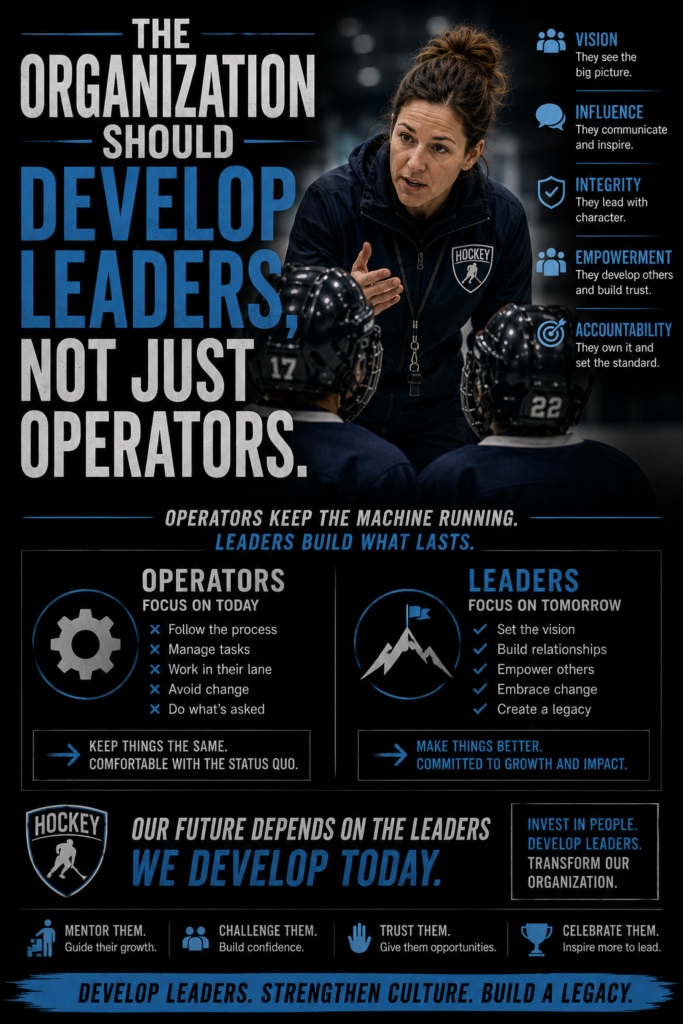
WHAT THE DIFFERENCE ACTUALLY IS
An operator focuses on:
- tasks
- logistics
- scheduling
- rosters
- systems
- and administration
A leader focuses on:
- people
- communication
- culture
- emotional stability
- trust
- and organizational direction
Both are important.
But organizations become unhealthy when:
everyone focuses only on:
operations —
while leadership behavior remains undeveloped.
IN SIMPLE TERMS
Running hockey activities is not the same thing as:
leading a hockey environment.
THE BIGGEST LEADERSHIP DEVELOPMENT FAILURE IN HOCKEY
Most hockey organizations promote people into leadership because:
- they know hockey
- volunteer often
- played the game
- or they are passionate
Those qualities matter.
But they do NOT automatically teach:
- communication maturity
- emotional discipline
- organizational leadership
- conflict management
- or culture protection
Strong organizations intentionally develop:
leadership skills.
Not just hockey knowledge.
IMPORTANT REALITY
Many leadership problems in hockey are not:
bad people problems.
They are:
untrained leadership behavior problems.
ORGANIZATIONS MUST TEACH LEADERSHIP EXPLICITLY
Leadership should not remain:
assumption-based.
Strong organizations intentionally teach:
- communication standards
- conflict management
- emotional discipline
- accountability systems
- meeting behavior
- professionalism
- and organizational expectations
This creates:
leadership consistency.
Weak organizations assume:
people will “figure it out.”
Usually:
they do not.
THE ROLE OF LEADERSHIP MODELING
People copy:
what leadership normalizes.
If senior leadership:
- gossips
- reacts emotionally
- avoids accountability
- or behaves politically
the organization slowly absorbs:
those habits.
Strong organizations model:
- calmness
- professionalism
- communication maturity
- and emotional steadiness
Leadership behavior teaches culture daily.
IN SIMPLE TERMS
People do not only listen to leadership.
They study leadership behavior constantly.
THE ROLE OF COACH DEVELOPMENT
Coaches are leadership figures —
not just hockey instructors.
Strong organizations develop coaches in:
- communication
- emotional leadership
- accountability
- culture management
- and player development psychology
Not only:
systems and tactics.
A coach can understand hockey deeply while still creating:
emotionally unhealthy environments.
Organizations must recognize:
leadership development matters at every level.
THE DANGER OF “HOCKEY IQ ONLY” LEADERSHIP
Some organizations overvalue:
technical hockey knowledge
while undervaluing:
people leadership.
This creates environments where:
- systems may improve
BUT - communication weakens
- trust declines
- and culture becomes unstable
Modern organizations require:
both:
- hockey competence AND leadership competence
Together.
IMPORTANT REALITY
Players and families experience:
leadership behavior every day.
Not just hockey systems.
THE ROLE OF EMOTIONAL INTELLIGENCE
Modern hockey leadership requires:
emotional intelligence.
This includes:
- self-awareness
- emotional control
- communication awareness
- empathy
- listening skills
- and conflict management
This does NOT mean:
lowering standards.
It means:
leaders understand:
how emotional behavior affects:
- trust
- development
- and organizational culture
Strong leaders manage:
emotion responsibly.
THE DANGER OF EMOTIONALLY IMMATURE LEADERSHIP
Emotionally immature leadership creates:
- tension
- fear
- instability
- gossip
- overreaction
- and unhealthy culture
Examples:
- public emotional reactions
- defensive communication
- ego-driven decisions
- inability to accept feedback
- emotional punishment
- and inconsistent accountability
Organizations become:
emotionally exhausting under immature leadership.
IN SIMPLE TERMS
Strong leaders stabilize environments.
Weak leaders emotionally destabilize them.
THE ROLE OF SELF-AWARENESS
Strong leaders understand:
their behavior affects:
- players
- coaches
- volunteers
- parents
- and the emotional atmosphere of the organization
Self-awareness helps leaders ask:
- How do people experience my leadership?
- Does my communication create calmness or tension?
- Do people feel respected around me?
- Does my behavior strengthen or weaken trust?
Leadership reflection matters enormously.
THE ROLE OF LEADERSHIP FEEDBACK
Healthy organizations create:
feedback pathways for leadership growth.
Not:
political criticism.
Real development feedback.
Strong leaders remain:
- teachable
- reflective
- and open to improvement
Weak leaders protect:
ego over growth.
That eventually weakens organizations.
IMPORTANT REALITY
Experience alone does not automatically improve leadership.
Intentional reflection and development do.
THE ROLE OF SUCCESSION PLANNING
Strong organizations intentionally prepare:
future leaders.
Weak organizations panic every time:
a key volunteer leaves.
Leadership continuity requires:
- mentorship
- onboarding
- leadership education
- and organizational systems
Healthy organizations build:
future leadership pipelines continuously.
THE DANGER OF “ONE PERSON HOLDS EVERYTHING”
Some organizations become dependent on:
one dominant personality.
This creates:
fragility.
If one person leaving causes:
organizational crisis,
the organization lacked:
leadership depth and structure.
Strong organizations distribute:
knowledge,
systems,
and leadership development intentionally.
THE ROLE OF LEADERSHIP LANGUAGE
Leadership language shapes culture.
Strong leaders communicate:
- respectfully
- clearly
- calmly
- and professionally
Weak leadership often normalizes:
- sarcasm
- negativity
- emotional escalation
- and dismissiveness
Language becomes:
cultural modeling.
People eventually mirror:
leadership tone.
THE ROLE OF ORGANIZATIONAL LEARNING
Healthy organizations constantly evolve.
They ask:
- What leadership habits are helping?
- What behaviors are hurting culture?
- What communication systems need improvement?
- What leadership training is missing?
- What emotional patterns are weakening trust?
Modern organizations stay:
growth-oriented.
Not:
ego-protective.
IN SIMPLE TERMS
Strong organizations are willing to improve:
how leadership operates —
not just how hockey operates.
THE ROLE OF HUMILITY
Strong leadership includes:
humility.
Not weakness.
Humility means:
leaders understand:
they are still learning,
still growing,
and still responsible for improving organizational health.
Arrogant leadership often resists:
feedback and evolution.
That creates:
stagnation.
THE ROLE OF ORGANIZATIONAL STANDARDS
Leadership development should become:
part of organizational standards.
Examples:
- communication expectations
- emotional behavior standards
- meeting professionalism
- accountability procedures
- and leadership conduct guidelines
Leadership should never feel:
undefined.
Strong organizations intentionally define:
what good leadership looks like operationally.
THE MOST IMPORTANT LEADERSHIP DEVELOPMENT QUESTION
Organizations should constantly ask:
“Are we simply assigning people positions —
or are we intentionally developing healthy leaders?”
That question changes organizations dramatically.
THE HARD TRUTH ABOUT HOCKEY LEADERSHIP
Many organizations unintentionally place people into:
high-impact leadership positions
without ever teaching:
- leadership behavior
- communication
- emotional management
- or organizational culture development
Good people then struggle inside:
poorly defined leadership systems.
Strong organizations solve this intentionally.
HOW STRONG ORGANIZATIONS DEVELOP LEADERS
Strong organizations:
- teach leadership behavior
- model professionalism
- reinforce emotional discipline
- train communication
- mentor future leaders
- encourage reflection
- and prioritize organizational health alongside hockey operations
Over time:
leadership becomes:
- calmer
- more consistent
- more emotionally mature
- and more trusted
That becomes:
organizational strength.
FINAL PRINCIPLE — DEVELOP LEADERS, NOT JUST OPERATORS
Strong hockey organizations understand:
great hockey environments are not created simply through:
- scheduling
- systems
- budgets
- or hockey knowledge alone.
They are created through:
emotionally mature,
well-developed,
communicative,
accountable leaders
who understand:
they are shaping people,
culture,
and long-term organizational health every single day.
About The Hockey Resource
The Hockey Resource exists to help players, parents, coaches, teams, leagues, tournaments, and hockey organizations make better decisions through education, leadership, and community-focused resources.
For additional hockey leadership articles, hockey parent resources, tournament information, and industry insights, visit:
The Hockey Resource – https://thehockeyresource.com
The Hockey Tournament Resource – https://thehockeytournamentresource.com
Mark Hetherman
Executive Director
The Hockey Resource