
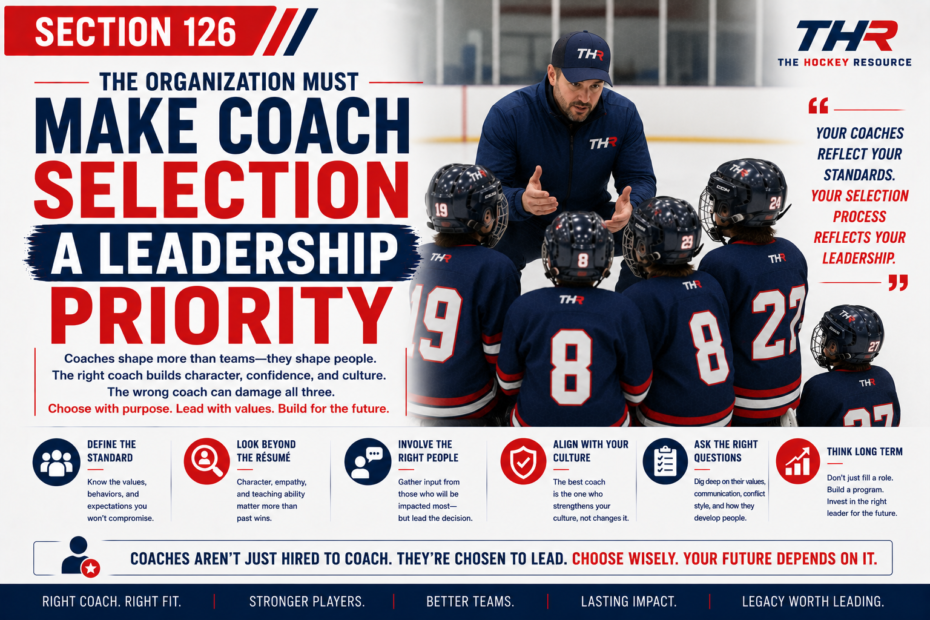
Few decisions influence a hockey organization more than coach selection.
Players spend countless hours with their coaches.
Parents often judge organizations based on coaching experiences.
Team culture is heavily influenced by coaching leadership.
Player development depends on coaching quality.
Despite this reality, some organizations devote more attention to selecting tournament hotels than they do to selecting coaches.
That is a mistake.
Strong organizations recognize that coach selection is one of the most important leadership responsibilities they have.
Coaches Shape More Than Hockey Skills
Many people evaluate coaches primarily through wins and losses.
Winning matters.
Development matters.
Competitive success has value.
However, coaching influence extends far beyond the scoreboard.
Coaches shape confidence.
They influence culture.
model behaviour.
affect how players feel about the game.
For young athletes, a coach may become one of the most influential adults they encounter during a season.
Because of this, organizations should evaluate coaching candidates through a much broader lens than hockey knowledge alone.
Technical Knowledge Is Only One Requirement
A coach can possess exceptional hockey knowledge.
Systems can be outstanding.
Practice plans can be excellent.
Game management can be impressive.
Yet coaching effectiveness requires additional skills.
Communication matters.
Leadership matters.
Emotional intelligence matters.
Relationship-building matters.
Organizations that focus exclusively on technical qualifications often overlook characteristics that may be equally important.
The best coaches combine hockey expertise with strong people skills.
Hiring the Best Parent Is Not Always the Same as Hiring the Best Coach
Many community hockey programs depend on parent coaches.
Without them, teams could not operate.
This reality deserves appreciation.
At the same time, organizations should avoid assuming that willingness automatically equals suitability.
A great parent may not be the best coaching candidate.
Similarly, a strong coach may not have a child on the team.
Effective coach selection requires objective evaluation rather than convenience.
The goal should always be finding the best person for the role.
Expectations Should Be Clear from the Beginning
Many coaching conflicts originate from unclear expectations.
Organizations assume coaches understand responsibilities.
Coaches assume organizations understand their approach.
Parents assume everyone shares the same priorities.
Problems emerge when those assumptions prove incorrect.
Clear expectations help prevent misunderstandings.
Coaching standards.
Communication requirements.
Player development priorities.
Organizational values.
When these expectations are discussed early, alignment becomes much easier.
Coach Evaluation Should Be Ongoing
Selection is only the first step.
Strong organizations continue to support and evaluate coaches throughout the season.
Feedback should not occur only when problems arise.
Positive performance deserves recognition.
Development opportunities should be available.
Constructive conversations should occur regularly.
This approach helps coaches improve while reinforcing organizational standards.
Players Deserve Consistency
Young athletes thrive when expectations are clear, and environments are stable.
A well-selected coach contributes significantly to that experience.
Players benefit from consistency.
Families benefit from consistency.
Organizations benefit from consistency.
For that reason, coach selection should never be rushed or treated as a routine administrative task.
The impact extends throughout the organization.
Leadership Must Think Long-Term
Some coaching decisions solve immediate problems.
Others strengthen the organization for years.
Strong leaders focus on the latter.
Developing a coaching pipeline.
Supporting emerging coaches.
Creating mentorship opportunities.
Building leadership capacity.
These investments help ensure the quality of future coaching rather than relying on last-minute recruitment every season.
Final Leadership Reality
Players may remember goals, championships, and tournaments.
Many will remember their coaches even longer.
The influence of coaching extends far beyond hockey.
Organizations that take coach selection seriously create stronger cultures, better player experiences, and healthier communities.
That is why coach selection should never be viewed as filling a vacancy.
It should be viewed as one of the most important leadership decisions an organization makes.
One-Line Truth:
The quality of a hockey organization is often reflected in the quality of the coaches it chooses to lead its players.
This article is part of the Foundations of Modern Hockey Leadership series.
About The Hockey Resource
The Hockey Resource exists to help players, parents, coaches, teams, leagues, tournaments, and hockey organizations make better decisions through education, leadership, and community-focused resources.
For additional hockey leadership articles, hockey parent resources, tournament information, and industry insights, visit:
The Hockey Resource – https://thehockeyresource.com
The Hockey Tournament Resource – https://thehockeytournamentresource.com
Mark Hetherman
Executive Director
The Hockey Resource
As always, thank you for being part of The Hockey Resource Community.
AMAZON Hockey
NEW Tournament Search APP
https://play.google.com/store/apps/details?id=com.hockeyresource.hockeytournamentapp&hl=en_CA&pli=1
NEW!!! The Hockey Moments Cards
GUMROAD – eBooks
https://thehockeyresource.gumroad.com
SEE My Interview with the Mental Health Academy
https://thehockeyresource.com/category/blog/hockey-career-starts-here
SEE My Interview on Podcast with Constant Sports
https://www.youtube.com/watch?v=_8VJUTfAGp
TheHockeyResource.com