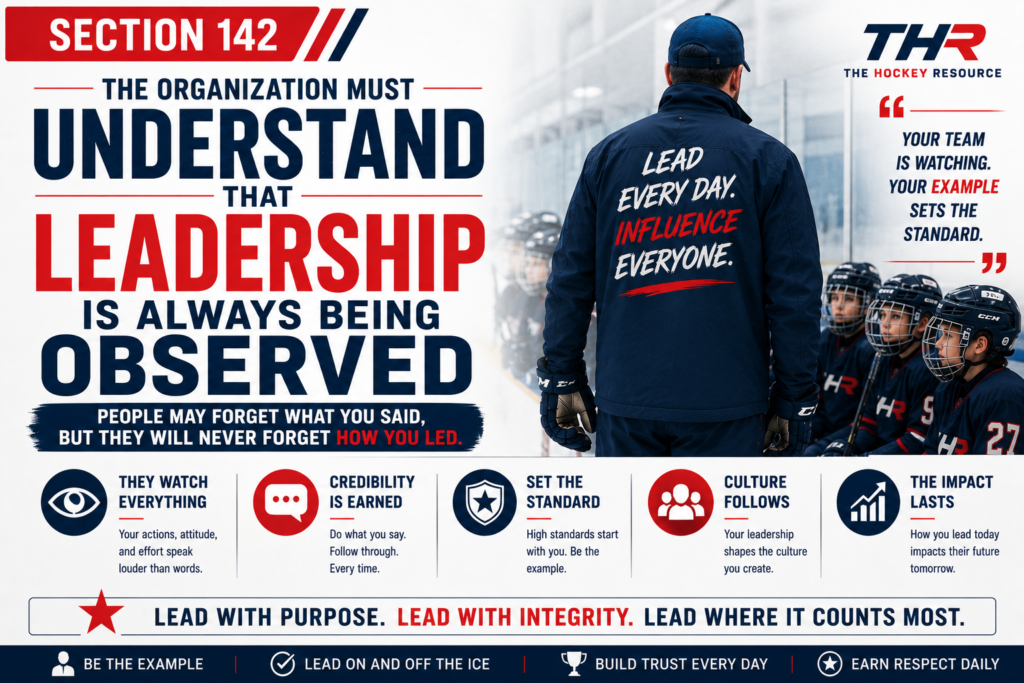

Many organizations spend years searching for strong leaders.
Few spend enough time developing them.
That is a mistake.
The long-term strength of a hockey organization is not determined by the quality of a single president, board member, coach, or volunteer. Instead, it is determined by how many people are prepared to step forward when leadership opportunities arise.
Organizations that depend on a handful of individuals often struggle during periods of transition. Organizations that continuously develop new leaders tend to remain stable, adaptable, and resilient.
For that reason, leadership development should be viewed as a strategic priority rather than an occasional activity.
Leadership Is Not a Position
One of the biggest misconceptions in hockey organizations is the belief that leadership belongs only to people with titles.
Presidents lead.
Board members lead.
Committee chairs lead.
However, leadership exists throughout the organization.
Coaches influence culture.
Team managers shape experiences.
Volunteers set examples.
Parents contribute to the environment around young athletes.
When leadership is viewed this way, development opportunities become much easier to identify.
Organizations Grow When People Grow
Strong organizations understand a simple truth.
As individuals improve, the organization improves.
Communication skills become stronger.
Decision-making becomes better.
Problem-solving becomes more effective.
Relationships become healthier.
Consequently, investing in people often creates greater long-term returns than investing in systems alone.
Leadership development is ultimately an investment in organizational capacity.
Opportunities Create Confidence
Many capable people hesitate to pursue leadership roles.
Some doubt their experience.
Others question whether they are qualified.
A number simply needs encouragement.
Providing opportunities to lead small projects, serve on committees, or contribute to initiatives allows individuals to build confidence gradually.
Over time, those experiences create future leaders.
Without opportunities, potential often remains hidden.
Mentorship Accelerates Growth
Few leaders develop entirely on their own.
Most can identify someone who provided guidance, support, or advice during critical moments.
Mentorship remains one of the most effective leadership development tools available.
Experienced leaders can share lessons learned.
They can provide perspective.
They can help emerging leaders avoid common mistakes.
More importantly, mentorship helps transfer organizational knowledge from one generation of leaders to the next.
Leadership Development Reduces Organizational Risk
Every organization eventually experiences turnover.
Volunteers leave.
Board members step down.
Families move on.
Without a leadership pipeline, these transitions can create significant disruption.
Organizations that consistently develop leaders are better prepared.
Knowledge is retained.
Responsibilities can be transferred more smoothly.
Future vacancies become less concerning.
As a result, organizational stability improves.
Empowerment Matters
Some leaders unintentionally create dependence.
Every decision flows through the same individuals.
problem requires their involvement.
initiative depends on their approval.
While this approach may provide control, it limits organizational growth.
Strong leaders empower others.
They delegate responsibility.
encourage participation.
create opportunities for others to succeed.
Through this process, leadership capacity expands across the organization.
Culture Influences Leadership Development
People are more likely to pursue leadership roles when they feel supported.
A welcoming environment encourages participation.
Respectful communication encourages engagement.
Constructive feedback encourages growth.
Organizations that create positive cultures often develop leaders more effectively because individuals feel comfortable stepping forward and contributing.
Culture and leadership development are closely connected.
Final Leadership Reality
A great leader can improve an organization.
A great leadership culture can transform it.
Organizations that focus exclusively on current leaders often struggle with succession, continuity, and growth.
Organizations that continuously develop new leaders create lasting strength.
Ultimately, leadership is not measured by how many people follow.
Leadership is measured by how many future leaders are created along the way.
One-Line Truth:
The strongest organizations are not built around one leader—they are built around a culture that develops many leaders.
This article is part of the Foundations of Modern Hockey Leadership series.
About The Hockey Resource
The Hockey Resource exists to help players, parents, coaches, teams, leagues, tournaments, and hockey organizations make better decisions through education and community-focused resources.
For additional hockey leadership articles, hockey parent resources, tournament information, and industry insights, visit:
The Hockey Resource – https://thehockeyresource.com
The Hockey Tournament Resource – https://thehockeytournamentresource.com
Mark Hetherman
Executive Director
The Hockey Resource
As always, thank you for being part of The Hockey Resource Community.
AMAZON Hockey
NEW Tournament Search APP
https://play.google.com/store/apps/details?id=com.hockeyresource.hockeytournamentapp&hl=en_CA&pli=1
NEW!!! The Hockey Moments Cards
GUMROAD – eBooks
https://thehockeyresource.gumroad.com
SEE My Interview with the Mental Health Academy
https://thehockeyresource.com/category/blog/hockey-career-starts-here
SEE My Interview on Podcast with Constant Sports
https://www.youtube.com/watch?v=_8VJUTfAGp