
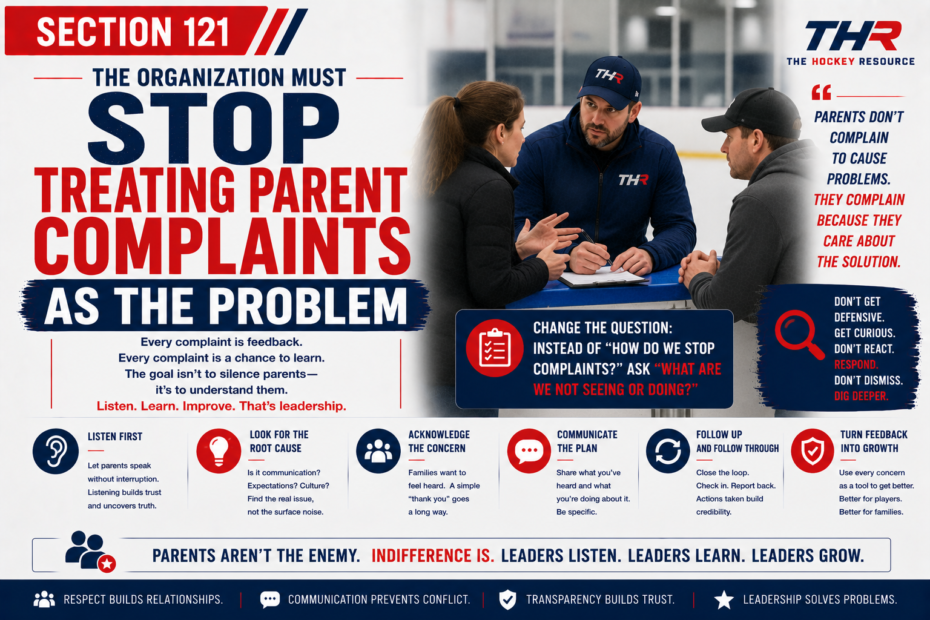
Few things create more stress for executives than parent complaints.
Emails arrive late at night.
Phone calls follow games.
Concerns appear on social media.
Board members discuss recurring issues at meetings.
Over time, some organizations begin viewing complaints themselves as the problem.
That perspective is understandable.
It is also dangerous.
In many cases, complaints are not the actual problem. Instead, they are symptoms of something deeper that deserves attention.
Strong organizations understand the difference.
Every Complaint Contains Information
Not every complaint is valid.
every concern requires organizational change.
every criticism reflects the full picture.
Nevertheless, every complaint contains information.
A parent may be frustrated by communication.
volunteer may feel unsupported.
coach may believe expectations are unclear.
The complaint itself is often less important than the issue that triggered it.
Leaders who focus only on stopping complaints may miss valuable opportunities for improvement.
Patterns Matter More Than Individual Incidents
Every organization occasionally encounters unreasonable complaints.
That reality is unavoidable.
One isolated concern does not necessarily indicate a systemic problem.
Patterns are different.
When multiple families raise similar issues, leadership should pay attention.
When volunteers express the same frustration repeatedly, it deserves investigation.
coaches identify recurring obstacles, those concerns may reveal opportunities for improvement.
Strong leaders look for trends rather than reacting solely to individual situations.
Defensive Leadership Creates Bigger Problems
Many complaints trigger defensive reactions.
“We already explained that.”
“They do not understand the situation.”
“We followed the policy.”
Those statements may be accurate.
However, defensiveness often prevents productive conversations.
Listening does not require agreement.
It simply requires a willingness to understand another perspective.
Organizations that remain open to feedback are usually better positioned to identify and address emerging challenges.
Communication Solves Many Complaints
A surprising number of complaints originate from uncertainty.
Families lack information.
Expectations are unclear.
Processes are misunderstood.
As a result, assumptions begin replacing facts.
Proactive communication can prevent many of these situations.
When organizations explain decisions, clarify expectations, and provide regular updates, confusion often decreases.
Consequently, complaint volume frequently declines as well.
Some Complaints Reveal Organizational Blind Spots
Leadership teams see the organization from a unique perspective.
Board members attend meetings.
Committee members understand operational challenges.
Parents and volunteers experience the organization differently.
That difference matters.
Occasionally, complaints reveal issues that leadership did not realize existed.
The concern may not always be presented perfectly. Nevertheless, it can still highlight a legitimate area for improvement.
Strong leaders remain curious enough to explore that possibility.
Respect Should Remain Constant
A complaint should never determine how someone is treated.
Parents deserve respect.
Volunteers deserve respect.
Coaches deserve respect.
Professional responses create better outcomes than emotional reactions.
Even when leadership ultimately disagrees with the concern being raised, respectful communication helps preserve relationships and maintain trust.
That professionalism becomes especially important during difficult conversations.
Organizations Improve Through Feedback
The strongest organizations actively seek feedback rather than avoiding it.
Surveys.
Conversations.
Committee discussions.
Volunteer meetings.
These tools create opportunities to identify concerns before they become larger problems.
More importantly, they demonstrate that leadership values community input.
When people feel heard, trust often grows.
Final Leadership Reality
Parent complaints can be frustrating.
Volunteer concerns can be uncomfortable.
Critical feedback can be difficult to hear.
Yet these moments often provide valuable information about an organization’s health.
Strong leaders do not view complaints as enemies.
They view them as opportunities to understand experiences, identify patterns, and improve the organization.
The goal is not to eliminate every complaint.
The goal is to create an environment where concerns can be addressed constructively and professionally.
One-Line Truth:
The complaint is not always the problem—sometimes it is the clue that helps reveal the real problem.
This article is part of the Foundations of Modern Hockey Leadership series.
About The Hockey Resource
The Hockey Resource exists to help players, parents, coaches, teams, leagues, tournaments, and hockey organizations make better decisions through education, leadership, and community-focused resources.
For additional hockey leadership articles, hockey parent resources, tournament information, and industry insights, visit:
The Hockey Resource – https://thehockeyresource.com
The Hockey Tournament Resource – https://thehockeytournamentresource.com
Mark Hetherman
Executive Director
The Hockey Resource

As always, thank you for being part of The Hockey Resource Community.
AMAZON Hockey
NEW Tournament Search APP
https://play.google.com/store/apps/details?id=com.hockeyresource.hockeytournamentapp&hl=en_CA&pli=1
NEW!!! The Hockey Moments Cards
GUMROAD – eBooks
SEE My Interview with the Mental Health Academy
https://thehockeyresource.com/category/blog/hockey-career-starts-here
SEE My Interview on Podcast with Constant Sports