
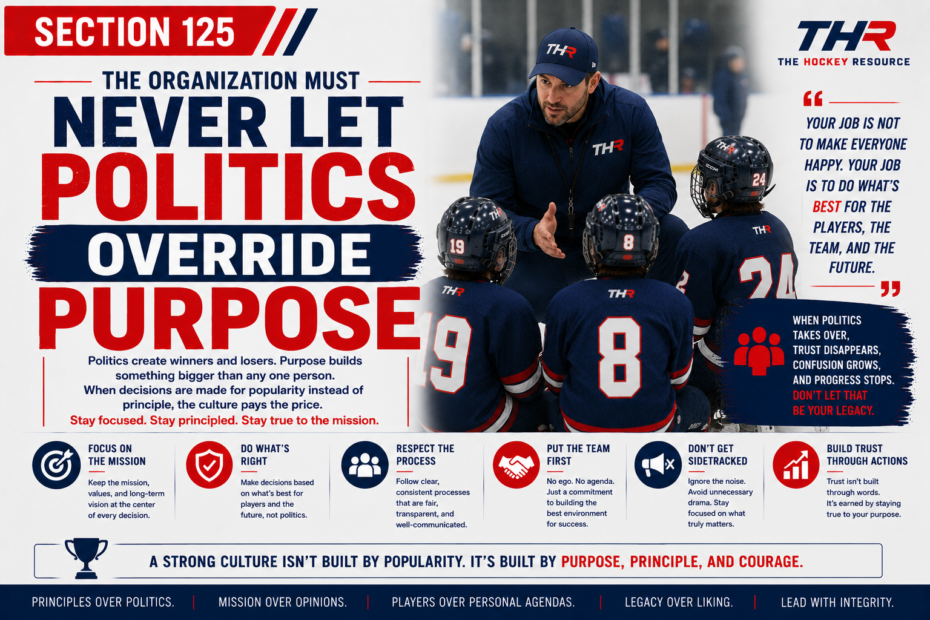
Every hockey organization begins with a purpose.
Develop players.
Support families.
Build community.
Create positive experiences through sport.
Over time, however, some organizations drift away from that purpose.
Personal agendas emerge.
Internal politics develop.
Relationships begin influencing decisions.
Disagreements become more about people than principles.
When this happens, the organization slowly starts serving itself instead of serving its members.
Strong leaders recognize this risk and work continuously to keep the mission at the center of every decision.
Politics Exists in Every Organization
Many people dislike the word politics.
Unfortunately, avoiding the word does not eliminate the reality.
Whenever groups of people work together, differences in opinion will exist.
Different priorities emerge.
perspectives compete for attention.
personalities influence discussions.
This is normal.
The problem is not the existence of politics.
The problem occurs when politics becomes more important than purpose.
Members Notice More Than Leaders Realize
Parents pay attention.
Volunteers pay attention.
Coaches pay attention.
People notice when decisions appear driven by relationships rather than principles.
They notice when rules apply differently to different groups.
They notice when organizational priorities seem to change depending on who is involved.
As these observations accumulate, trust begins to weaken.
Consequently, leaders must understand that perceptions of fairness matter as much as fairness itself.
Purpose Creates Alignment
Organizations operate more effectively when everyone understands why they exist.
Purpose creates clarity.
creates consistency.
provides a framework for decision-making.
When difficult situations arise, leaders can ask a simple question:
Does this decision support our mission?
That question often provides greater guidance than personal preferences or political considerations.
Personal Agendas Create Division
Most volunteers join hockey organizations for positive reasons.
They want to contribute.
They want to help players.
They want to strengthen the community.
Occasionally, personal agendas begin influencing behaviour.
A position becomes more important than the mission.
An individual priority becomes more important than organizational goals.
A disagreement becomes personal.
When this occurs, collaboration becomes more difficult and trust often declines.
Strong leaders recognize these warning signs early.
Transparency Reduces Political Tension
Uncertainty creates opportunities for speculation.
Speculation creates opportunities for mistrust.
Transparent communication helps reduce both.
When decision-making processes are clear, people are less likely to assume hidden motives.
When expectations are consistent, confidence grows.
When leadership explains its reasoning, members gain a better understanding of organizational priorities.
Transparency does not eliminate disagreements.
It often reduces suspicion.
Leadership Requires Objectivity
Every leader has opinions.
Every leader has relationships.
Every leader has personal experiences that influence perspective.
The challenge is ensuring those factors do not override the organization’s best interests.
Effective leaders strive for objectivity.
They evaluate decisions fairly.
consider multiple viewpoints.
focus on long-term organizational success rather than short-term personal preferences.
That discipline strengthens credibility.
Healthy Governance Protects the Mission
Strong governance structures exist for a reason.
Policies create consistency.
Committees create accountability.
Board processes create oversight.
These systems help ensure decisions remain aligned with organizational values and objectives.
Without them, personal influence can gradually replace principled leadership.
Healthy governance protects both the organization and the people leading it.
Final Leadership Reality
Politics will always exist to some degree in community organizations.
The goal is not to eliminate differences of opinion.
The goal is to ensure that purpose remains more powerful than politics.
Organizations thrive when decisions are guided by mission, values, and the needs of the community.
They struggle when personal agendas become the primary influence.
Great leaders understand this distinction.
More importantly, they protect it.
One-Line Truth:
The moment politics becomes more important than purpose, the organization begins moving away from the people it exists to serve.
This article is part of the Foundations of Modern Hockey Leadership series.
About The Hockey Resource
The Hockey Resource exists to help players, parents, coaches, teams, leagues, tournaments, and hockey organizations make better decisions through education, leadership, and community-focused resources.
For additional hockey leadership articles, hockey parent resources, tournament information, and industry insights, visit:
The Hockey Resource – https://thehockeyresource.com
The Hockey Tournament Resource – https://thehockeytournamentresource.com
Mark Hetherman
Executive Director
The Hockey Resource
As always, thank you for being part of The Hockey Resource Community.
AMAZON Hockey
NEW Tournament Search APP
https://play.google.com/store/apps/details?id=com.hockeyresource.hockeytournamentapp&hl=en_CA&pli=1
NEW!!! The Hockey Moments Cards
GUMROAD – eBooks
https://thehockeyresource.gumroad.com
SEE My Interview with the Mental Health Academy
https://thehockeyresource.com/category/blog/hockey-career-starts-here
SEE My Interview on Podcast with Constant Sports
https://www.youtube.com/watch?v=_8VJUTfAGp
TheHockeyResource.com