
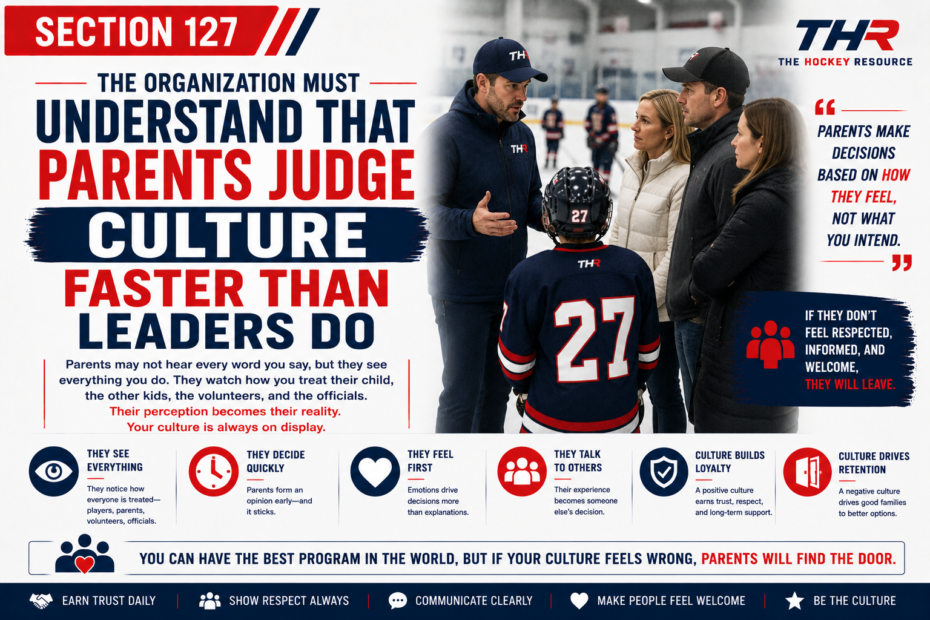
Most Hockey organizations spend significant time discussing culture.
Mission statements are created.
Core values are defined.
Leadership teams talk about respect, accountability, and development.
All of these efforts are important.
However, there is a reality that many organizations overlook.
Parents often identify cultural problems long before leadership recognizes them.
Families experience the organization differently.
They see interactions at practices.
observe communication between coaches and players.
watch how volunteers are treated.
They hear conversations in hallways and arenas.
As a result, parents frequently form opinions about organizational culture much faster than leaders expect.
Culture Is Experienced, Not Announced
Organizations sometimes assume that culture is defined by what leadership says.
In reality, culture is defined by what people experience.
A website may talk about respect.
handbook may discuss accountability.
presentation may highlight organizational values.
None of these things matter if daily behaviour tells a different story.
Parents judge culture based on actions.
How concerns are handled.
players are treated.
coaches communicate.
How volunteers are supported.
These experiences shape perception far more than any formal statement.
Small Behaviours Reveal Big Truths
Cultural problems rarely begin with major incidents.
More often, they appear through smaller behaviours.
A coach speaking disrespectfully.
volunteer feeling ignored.
parent being dismissed.
policy applied inconsistently.
Individually, these situations may seem minor.
Collectively, they tell a story about the organization.
Families notice those stories.
Over time, they begin sharing them with others.
That process influences reputation and trust.
Parents Compare What Organizations Say and Do
Families pay close attention to consistency.
When organizational behaviour aligns with stated values, confidence grows.
When behaviour contradicts stated values, credibility suffers.
For example, an organization that promotes respect but tolerates disrespectful behaviour sends mixed messages.
Similarly, an organization that emphasizes communication while ignoring parent concerns creates confusion.
Strong cultures require alignment between words and actions.
Parents notice when that alignment exists.
They also notice when it does not.
Feedback Provides Valuable Insight
Some organizations become defensive when parents raise cultural concerns.
That reaction can be costly.
Parents experience the organization from a unique perspective.
They often identify issues leadership cannot easily see.
Listening to feedback does not require agreement with every concern.
It does require curiosity.
Organizations that remain open to feedback are more likely to recognize emerging problems before they become larger challenges.
Culture Influences Retention
Families rarely leave organizations because of a single practice or one difficult game.
More often, they leave because of culture.
They no longer feel welcomed.
no longer trust leadership.
no longer believe the environment aligns with their expectations.
This reality makes culture one of the most important retention factors in youth hockey.
Strong cultures attract families.
Weak cultures drive them away.
Leadership Must Regularly Assess Reality
Board members should not assume culture is healthy simply because no one is complaining.
Silence does not always indicate satisfaction.
Leaders should actively seek input.
Surveys can help.
Conversations can help.
Volunteer feedback can help.
The goal is understanding what people are actually experiencing rather than what leadership hopes they are experiencing.
That distinction is critical.
Culture Is Built Every Day
Culture is not created during annual planning sessions.
It is built daily.
Every conversation matters.
interaction matters.
leadership decision matters.
Parents witness these moments throughout the season.
Their perceptions are shaped accordingly.
Organizations that understand this reality are far more likely to create cultures that reflect their stated values.
Final Leadership Reality
Leadership teams often spend years trying to build positive cultures.
Parents can often tell within weeks whether those efforts are succeeding.
That reality should not be viewed as criticism.
It should be viewed as valuable feedback.
Families experience the organization firsthand.
Their observations often provide important clues about cultural strengths and weaknesses.
Strong organizations pay attention.
More importantly, they act on what they learn.
One-Line Truth:
Parents usually judge an organization’s culture by what they experience, not by what the organization says about itself.
This article is part of the Foundations of Modern Hockey Leadership series.
About The Hockey Resource
The Hockey Resource exists to help players, parents, coaches, teams, leagues, tournaments, and hockey organizations make better decisions through education, leadership, and community-focused resources.
For additional hockey leadership articles, hockey parent resources, tournament information, and industry insights, visit:
The Hockey Resource – https://thehockeyresource.com
The Hockey Tournament Resource – https://thehockeytournamentresource.com
Mark Hetherman
Executive Director
The Hockey Resource
As always, thank you for being part of The Hockey Resource Community.
AMAZON Hockey
NEW Tournament Search APP
https://play.google.com/store/apps/details?id=com.hockeyresource.hockeytournamentapp&hl=en_CA&pli=1
NEW!!! The Hockey Moments Cards
GUMROAD – eBooks
https://thehockeyresource.gumroad.com
SEE My Interview with the Mental Health Academy
https://thehockeyresource.com/category/blog/hockey-career-starts-here
SEE My Interview on Podcast with Constant Sports