
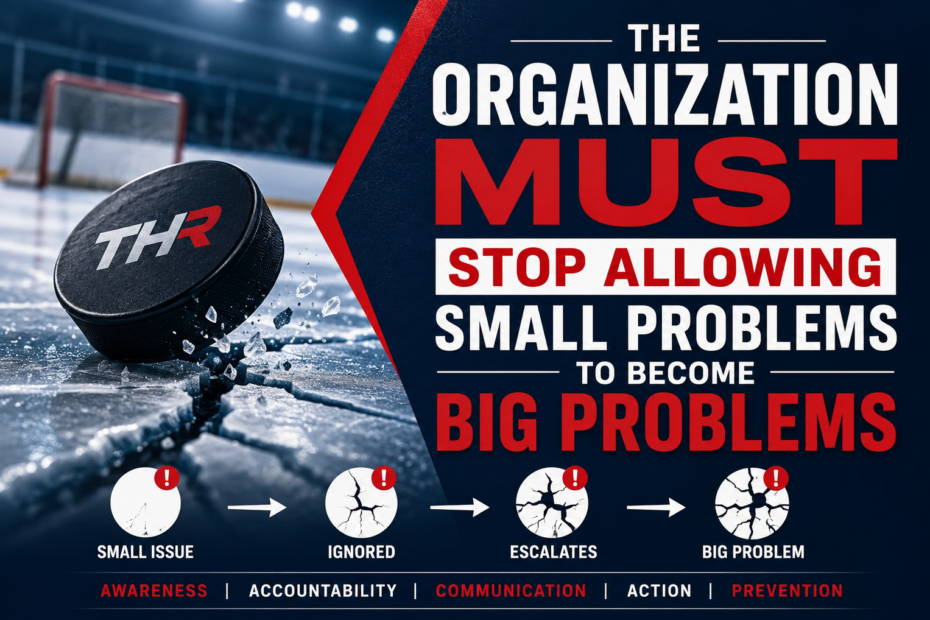
Major organization challenges rarely appear without warning.
Conflict does not usually emerge overnight.
Volunteer burnout does not happen in a single week.
Parent frustration does not suddenly appear without cause.
More often, significant problems begin as small issues that receive little attention.
A misunderstanding goes unresolved.
A concern is dismissed.
An expectation remains unclear.
Months later, leadership finds itself dealing with a much larger situation.
Strong organizations recognize that early intervention is one of the most valuable leadership skills they can develop.
Small Issues Tend to Grow
Problems rarely stay the same size.
A communication concern may affect one family today.
Left unaddressed, it may influence multiple families later.
A frustrated volunteer may remain engaged for a while.
Eventually, that frustration may lead to resignation.
An unresolved coaching issue may begin as a minor concern.
Over time, it can affect team culture and parent confidence.
Addressing issues early is often easier, less stressful, and more effective than waiting.
People Want to Feel Heard
Not every concern requires immediate action.
Not every complaint requires organizational change.
However, people generally want to know their concerns have been acknowledged.
Listening creates trust.
Ignoring concerns creates frustration.
Even when leadership cannot provide the outcome someone desires, respectful communication often prevents situations from escalating unnecessarily.
This principle applies across every level of the organization.
Delayed Conversations Create Risk
Difficult conversations are rarely enjoyable.
Because of this, leaders sometimes postpone them.
A coach issue is left alone.
volunteer concern is set aside.
parent conflict is allowed to linger.
Unfortunately, delay often increases complexity.
Issues that could have been resolved quickly may become far more challenging weeks or months later.
Timely conversations usually produce better outcomes.
Warning Signs Deserve Attention
Healthy organizations pay attention to patterns.
Attendance begins to decline.
Volunteer participation decreases.
Feedback becomes increasingly negative.
Communication slows down.
None of these signs automatically indicate a major problem.
At the same time, they may signal that something deserves further attention.
Leaders who notice trends early gain an opportunity to act before situations become more difficult to manage.
Proactive Leadership Reduces Crisis Management
Some organizations spend much of their time reacting.
A problem appears.
Leadership responds.
Another problem emerges.
The cycle continues.
By contrast, proactive organizations focus on prevention.
Potential concerns are identified.
Processes are reviewed.
Communication gaps are addressed.
This approach reduces the number of crises requiring urgent attention.
Culture Influences Problem Resolution
A positive culture encourages openness.
People feel comfortable asking questions.
Volunteers feel comfortable raising concerns.
Families feel comfortable seeking clarification.
When communication flows freely, issues are often identified earlier and resolved more effectively.
That environment benefits everyone involved.
Prevention Is Usually Less Expensive
Large problems often require significant resources.
Additional meetings may be needed.
Relationships may need repair.
Community confidence may need rebuilding.
By comparison, addressing concerns early often requires far less effort.
Preventive leadership protects both organizational resources and organizational reputation.
Final Leadership Reality
Leadership is not simply about solving problems.
It is also about preventing problems from growing.
The strongest organizations recognize concerns early, communicate openly, and address issues before they become crises.
This approach requires attention, discipline, and sometimes uncomfortable conversations.
Nevertheless, the alternative is usually much more difficult.
Small problems are easiest to solve while they are still small.
One-Line Truth:
The easiest problem to solve is the one addressed before it has a chance to grow.
This article is part of the Foundations of Modern Hockey Leadership series.
About The Hockey Resource
The Hockey Resource exists to help players, parents, coaches, teams, leagues, tournaments, and hockey organizations make better decisions through education, leadership, and community-focused resources.
For additional hockey leadership articles, hockey parent resources, tournament information, and industry insights, visit:
The Hockey Resource – https://thehockeyresource.com
The Hockey Tournament Resource – https://thehockeytournamentresource.com
Mark Hetherman
Executive Director
The Hockey Resource
As always, thank you for being part of The Hockey Resource Community.
AMAZON Hockey
NEW Tournament Search APP
https://play.google.com/store/apps/details?id=com.hockeyresource.hockeytournamentapp&hl=en_CA&pli=1
NEW!!! The Hockey Moments Cards
GUMROAD – eBooks
https://thehockeyresource.gumroad.com
SEE My Interview with the Mental Health Academy
https://thehockeyresource.com/category/blog/hockey-career-starts-here
SEE My Interview on Podcast with Constant Sports