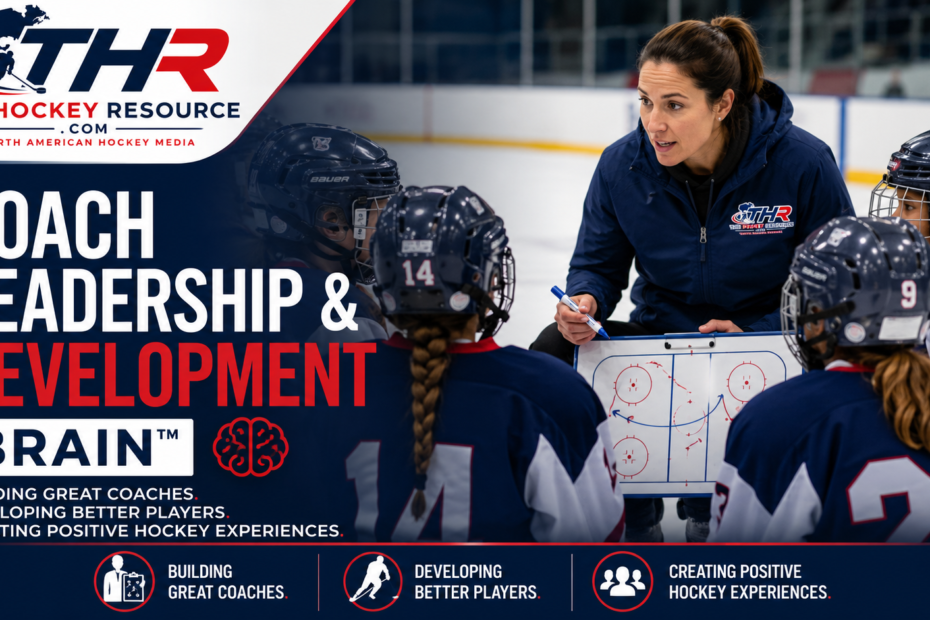
Leading with Confidence, Composure, and Purpose
Coach Leadership & Development BRAIN™
The BRAIN Behind Better Coaching™
The puck has dropped.
Your practice plans are complete. Your systems have been installed. Your players are ready.
Now comes one of the most overlooked coaching skills in hockey—game day leadership.
Many coaches believe games are won by making the perfect line change or drawing up the perfect play. While strategy matters, the greatest game-day leaders understand something even more important: players perform their best when their coach provides confidence, stability, and clear direction.
If you’ve already read Section 152A – How to Build a Positive Team Culture in Hockey, you’ll recognize that culture is tested on game day, not created there. Likewise, the communication principles discussed in Section 152B – How Great Hockey Coaches Build Trust Through Communication become even more valuable when emotions are high, and the preparation techniques from Section 152C – How to Plan Hockey Practices That Develop Every Player should naturally carry into competition.
According to USA Hockey’s American Development Model (ADM) (https://www.usahockey.com/adm), games should reinforce player development by encouraging decision-making, creativity, and confidence rather than fear of making mistakes. Similarly, Hockey Canada promotes creating positive game environments where learning remains a priority alongside competition (https://www.hockeycanada.ca).
Great Coaching Starts Before the Opening Faceoff
Outstanding coaches rarely make emotional decisions because most of their work has already been completed before arriving at the arena.
Before the game begins, review:
- Line combinations
- Special teams
- Matchups
- Opponent tendencies
- Player availability
- Goaltending plan
- Bench responsibilities
Preparation reduces stress.
Players quickly recognize when a coach is organized.
For more preparation strategies, read Section 152C – How to Plan Hockey Practices That Develop Every Player and our Practice Planning BRAIN™ resource (Internal Link).
Set the Emotional Temperature
Players constantly watch their coach.
If you’re nervous…
They become nervous.
If you’re angry…
They become anxious.
If you’re calm…
Confidence spreads throughout the bench.
Pregame meetings should inspire—not overwhelm.
Instead of discussing fifteen tactical adjustments, focus on three simple priorities players can remember throughout the game.
The NHL Coaches’ Association regularly discusses the importance of preparation, communication, and maintaining composure behind the bench (https://www.nhlcoaches.com).
Coach the Next Shift
One bad shift should never define a player.
One mistake should never erase a week of outstanding practice.
Great coaches avoid questions like:
“What were you thinking?”
Instead ask:
“What did you see?”
“What can we do differently next shift?”
This approach develops hockey IQ while protecting player confidence.
Our Player Development BRAIN™ explores how confidence directly influences decision-making and long-term improvement (Internal Link).
Keep Communication Short
Hockey moves too quickly for long speeches.
Effective bench communication sounds like this:
- “Good read.”
- “Keep moving.”
- “Support low.”
- “Stay patient.”
- “Next shift.”
Short messages keep players thinking about solutions rather than mistakes.
If you’d like to improve your communication style, continue with Section 152B – How Great Hockey Coaches Build Trust Through Communication (Internal Link).
Manage People Before Managing the Score
Winning coaches monitor far more than goals.
Watch for:
- Confidence
- Fatigue
- Frustration
- Body language
- Energy
- Engagement
Sometimes your best coaching decision isn’t tactical.
Sometimes it’s simply encouraging a player who needs reassurance.
Our Hockey Leadership BRAIN™ explains why emotional intelligence often separates exceptional coaches from average ones (Internal Link).
Adapt Without Panic
Every hockey game changes.
A goalie gives up an early goal.
A defenseman gets injured.
Your top scorer takes a penalty.
Championship coaches don’t panic.
They evaluate.
Ask:
- What’s actually happening?
- Is this temporary?
- Do we need adjustments or patience?
Most games are lost by emotional decisions rather than strategic ones.
The International Ice Hockey Federation (IIHF) emphasizes adaptability, communication, and player decision-making as core coaching competencies within its coach education resources (https://www.iihf.com).
Respect the Officials
Officials will miss calls.
Coaches will disagree.
Players are watching your response.
Every conversation with an official teaches your team how to handle adversity.
Respect earns credibility.
Arguing every decision rarely changes the outcome.
Both USA Hockey and Hockey Canada identify respect for officials as an essential component of player and coach development.
Every Player Needs Coaching
Not every player receives equal ice time.
Every player deserves equal attention.
Talk to every player.
Recognize:
- Smart decisions
- Hard work
- Team-first attitude
- Strong communication
- Hustle
Players remember how coaches make them feel far longer than they remember the final score.
Continue reading Section 151 – Building Positive Relationships with Every Player to strengthen your daily coaching relationships (Internal Link).
Use Intermissions Wisely
Intermissions are for clarity.
Not criticism.
A simple format works best.
What went well?
Celebrate success.
What needs adjustment?
Identify one or two priorities.
What do we believe?
Finish positively.
Players leave the room believing they can succeed.
The Post-Game Matters
The final buzzer doesn’t end coaching.
Whether you win or lose:
Teach.
Encourage.
USA Hockey – American Development Model (ADM): https://www.usahockey.com/adm Hockey Canada – Coaching Resources: https://www.hockeycanada.ca IIHF – Coaching Development: https://www.iihf.com NHL Coaches’ Association: https://www.nhlcoaches.com
Reflect.
Develop.
Many of the most important conversations happen after the game. That’s why our The Car Ride Home BRAIN™ helps parents reinforce positive lessons once families leave the arena (Internal Link). Coaches can also encourage parents to explore Hockey Parent BRAIN™ for guidance on supporting young athletes throughout the season (Internal Link).
Coach Leadership & Development BRAIN™ Takeaway
Game-day leadership isn’t about controlling every shift.
It’s about creating an environment where players can perform with confidence.
Great coaches prepare thoroughly, communicate clearly, remain composed during adversity, respect everyone involved in the game, and help players focus on the next opportunity instead of the last mistake.
Winning games is rewarding.
Developing people is lasting.
The coaches who do both become the leaders players remember for life.