One of the most dangerous structural weaknesses in Hockey organizations:
allowing the organization to become dependent on individuals instead of systems.
This happens constantly in minor Hockey.
One coach becomes:
“untouchable.”
One volunteer becomes:
“the only person who knows how things work.”
One board member becomes:
“the organization.”
One parent group begins:
controlling emotional direction.
Eventually:
the organization stops operating through:
- structure
- standards
- and process
and starts operating through:
personalities,
relationships,
and influence.
That creates:
fragility.
Strong organizations understand:
no single person should ever become:
larger than:
- the culture
- the standards
- the structure
- or the long-term health of the organization.
WHAT THIS ACTUALLY MEANS
Healthy organizations are built around:
- systems
- leadership standards
- documented process
- communication structure
- and organizational philosophy
Not:
individual control.
This does NOT mean:
people are unimportant.
Strong people matter enormously.
But healthy organizations remain:
stable even when:
leaders,
coaches,
or volunteers change over time.
That is:
organizational maturity.
IN SIMPLE TERMS
If one person leaving creates chaos,
the organization relied too heavily on:
a personality —
not proper structure.
THE BIGGEST “ONE PERSON” FAILURE IN HOCKEY
Many organizations unintentionally build:
dependency culture.
Examples:
- only one person understands operations
- one coach controls culture completely
- one volunteer handles all communication
- one leader makes every decision
- or organizational knowledge exists only inside people’s heads
This creates:
- burnout
- instability
- fear of change
- leadership bottlenecks
- and organizational paralysis
Strong organizations distribute:
knowledge,
leadership,
and responsibility intentionally.
IMPORTANT REALITY
Organizations become fragile when:
systems depend entirely on personalities.
THE DANGER OF “UNTOUCHABLE” PEOPLE
Some organizations eventually protect individuals because:
- they win
- they volunteer heavily
- they donate
- they have influence
- or leadership fears losing them
This becomes dangerous quickly.
The moment someone becomes:
“above accountability,”
organizational culture weakens.
Strong organizations protect:
standards first.
Not:
individual status.
THE ROLE OF STRUCTURE
Structure protects organizations from:
personality dependence.
Strong organizations document:
- processes
- communication systems
- operational procedures
- leadership expectations
- and organizational standards
This creates:
continuity.
Weak organizations rely on:
memory,
relationships,
and informal knowledge.
That creates:
organizational vulnerability.
IN SIMPLE TERMS
Healthy organizations should still function well:
even when leadership changes.
THE ROLE OF SUCCESSION PLANNING
Strong organizations constantly prepare:
future leaders.
This includes:
- mentoring volunteers
- onboarding future board members
- developing assistant coaches
- sharing operational knowledge
- and documenting systems
Weak organizations wait until:
someone leaves —
then panic.
Leadership continuity should be:
intentional.
IMPORTANT REALITY
Healthy organizations think:
years ahead.
Not:
season to season only.
THE ROLE OF HUMILITY
Strong leaders understand:
they are:
temporary stewards of the organization.
Not:
owners of it emotionally.
Weak leadership often becomes:
ego-attached to position,
control,
or identity inside the organization.
That creates:
power struggles and instability.
Healthy leadership prepares:
the organization to thrive even beyond themselves.
That is:
real leadership maturity.
THE DANGER OF PERSONALITY-DRIVEN CULTURE
Some organizations become emotionally controlled by:
dominant personalities.
Examples:
- emotional leaders setting organizational tone
- powerful coaches controlling standards privately
- influential parents shaping decisions emotionally
- or volunteers operating without accountability because:
“we need them”
This weakens:
organizational fairness and structure.
Strong organizations ensure:
systems remain stronger than personalities.
THE ROLE OF LEADERSHIP TEAMS
Healthy organizations build:
shared leadership.
Not:
single-person dependency.
Strong leadership teams:
- communicate
- align standards
- distribute responsibilities
- and support organizational continuity together
This creates:
greater stability and sustainability.
IN SIMPLE TERMS
Organizations become healthier when:
leadership becomes:
shared,
structured,
and sustainable.
THE ROLE OF DOCUMENTATION
Documentation protects:
organizational continuity.
Examples:
- role descriptions
- operational manuals
- onboarding systems
- meeting procedures
- communication templates
- and leadership standards
Without documentation:
every leadership transition becomes:
emotionally chaotic.
Strong organizations preserve:
institutional knowledge intentionally.
THE DANGER OF “INFORMAL POWER”
Sometimes unofficial influence becomes:
stronger than official structure.
Examples:
- hallway decision-makers
- social group influence
- emotional lobbying
- or long-time members controlling culture informally
This creates:
politics and confusion.
Healthy organizations reinforce:
official leadership structure and process clearly.
IMPORTANT REALITY
Unclear power systems create:
organizational instability quickly.
THE ROLE OF ACCOUNTABILITY
No individual should become:
immune from accountability.
This applies to:
- Presidents
- coaches
- board members
- volunteers
- and influential families
Strong organizations protect:
organizational integrity consistently.
Weak organizations protect:
individual influence selectively.
That difference defines:
organizational culture.
THE ROLE OF COMMUNICATION
Organizations should communicate:
through systems —
not personality dependency.
Examples:
- shared communication standards
- centralized information systems
- operational calendars
- documented expectations
- and leadership alignment
Strong communication structure reduces:
organizational confusion during leadership transitions.
THE ROLE OF ORGANIZATIONAL IDENTITY
Healthy organizations build identity around:
- values
- standards
- culture
- development philosophy
- and leadership behavior
Not around:
individual personalities alone.
This creates:
long-term organizational strength.
Organizations should feel:
stable beyond any one person.
IN SIMPLE TERMS
People matter greatly.
But the organization must remain:
bigger than individuals.
THE ROLE OF CULTURE
Healthy cultures reinforce:
- teamwork
- shared responsibility
- leadership development
- accountability
- and sustainability
Toxic cultures often reinforce:
- control
- dependency
- politics
- ego
- and personality-driven leadership
Culture determines:
whether organizations become:
stable
or
fragile.
THE DANGER OF EMOTIONAL OWNERSHIP
Some leaders begin emotionally believing:
the organization belongs to them personally.
This creates:
- resistance to change
- territorial behavior
- leadership conflict
- and unhealthy power dynamics
Strong leaders understand:
their responsibility is:
to strengthen the organization —
not personally possess it emotionally.
IMPORTANT REALITY
Organizations survive longest when:
leadership thinks like:
caretakers of culture —
not controllers of it.
THE ROLE OF LONG-TERM THINKING
Strong organizations constantly ask:
- If key people leave tomorrow, does the organization remain stable?
- Are systems documented?
- Are future leaders developing?
- Is knowledge being shared?
- Are standards stronger than personalities?
That is:
organizational sustainability thinking.
THE MOST IMPORTANT STRUCTURE QUESTION
Leadership should constantly ask:
“Is this organization being strengthened structurally —
or becoming emotionally dependent on individuals?”
That question reveals:
organizational maturity immediately.
THE HARD TRUTH ABOUT PERSONALITY-DRIVEN ORGANIZATIONS
Many hockey organizations eventually experience:
- burnout
- conflict
- collapse
- politics
- or instability
because:
too much organizational weight rested on:
too few people.
Strong organizations solve this intentionally through:
structure,
leadership development,
documentation,
and succession planning.
HOW STRONG ORGANIZATIONS BECOME BIGGER THAN INDIVIDUALS
Strong organizations:
- build systems
- develop future leaders
- document operations
- distribute responsibility
- reinforce accountability
- and protect culture consistently
Over time:
the organization becomes:
- more stable
- more sustainable
- less political
- and less emotionally fragile
That becomes:
organizational longevity.
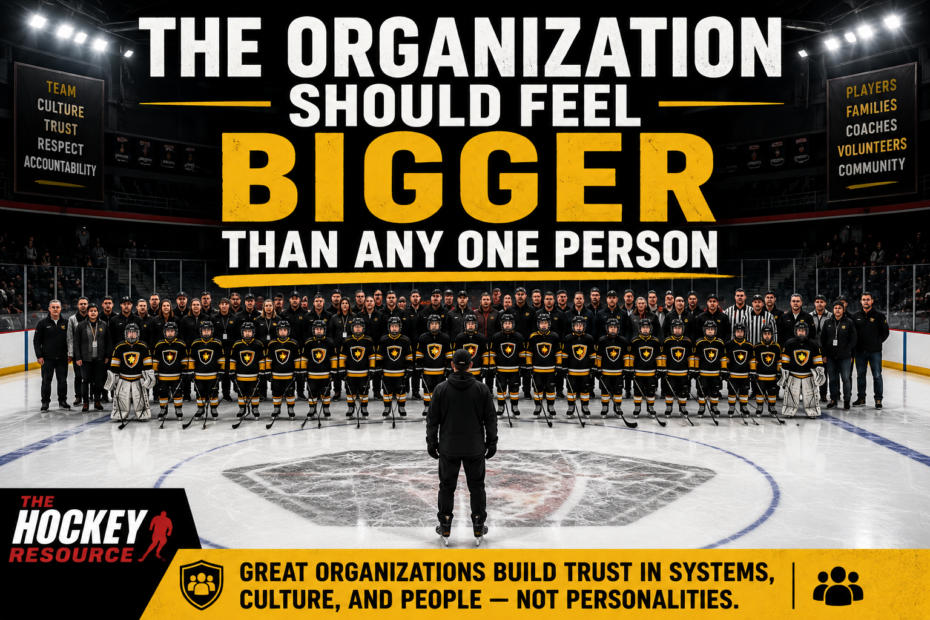
FINAL PRINCIPLE — THE ORGANIZATION MUST BE BIGGER THAN ANY ONE PERSON
Strong hockey organizations understand:
great organizations are not built around:
personalities,
control,
or emotional ownership.
They are built around:
- structure
- standards
- leadership development
- shared responsibility
- accountability
- and healthy culture
that remain stable long after:
individual people move on.
Because ultimately:
healthy organizations should feel:
stronger than any one season,
any one coach,
any one board,
or any one personality.
That is:
real organizational strength.
PRESENTED BY: thehockeyresource.com – thehockeytournamentresource.com – mark@thehockeyresource.com
As always, thank you for being part of The Hockey Resource Community.
AMAZON Hockey
NEW Tournament Search APP
https://play.google.com/store/apps/details?id=com.hockeyresource.hockeytournamentapp&hl=en_CA&pli=1
NEW!!! The Hockey Moments Cards
GUMROAD – eBooks
https://thehockeyresource.gumroad.com
SEE My Interview with the Mental Health Academy
https://thehockeyresource.com/category/blog/hockey-career-starts-here
SEE My Interview on Podcast with Constant Sports
https://www.youtube.com/watch?v=_8VJUTfAGp
CLICK LINK FOR AWESOME HOCKEY PRODUCTS – https://thehockeyresource.com/discount-hockey-products-amazon/