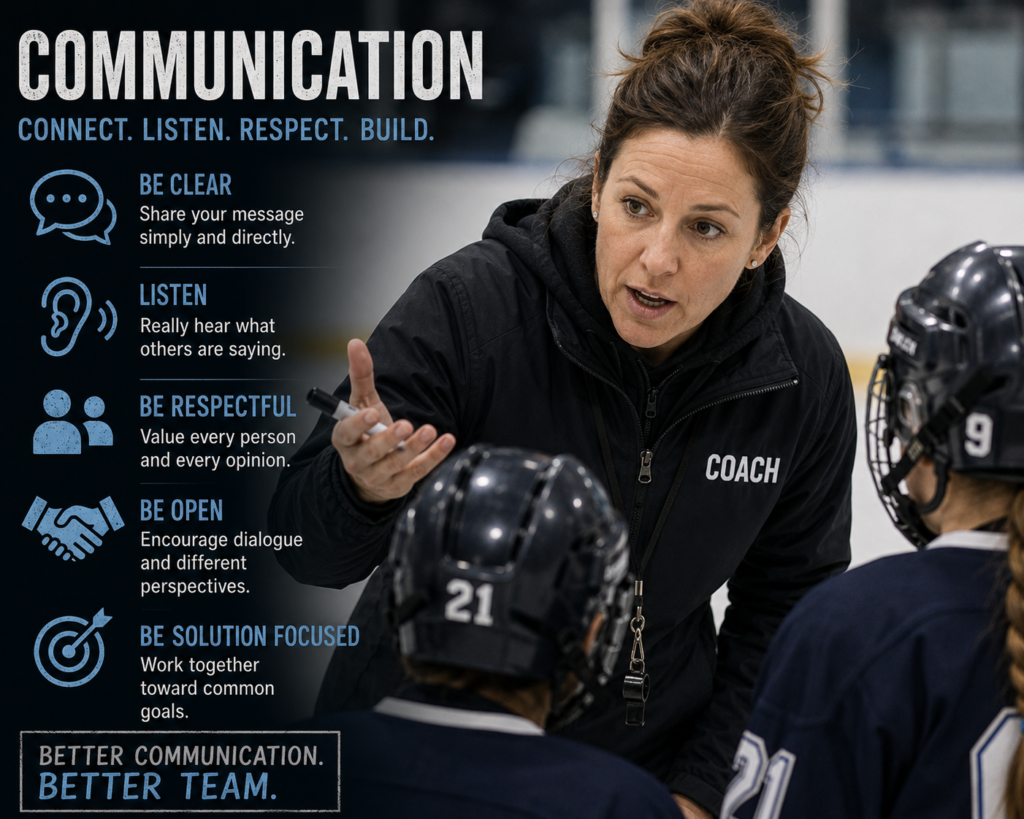
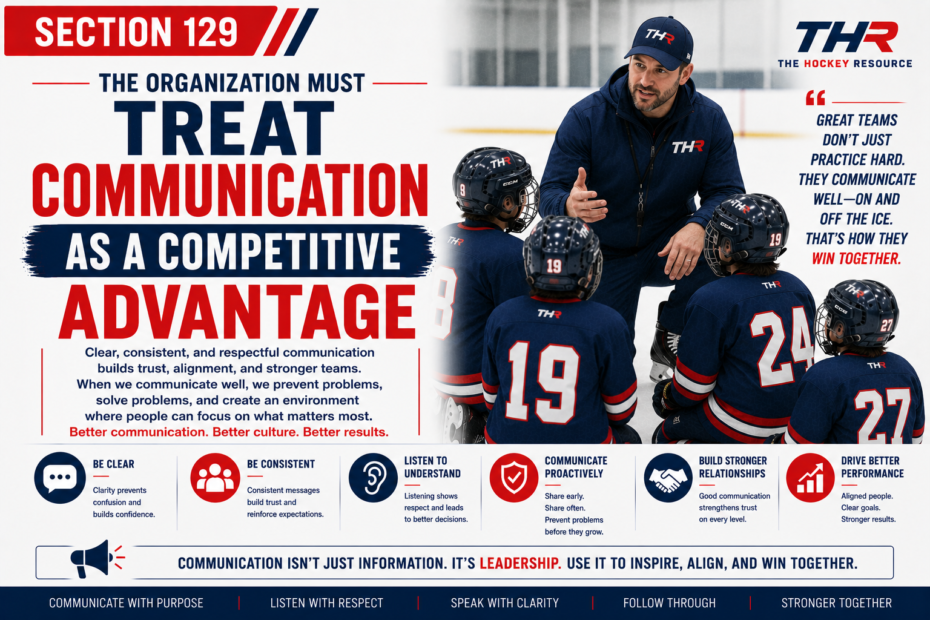
Every hockey organization communicates.
However, not every organization communicates well.
Some organizations send information only when problems arise. Others communicate inconsistently, leaving families confused about what is happening and why.
As a result, misunderstandings begin to grow. Rumours fill information gaps. Frustration increases. Trust slowly declines.
Meanwhile, the strongest organizations understand something important:
Communication is not an administrative task.
It is a leadership responsibility.
People Cannot Support What They Do Not Understand
Many organizational conflicts begin with a lack of information.
Parents become frustrated when expectations are unclear.
Volunteers become discouraged when they do not understand priorities.
Coaches struggle when communication is inconsistent.
In many cases, the issue is not the decision itself. Instead, the issue is that people do not understand the decision.
Therefore, leaders should focus on explaining both the “what” and the “why.”
When people understand the reasoning behind decisions, they are far more likely to support them.
Silence Creates Its Own Story
One of the biggest mistakes leaders make is assuming that no news is good news.
Unfortunately, silence often creates uncertainty.
When communication stops, people begin filling in the blanks themselves.
Questions become assumptions.
Assumptions become rumours.
Rumours become perceived facts.
Consequently, leadership loses control of the message.
Regular communication helps prevent this cycle. Even a brief update is often better than no update at all.
Consistency Builds Confidence
Families want reliable information.
They want to know where updates will come from, when they will arrive, and who is responsible for sharing them.
For that reason, organizations should establish communication standards.
For example, important announcements should follow a consistent process. Likewise, registration information, tryout updates, scheduling changes, and policy changes should be communicated clearly and promptly.
Over time, consistency builds confidence.
People trust organizations that communicate predictably.
Good Communication Is Two-Way
Communication is not simply about sending messages.
It is also about listening.
Strong organizations create opportunities for feedback.
They encourage questions.
They welcome respectful discussion.
Most importantly, they make people feel heard.
This does not mean leadership must agree with every opinion. However, people are more likely to accept decisions when they believe their perspective was considered.
Therefore, listening is just as important as speaking.
Difficult Conversations Matter Most
Anyone can communicate when things are going well.
Leadership is tested when circumstances become challenging.
A player concern.
coaching issue.
disciplinary matter.
controversial decision.
During these situations, communication must become even stronger.
Leaders should be honest, respectful, and timely.
Delaying difficult conversations rarely improves them. In fact, problems often become larger when communication is avoided.
Technology Is a Tool, Not a Solution
Many organizations invest heavily in communication platforms.
Apps.
Websites.
Email systems.
Social media channels.
While these tools are valuable, technology alone does not create effective communication.
People do.
The quality of the message remains more important than the method used to deliver it.
Therefore, organizations should focus on clarity, accuracy, and consistency before worrying about technology.
Great Communication Reduces Conflict
Most organizational conflict does not begin with bad intentions.
Instead, it often begins with confusion.
When expectations are clear, fewer misunderstandings occur.
When updates are timely, fewer rumours develop.
When leaders communicate openly, trust becomes easier to maintain.
As a result, many problems can be prevented before they ever reach a boardroom, bench, or parking lot.
Final Leadership Reality
Every organization communicates.
The question is whether communication strengthens or weakens trust.
Strong leaders understand that communication is more than sharing information.
It is a tool for building culture.
It is a tool for creating alignment.
Most importantly, it is a tool for building confidence throughout the organization.
When communication becomes a strength, the entire organization benefits.
One-Line Truth:
People can tolerate difficult decisions far more easily than they can tolerate poor communication.
PRESENTED BY: thehockeyresource.com and thehockeytournamentresource.com – mark@thehockeyresource.com
As always, thank you for being part of The Hockey Resource community.
You can find all the cards at thehockeytournamentresource.com
GUMROAD – ALL HOCKEY EBOOKS
https://thehockeyresource.gumroad.com/
CLICK LINK FOR AWESOME HOCKEY PRODUCTS – https://thehockeyresource.com/discount-hockey-products-amazon/
CLICK TO SEE MARK ON PODCAST https://www.buzzsprout.com/1824112/episodes/13519482
Mark Hetherman
Executive Director
The Hockey Resource
mark@thehockeyresource.com
thehockeyresource.com
thehockeytournamentresource.com
As always, thank you for being part of The Hockey Resource Community.
AMAZON Hockey
NEW Tournament Search APP
https://play.google.com/store/apps/details?id=com.hockeyresource.hockeytournamentapp&hl=en_CA&pli=1
NEW!!! The Hockey Moments Cards
GUMROAD – eBooks
https://thehockeyresource.gumroad.com
SEE My Interview with the Mental Health Academy
https://thehockeyresource.com/category/blog/hockey-career-starts-here
SEE My Interview on Podcast with Constant Sports
https://www.youtube.com/watch?v=_8VJUTfAGp