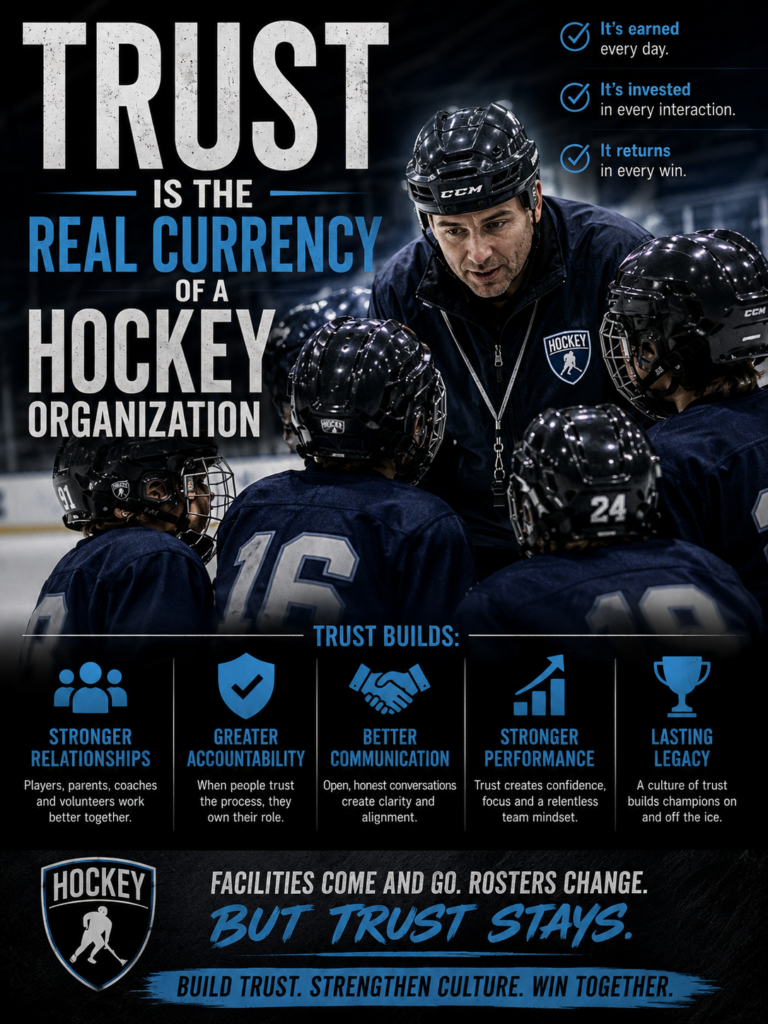
Trust is one of the most valuable assets a hockey organization can possess.
Unlike equipment, facilities, or sponsorship revenue, you can’t buy trust. It develops gradually through consistent actions, responsible leadership, and positive experiences.
Unfortunately, many organizations assume that once trust has been established, it will remain in place indefinitely.
That assumption can be costly.
Community trust must be earned repeatedly because every new season brings new families, new volunteers, new coaches, and new expectations.
Reputation Is Built Through Daily Experiences
Most people do not form opinions based on mission statements.
Instead, they judge organizations through interactions.
A parent may remember how a concern was handled.
A volunteer may recall whether support was available when challenges arose.
Likewise, a coach often evaluates leadership through communication, consistency, and professionalism.
Although these moments may seem small, they collectively shape the organization’s reputation.
Over time, those experiences become the stories people share throughout the community.
Trust Grows When Actions Match Values
Many organizations speak about respect, accountability, and player development.
Those values are important.
However, community confidence increases when people see those principles reflected in everyday decisions.
For example, a difficult situation handled fairly often strengthens trust more than a routine success. Similarly, leaders who remain transparent during challenges tend to build credibility with their members.
Words create expectations.
Actions determine whether those expectations are fulfilled.
Communication Plays a Critical Role
Uncertainty often creates frustration.
Whenever communication is inconsistent or unclear, people begin filling information gaps with assumptions.
As questions circulate, rumors can quickly replace facts.
Consequently, trust becomes harder to maintain.
Organizations that communicate regularly help prevent this problem. Even when difficult decisions must be made, timely and honest communication often reduces confusion and strengthens confidence.
In many cases, people are willing to accept outcomes they dislike if they believe the process was fair and transparent.
Every Interaction Influences Perception
Community trust is not shaped solely by the board of directors.
Parents contribute to it.
Coaches contribute to it.
Volunteers contribute to it.
Players contribute to it as well.
Because every interaction influences perception, culture becomes an important part of reputation management.
A respectful environment creates positive experiences.
A toxic environment creates negative ones.
The difference becomes visible throughout the organization.
Difficult Situations Reveal Organizational Character
Success is easy to celebrate.
Challenges are more revealing.
When conflict arises, members pay close attention to leadership behavior. They notice whether decisions are fair. They observe how communication is handled. They evaluate whether leaders remain consistent under pressure.
For that reason, difficult situations often become defining moments.
Organizations that respond professionally tend to strengthen trust, while poor responses can damage relationships that took years to build.
Community Confidence Supports Growth
Families are more likely to join organizations they trust.
Volunteers are more willing to contribute when they have confidence.
Sponsors are more comfortable supporting organizations with strong reputations.
As a result, trust influences growth in ways that are not always immediately visible.
Strong community relationships often become a competitive advantage over time.
Looking Beyond the Current Season
Building trust should never be viewed as a short-term objective.
Instead, it should be treated as an ongoing leadership responsibility.
Every decision contributes to a larger picture.
Every interaction influences perception.
Every season provides another opportunity to strengthen credibility.
Organizations that understand this perspective are often better positioned for long-term success.
Final Leadership Reality
Community trust is not built through marketing campaigns or promotional messages.
It develops when people consistently experience professionalism, fairness, respect, and accountability.
Strong organizations understand that reputation is earned one interaction at a time.
Because of that, they work diligently to ensure their actions reflect the values they promote.
In the end, trust may be invisible, but its impact can be felt throughout the organization.
One-Line Truth:
Trust is not something an organization owns—it is something the community chooses to give.
This article is part of the Foundations of Modern Hockey Leadership series.
About The Hockey Resource
The Hockey Resource exists to help players, parents, coaches, teams, leagues, tournaments, and hockey organizations make better decisions through education, leadership, and community-focused resources.
For additional hockey leadership articles, hockey parent resources, Tournament information, and industry insights, visit:
The Hockey Resource – https://thehockeyresource.com
The Hockey Tournament Resource – https://thehockeytournamentresource.com
Mark Hetherman
Executive Director
The Hockey Resource
As always, thank you for being part of The Hockey Resource Community.
AMAZON Hockey
NEW Tournament Search APP
https://play.google.com/store/apps/details?id=com.hockeyresource.hockeytournamentapp&hl=en_CA&pli=1
NEW!!! The Hockey Moments Cards
GUMROAD – eBooks
https://thehockeyresource.gumroad.com
SEE My Interview with the Mental Health Academy
https://thehockeyresource.com/category/blog/hockey-career-starts-here
SEE My Interview on Podcast with Constant Sports
https://www.youtube.com/watch?v=_8VJUTfAGp