
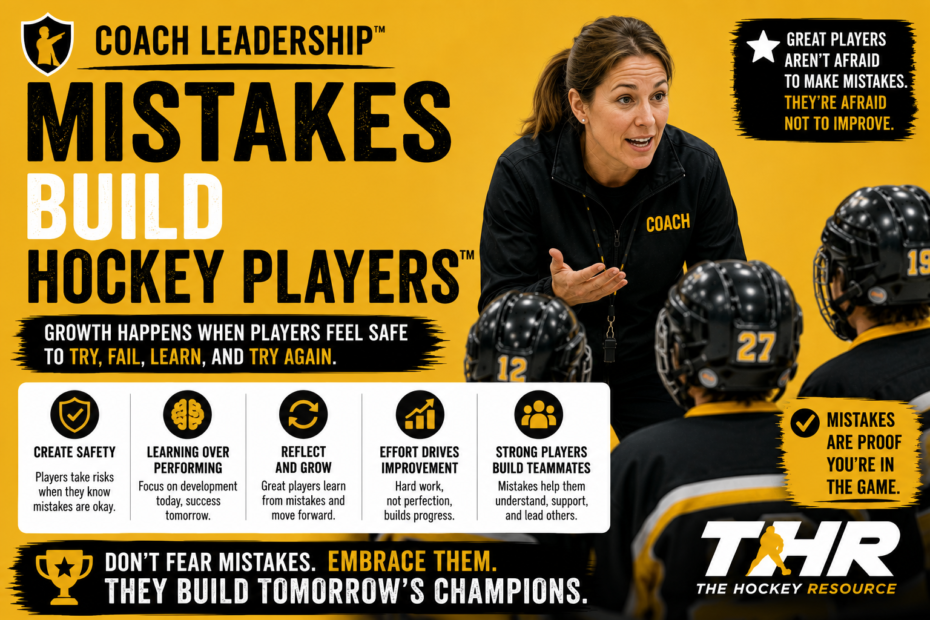
Every hockey organization makes mistakes.
A communication breakdown may create confusion.
A policy decision may produce an unintended outcome.
An event may not go as planned.
At some point, every leadership group will face situations it wishes it had handled differently.
The organizations that improve over time are not the ones that avoid mistakes entirely. Rather, they are the ones that learn from them.
Progress begins when leaders are willing to examine what happened, understand why it happened, and make adjustments moving forward.
Perfection Is Not a Realistic Goal
Many leaders place tremendous pressure on themselves to avoid errors.
While high standards are important, perfection is not attainable.
People make decisions with incomplete information.
Unexpected challenges arise.
Circumstances change.
As a result, even thoughtful leaders occasionally make choices that prove less effective than expected.
Recognizing this reality creates an opportunity for growth. Instead of hiding mistakes, organizations can use them as valuable learning experiences.
Accountability Builds Credibility
When something goes wrong, the natural reaction is often to defend the decision or explain away the outcome.
Unfortunately, that approach rarely strengthens trust.
Members generally understand that mistakes happen.
What they pay attention to is how leadership responds.
Acknowledging an error demonstrates accountability.
Taking responsibility demonstrates maturity.
Implementing improvements demonstrates commitment.
Consequently, organizations that own their mistakes often emerge with stronger credibility than those that attempt to avoid responsibility.
Reflection Creates Better Decisions
Successful organizations regularly evaluate their performance.
Tournaments are reviewed.
Programs are assessed.
Communication strategies are examined.
Major initiatives are discussed after completion.
This process is not about assigning blame.
Instead, it focuses on identifying lessons that can improve future results.
By asking what worked, what did not work, and what could be done differently, leaders create a culture of continuous improvement.
Feedback Should Be Viewed as Information
Not every complaint is valid.
Not every suggestion should be implemented.
Nevertheless, feedback provides valuable insight.
Parents, coaches, volunteers, and players often experience the organization from different perspectives. Their observations can reveal blind spots that leadership may not recognize on its own.
For that reason, effective leaders remain curious rather than defensive.
Listening carefully does not mean agreeing with every opinion. It simply means being open to learning from the experiences of others.
Mistakes Often Reveal System Problems
When the same issue appears repeatedly, the problem may be larger than an individual decision.
Perhaps expectations are unclear.
Maybe communication processes need improvement.
In some cases, responsibilities have not been properly defined.
Looking beyond the immediate issue helps leaders identify the underlying cause.
Once the root problem is understood, meaningful improvements become possible.
As a result, the organization becomes stronger rather than simply recovering from another challenge.
Growth Requires Humility
Strong leadership is not about always being right.
Instead, it involves a willingness to learn, adapt, and improve.
Humility allows leaders to acknowledge weaknesses without losing confidence.
At the same time, it encourages honest conversations about what needs to change.
Organizations that embrace this mindset tend to evolve more effectively because learning becomes part of the culture.
Future Success Depends on Today’s Lessons
Every season provides opportunities to improve.
Some lessons come from successes.
Others emerge from disappointments.
Both have value.
The key is ensuring that experience becomes knowledge rather than repetition.
When organizations document lessons learned and apply them moving forward, mistakes become investments in future success rather than recurring frustrations.
Final Leadership Reality
Mistakes are unavoidable.
Repeating the same mistakes is not.
The strongest hockey organizations view challenges as opportunities to learn rather than reasons to assign blame.
By embracing accountability, seeking feedback, and committing to continuous improvement, leaders create an environment where progress becomes part of everyday operations.
Ultimately, growth is not determined by how often mistakes occur.
Growth is determined by what an organization does after they happen.
One-Line Truth:
Mistakes become valuable only when they lead to better decisions in the future.
This article is part of the Foundations of Modern Hockey Leadership series.
About The Hockey Resource
The Hockey Resource exists to help players, parents, coaches, teams, leagues, tournaments, and hockey organizations make better decisions through education, leadership, and community-focused resources.
For additional hockey leadership articles, hockey parent resources, tournament information, and industry insights, visit:
The Hockey Resource – https://thehockeyresource.com
The Hockey Tournament Resource – https://thehockeytournamentresource.com
Mark Hetherman
Executive Director
The Hockey Resource